Remove border-right on Start tab and border-bottom on tab bar when no
file tabs are open, making the tab area blend seamlessly with the
content area below.
Replace placeholder sandbox provider icons with official brand assets:
- Docker: white whale SVG on brand blue (#1D63ED) background
- E2B: official PNG logo via CSS module
- Local: Dify-branded SVG icon (SandboxLocal)
Add a component-level regression test for variable inspect artifacts tab:\n- verifies selected file path is used before reset\n- verifies stale selected path is dropped after files are cleared\n- verifies download url query call keeps retry disabled in this component
Problem:\n- In variable inspect artifacts view, clicking Reset All invalidates sandbox download query keys.\n- If a previously selected file has been removed, the download-url query may still refetch with stale path and return 400.\n- Default query retry amplifies this into repeated failed requests in this scenario.\n\nSolution:\n- Extend sandbox file invalidation with an option to skip download query refetch.\n- Use that option in Reset All flow so download-url queries are marked stale without immediate refetch.\n- Derive selected file path from latest sandbox flat data and disable download-url query when file no longer exists.\n- Disable retry only for artifacts-tab download-url query to avoid repeated 400 retries in this path.\n- Align tree selectedPath with derived selectedFilePath and add hook tests for invalidation behavior.\n\nValidation:\n- pnpm vitest --run service/use-sandbox-file.spec.tsx
Extract SearchResultRow component with useDelayedClick to match file
tree behavior (single-click preview, double-click pin). Subscribe to
derived boolean instead of raw activeTabId to avoid unnecessary
re-renders across all rows.
Replace the tree-filtered search with a flat list that shows icon + name
on the left and parent path on the right, matching the Figma design.
Clicking a file opens its tab; clicking a folder clears the search and
reveals the folder in the tree.
Remove isFocused ring style from TreeNode since focus-visible already
handles keyboard focus indication. Add rowClassName="outline-none" to
suppress the default browser outline on react-arborist row containers.
Add editorAutoFocusFileId state to automatically focus the editor when
a new text file is created. Improve tree-tab synchronization by adding
syncSignal/isTreeLoading guards, deduplicating rAF calls, and skipping
redundant select/openParents operations when the node is already active.
Enable PDF files to be previewed directly in the file content panel
instead of showing as unsupported files requiring download. Uses the
existing react-pdf-highlighter library with zoom controls and keyboard
shortcuts (up/down arrows).
Add "Import skills(.zip)" option to root-level context menu and sidebar
add menu with a question mark tooltip showing usage hint. Update menu
item labels and icons for consistency with design.
- Change Reset All button visibility from Variables-tab-only to both tabs,
displaying when either variables or artifacts have data
- Invalidate sandbox files cache in deleteAllInspectorVars alongside
existing conversation/system var invalidations
feat: hide output tools and improve JSON formatting for structured output
feat: hide output tools and improve JSON formatting for structured output
fix: handle prompt template correctly to extract selectors for step run
fix: emit StreamChunkEvent correctly for sandbox agent
chore: better debug message
fix: incorrect output tool runtime selection
fix: type issues
fix: align parameter list
fix: align parameter list
fix: hide internal builtin providers from tool list
vibe: implement file structured output
vibe: implement file structured output
fix: refix parameter for tool
fix: crash
fix: crash
refactor: remove union types
fix: type check
Merge branch 'feat/structured-output-with-sandbox' into feat/support-agent-sandbox
fix: provide json as text
fix: provide json as text
fix: get AgentResult correctly
fix: provides correct prompts, tools and terminal predicates
fix: provides correct prompts, tools and terminal predicates
fix: circular import
feat: support structured output in sandbox and tool mode
Replaced plain array query key in useSandboxFileDownloadUrl with
oRPC-generated queryKey for type safety and consistency. Added
downloadFile cache invalidation to useInvalidateSandboxFiles so
stale download URLs are cleared after workflow/chatflow runs.
The Skill view is locked (ViewPicker disabled) while a workflow
is running or chatflow is responding, so ArtifactsSection is never
mounted during runs. Polling there is dead code.
Add conditional refetchInterval to Artifacts components so the file
list refreshes automatically while a workflow debug run or chatflow
preview is in progress, stopping once the run completes.
Leverage React Query mutation's isPending to disable the Publish button,
header trigger, and keyboard shortcut while a publish is in progress,
preventing duplicate submissions even when the menu is closed and reopened.
Add a unified isPreviewable flag to useFileTypeInfo that guards against
rendering binary files as text in both skill artifacts and variable
inspect artifacts preview. Upgrade extension arrays to Sets for O(1)
lookups.
Split SkillSaveContext and useSkillSaveManager into a separate file to
fix react-refresh/only-export-components lint error. Destructure
mutateAsync from useUpdateAppAssetFileContent for a stable callback
reference, preventing unnecessary useCallback cascade rebuilds. Extract
shared patchFileContentCache helper to unify setQueryData logic between
updateCachedContent and the collaboration event handler.
The backend route /apps/{app_id}/sandbox/files expects the actual app ID
as the URL parameter and derives sandbox_id from the logged-in user
internally. The frontend was incorrectly passing userProfile.id (user ID)
as the appId, resulting in wrong storage paths.
Add useInvalidateSandboxFiles hook and call it alongside
fetchInspectVars/invalidAllLastRun so the Artifacts tab refreshes
automatically when a chatflow preview or workflow debug run finishes.
Move the Divider into the OnlineUsers component so it conditionally
renders together with the online users content, preventing an orphaned
divider from appearing next to the preview button.
Added support for an optional `download_filename` parameter in the `get_download_url` and `get_download_urls` methods across various storage classes. This allows users to specify a custom filename for downloads, improving user experience by enabling better file naming during downloads. Updated related methods and tests to accommodate this new functionality.
Follow-up to SSR prefetch migration (2833965). Eliminates the Zustand
middleman that was syncing TanStack Query data into a separate store.
- Remove useGlobalPublicStore Zustand store entirely
- Create hooks/use-global-public.ts with useSystemFeatures,
useSystemFeaturesQuery, useIsSystemFeaturesPending, useSetupStatusQuery
- Migrate all 93 consumers to import from @/hooks/use-global-public
- Simplify global-public-context.tsx to a thin provider component
- Update 18 test files to mock the new hook interface
- Fix SetupStatusResponse.setup_at type from Date to string (JSON)
- Fix setup-status.spec.ts mock target to match consoleClient
BREAKING CHANGE: useGlobalPublicStore is removed. Use useSystemFeatures()
from @/hooks/use-global-public instead.
BREAKING CHANGE: commonLayout is now an async Server Component that
prefetches user-profile and current-workspace on the server via
TanStack Query's prefetchQuery + HydrationBoundary pattern. This
replaces the previous purely client-side data fetching approach.
Key changes:
- **SSR data prefetch (root layout)**: prefetch systemFeatures and
setupStatus in the root layout server component, wrap children with
HydrationBoundary to hydrate TanStack Query cache on the client.
- **SSR data prefetch (commonLayout)**: convert commonLayout from a
client component to an async server component that prefetches
user-profile (with x-version/x-env response headers) and
current-workspace. Client-side providers/UI extracted to a new
layout-client.tsx component.
- **Add loading.tsx (Next.js convention)**: add a Next.js loading.tsx
file in commonLayout that shows a centered spinner. This replaces the
deleted Splash component but works via Next.js built-in Suspense
boundary for route segments, not a client-side overlay.
- **Extract shared SSR fetch utilities (utils/ssr-fetch.ts)**: create
serverFetch (unauthenticated) and serverFetchWithAuth (with cookie
forwarding + CSRF token). getAuthHeaders is wrapped with React.cache()
for per-request deduplication across multiple SSR fetches.
- **Refactor AppInitializer**: split single monolithic async IIFE effect
into three independent useEffects (oauth tracking, education verify,
setup status check). Use useReducer for init flag, useRef to prevent
duplicate tracking in StrictMode. Now reads setupStatus from TanStack
Query cache (useSetupStatusQuery) instead of fetching independently.
- **Refactor global-public-context**: move Zustand store sync from
queryFn side-effect to a dedicated useEffect, keeping queryFn pure.
fetchSystemFeatures now simply returns the API response.
- **Fix usePSInfo SSR crash**: defer globalThis.location access from
hook top-level to callback execution time via getDomain() helper,
preventing "Cannot read properties of undefined" during server render.
- **Remove Splash component**: delete the client-side loading overlay
that relied on useIsLogin polling, replaced by Next.js loading.tsx.
- **Remove staleTime/gcTime overrides in useUserProfile**: allow the
SSR-prefetched data to be reused via default cache policy instead of
forcing refetch on every mount.
- **Revert middleware auth guard**: remove the cookie-based session
check in proxy.ts that caused false redirects to /signin for
authenticated users (Dify's auth uses token refresh, not simple
cookie presence).
Replace direct localStorage.getItem/setItem/removeItem with the
centralized storage module which provides versioned keys, automatic
JSON serialization, SSR safety, and error handling.
- Modified the SandboxService and related app generators to replace workflow_execution_id with sandbox_id for improved clarity and consistency in sandbox handling.
- Adjusted the AdvancedChatAppGenerator and WorkflowAppGenerator to align with the new parameter naming convention.
- Updated API routes to use app_id instead of sandbox_id for file operations, aligning with user-specific sandbox workspaces.
- Enhanced SandboxFileService and related classes to accommodate app_id in file listing and download functionalities.
- Refactored storage key generation for sandbox archives to include app_id, ensuring proper file organization.
- Adjusted frontend contracts and services to reflect the new app_id parameter in API calls.
Add import skill modal that accepts .zip files via drag-and-drop or
file picker, extracts them client-side using fflate, validates structure
and security constraints, then batch uploads via presigned URLs.
- Add fflate dependency for browser-side ZIP decompression
- Create zip-extract.ts with fflate filter API for validation
- Create zip-to-upload-tree.ts for BatchUploadNodeInput tree building
- Create import-skill-modal.tsx with drag-and-drop support
- Lazy-load ImportSkillModal via next/dynamic for bundle optimization
- Add en-US and zh-Hans i18n keys for import modal
- Updated the AWS S3 client initialization to enforce SigV4 for presigned URLs, ensuring consistent header signing behavior across S3-compatible providers.
- Introduced a dedicated configuration for the S3 client to manage addressing styles and signature versions more effectively.
- Implemented the `exists` method in `SandboxFileSource` and its subclasses to verify the availability of sandbox sources.
- Updated `SandboxFileService` to utilize the new `exists` method for improved error handling when listing files and downloading files.
- Removed the previous check for storage existence in `archive_source.py` and replaced it with the new method.
Drop CategoryTabs component, SkillTemplateTag type, icon/tags fields,
and UI_CONFIG from the fetch script. Upload folders now use the
kebab-case skill id (e.g. "skill-creator") instead of the display name.
Card shows the human-readable name from SKILL.md frontmatter while the
created folder uses the id for consistent naming.
Expose initialFocus prop on Modal component (passthrough to Headless
UI Dialog) so the create blank skill modal reliably focuses the name
input when opened, replacing the ineffective autoFocus attribute.
Wire up the "Create Blank Skill" action card to open a modal where
users enter a skill name. The modal validates against existing skill
names in real-time and creates a folder with a SKILL.md file via
batchUpload, then opens the file as a pinned tab.
Add useExistingSkillNames hook that derives root folder names from the
cached asset tree via TanStack Query select, then use it to show an
"Added" state on hover for already-present skills and block re-upload.
Pass disabled/loading props to TemplateCard declaratively from
loadingId state. All cards are disabled while any upload is in
progress, and the active card shows a loading spinner. Remove the
imperative pointer-events overlay in favor of native button disabled.
Replace custom search input with SearchInput component (built-in clear
button) and add 300ms debounce. Fix template card: use Tailwind token
for icon background, fix Badge to use children with badge-s class and
uppercase, match empty-tag fallback height to badge size.
Remove unused categories (Search, Security, Analysis) and add
real ones (Document, Design, Creative). Consolidate xlsx tags to
Document/Productivity and webapp-testing to Development only,
eliminating orphan tags with single-skill coverage.
Use useRef for batchUpload and emitTreeUpdate to remove unstable
dependencies from useCallback, preventing unnecessary memo invalidation
on all 16 TemplateCard components. Wrap filtered list in useMemo and
replace && conditional with ternary for rendering safety.
Add fetch-skill-templates.ts script that clones anthropics/skills repo
and generates complete directory trees (scripts, references, assets)
for all 16 skills with base64 encoding for binary files, replacing
the previous single-SKILL.md-only approach. Generated files are
lazy-loaded per skill on user click.
Introduce type definitions separating raw skill data (SkillTemplate)
from UI metadata (SkillTemplateWithMetadata) to match the actual
skill format from upstream repos. Add template card component with
hover state and file count display, template-to-upload conversion
utility, and i18n keys for en-US/zh-Hans.
- Replaced direct storage references with SilentStorage in various components to enhance fallback mechanisms.
- Updated storage key formats for sandbox archives and files to improve clarity and consistency.
- Refactored related classes and methods to utilize the new SandboxFilePath structure.
- Adjusted unit tests to reflect changes in the StorageTicket model and its serialization methods.
Only enable the tool query matching the node's provider_type instead of
all four, and use primitive useMemo dependencies instead of the whole
data object to avoid redundant recomputations on every render.
Add `enabled` parameter to tool query hooks so non-plugin nodes
(LLM, Code, IfElse, etc.) avoid registering React Query observers.
Extract shared matching functions into plugin-install-check utils to
eliminate duplicate logic between the hook and the checklist.
Replace useEffect-based state sync (_pluginInstallLocked/_dimmed) with
render-time derived computation in BaseNode, breaking the cycle of
effect → node data update → re-render → effect. Extract plugin missing
check into a pure utility function for checklist reuse.
- Removed the storage proxy controller and its associated endpoints for file download and upload.
- Updated the file controller to use the new storage ticket service for generating download and upload URLs.
- Modified the file presign storage to fallback to ticket-based URLs instead of signed proxy URLs.
- Enhanced unit tests to validate the new ticket generation and retrieval logic.
- Removed unused app asset download and upload endpoints, along with sandbox archive and file download endpoints.
- Updated imports in the file controller to reflect the removal of these endpoints.
- Simplified the generator.py file by consolidating the code context field definition.
- Enhanced the storage layer with a unified presign wrapper for better handling of presigned URLs.
- Moved the import of Queue and Empty from the top of the file to within the QueueTransportReadCloser class.
- This change improves encapsulation and ensures that the imports are only available where needed.
- Add BundleManifest with dsl_filename for 100% tree ID restoration
- Implement two-step import flow: prepare (get upload URL) + confirm
- Use sandbox for zip extraction and file upload via presigned URLs
- Store import session in Redis with 1h TTL
- Add SandboxUploadItem for symmetric download/upload API
- Remove legacy source_zip_extractor, inline logic in service
- Update frontend to use new prepare/confirm API flow
Migrate all icon usage in the skill directory from @remixicon/react
and custom SVG components to Tailwind CSS icon classes (i-ri-*, i-custom-*).
Update MenuItem API to accept string class names instead of React.ElementType.
Hardcoded colors (#354052, #676F83, #98A2B3, #155EEF, white) prevent
the Iconify parseColors callback from converting them to currentColor,
causing the icons to render as background-image instead of mask-image
and making text-* color utilities ineffective.
The toolbar download button now uses the already-fetched download URL
from useQuery (zero extra requests), while tree node downloads keep
using useMutation with React Query-managed isPending state instead of
a hand-rolled useState wrapper.
Introduce a dedicated Zustand ArtifactSlice to manage artifact selection
state with mutual exclusion against the main file tree. Artifact files
from the sandbox can now be opened as tabs in the skill editor, rendered
via a lightweight ArtifactContentPanel that reuses ReadOnlyFilePreview.
Backend returns extensions with a leading dot (e.g., `.png` from
`os.path.splitext`), causing binary/media files to be misclassified
as text since they didn't match the dot-free extension lists.
Implement ReadOnlyFilePreview to render sandbox files by type
(code, markdown, image, video, SQLite, unsupported) using existing
skill viewer components with readOnly support. Add
useSandboxFileDownloadUrl and useFetchTextContent hooks for data
fetching, and generalize useFileTypeInfo to accept any file-like
object.
Extract shared empty state card into ArtifactsEmpty component to
deduplicate the no-files and no-selection empty states. Align the
split-panel right-side empty state with the variables tab pattern.
Remove FC type annotations in favor of inline parameter types.
Mark the empty state SearchLinesSparkle icon as aria-hidden for screen
readers. Replace array-index keys with cumulative path keys (O(n) vs
O(n²)) to satisfy react/no-array-index-key and improve key stability.
Replace the minimal centered text card in artifacts tab empty state with
a full-height card layout matching the variables tab, including icon
container (SearchLinesSparkle), title, description, and learn more link.
Replace useClickAway + fixed positioning in file tree context menu with
a floating-ui based hook that provides collision detection (flip/shift),
ARIA role="menu", Escape/outside-click dismiss, and scroll dismiss via
passive capture listener with ref-stabilized callback.
Replaces window.open with the downloadUrl helper from utils/download.ts
to trigger proper browser download behavior via <a download> instead of
opening a new tab that may display garbled content.
- Added an `enabled` field to `DifyCliToolConfig` and `ToolDependency` to manage tool activation status.
- Updated `DifyCliConfig` to handle tool dependencies more effectively, ensuring only enabled tools are processed.
- Refactored `SkillCompiler` to utilize `tool_id` for better identification of tools and improved handling of disabled tools.
- Introduced a new method `_extract_disabled_tools` in `LLMNode` to streamline the extraction of disabled tools from node data.
- Enhanced metadata parsing to account for tool enablement, improving overall tool management.
Features:
- Add refresh button to clear test run history (data, inputs, node highlights)
- Persist workflowRunningData when closing panel (from previous commit)
Code quality improvements:
- Refactor to declarative pattern: effectiveTab derived from state, not set in effects
- Replace && with ternary operators for conditional rendering (Vercel best practices)
- Fix created_by type: change from string to object to match backend API
- Remove `as any` type assertion, use proper type-safe access
- Title now declaratively shows status based on workflowRunningData presence
Files changed:
- use-workflow-interactions.ts: add handleClearWorkflowRunHistory hook
- workflow-preview.tsx: declarative tab state, clear button, type-safe props
- types.ts: fix created_by type definition
- test files: update mock data to match corrected types
- Introduced a new regex pattern for tool groups to support multiple tool placeholders.
- Updated the DefaultToolResolver to format outputs for specific built-in tools (bash, python).
- Enhanced the SkillCompiler to filter out disabled tools in tool groups, ensuring only enabled tools are rendered.
- Added tests to verify the correct behavior of tool group filtering and rendering.
- Introduced a new boolean field `computer_use` in LLMNodeData to indicate whether the computer use feature should be enabled.
- Updated LLMNode to check the `computer_use` field when determining sandbox usage, ensuring proper error handling if sandbox is not available.
- Removed the obsolete `_has_skill_prompt` method to streamline the code.
Position the clear button relative to the right divider instead of
following the tab labels, ensuring consistent positioning across
different language translations. Also fix tab switching jitter by
setting a fixed header height.
Use shared object reference instead of separate variables to track
upload progress across concurrent Promise.all operations, preventing
progress bar from showing incorrect or regressing values.
Introduce prepareSkillUploadFile utility that wraps markdown file content
in a JSON payload format before uploading. This ensures consistent handling
of skill files across file upload, folder upload, and drag-and-drop operations.
Replace simple uploading/success indicator with a full three-state
tooltip (uploading, success, partial_error) that overlays the DropTip
position. Add upload slice to skill editor store and wire progress
tracking into file/folder upload operations.
- add SplitPanel to share left/right shell and narrow menu handling
- reuse InspectHeaderProps for tab header + actions across tabs
- refactor variables/artifacts tabs to plug into shared split layout
- align right-side header/close behavior and consolidate empty/loading flows
Updated multiple modules to utilize gevent for concurrency, ensuring compatibility with gevent-based WSGI servers. This includes replacing threading.Thread and threading.Event with gevent.spawn and gevent.event.Event, respectively, to prevent blocking and improve performance during I/O operations.
- Refactored SandboxBuilder, Sandbox, CommandFuture, and DockerDemuxer to use gevent.
- Added detailed docstrings explaining the changes and benefits of using gevent primitives.
This change enhances the responsiveness and efficiency of the application in a gevent environment.
Consolidate duplicated TabHeader + close button layout (8 occurrences) into a single
InspectLayout wrapper. Replace boolean props with children slots for better composition.
Co-Authored-By: Claude Opus 4.5 <noreply@anthropic.com>
Enhance getFileIconType to accept an extension parameter and cover all
13 FileAppearanceTypeEnum types using an O(1) Map lookup. Update all
call sites to pass the API-provided extension for accurate icon display.
Refactor the variable inspect panel into a tabbed layout with Variables
and Artifacts tabs. Extract variable logic into VariablesTab, add new
ArtifactsTab with sandbox file tree selection and preview pane, and
improve accessibility across tree nodes and interactive elements.
Use useRef to store saveFile reference and remove it from useEffect
dependencies to prevent cleanup from re-triggering on reference changes.
Also normalize metadata before comparison when clearing dirty state to
ensure filtered tools match correctly.
Simpler approach: disable the view picker toggle when preview is running,
preventing users from switching views during active runs.
This replaces the previous mounted ref guard approach (commits a0188bd9b5,
b7f1eb9b7b, 8332f0de2b) which added complexity to handle post-unmount
operations. Disabling the toggle is more direct and follows KISS principle.
Changes:
- Add disabled prop to ViewPicker based on isResponding state
- Revert mounted ref guards in use-chat-flow-control.ts
- Revert isMountedRef parameter in use-nodes/edges-interactions-without-sync.ts
- Revert defensive type check in markdown-utils.ts (no longer needed)
In React StrictMode (dev mode), effects are run twice to help detect
side effects. The cleanup-only pattern left isMountedRef as false after
StrictMode's simulated unmount-remount cycle, causing stop/cancel
operations to be skipped even when the component was mounted.
Now the effect setup explicitly sets isMountedRef.current = true,
ensuring correct behavior in both development and production.
Related to a9c5201485 - when switching views during active preview run,
the markdown preprocessors could receive non-string content (e.g., frozen
arrays from immer). Returning the original value caused ReactMarkdown to
fail with "Cannot assign to read only property" error.
Now both preprocessLaTeX and preprocessThinkTag return '' for non-string
input, preventing runtime errors during view switches.
When switching from graph view to skill view during an active preview run,
SSE callbacks continue executing and attempt to update ReactFlow node/edge
states. This could cause errors since the component is unmounted.
Add optional `isMountedRef` parameter to `useNodesInteractionsWithoutSync`
and `useEdgesInteractionsWithoutSync` hooks. When provided, operations are
skipped if the component has unmounted, preventing potential errors while
allowing the SSE connection to continue running in the background.
BREAKING CHANGE: `useNodesInteractionsWithoutSync` and
`useEdgesInteractionsWithoutSync` now accept an optional `isMountedRef`
parameter. Existing callers are unaffected as the parameter is optional.
The sidebar layout was broken when ArtifactsSection expanded - it would
squeeze the FileTree and neither area could scroll. This restructures the
layout so each section has its own scroll container with proper height
constraints.
Remove enabled condition so data is fetched when component mounts,
allowing blue dot to show when files exist even before expanding.
TanStack Query handles request deduplication automatically.
- Replace placeholder with functional ArtifactsSection component
- Add ArtifactsTree component for file tree rendering
- Support expand/collapse with lazy loading
- Show blue dot indicator when collapsed with files
- Add empty state card with hint text
- Add download button on file hover
- Add i18n translations (en-US, zh-Hans)
- Added sandbox archive upload and download proxy endpoints with signed URL verification.
- Introduced security helpers for generating and verifying signed URLs.
- Updated file-related API routes to include sandbox archive functionality.
- Refactored app asset storage methods to streamline download/upload URL generation.
Cover Ctrl+S and Cmd+S save triggers, guard clauses for start tab and
null active tab, success/error toast notifications, and fallback
registry integration.
Move global keyboard shortcut handling from component-level hook to
SkillSaveProvider, eliminating duplicate event listener registrations
and race conditions. Delete use-skill-file-save hook as its logic is
now consolidated in the provider with direct store access.
- use cleanup-based save on tab switch with stable fallback snapshots
- add fallback registry for metadata-only autosave consistency
- add autosave/save-manager tests
Centralize file save operations using Context/Provider pattern for better
maintainability. Add auto-save on tab switch, visibility change, page unload,
and component unmount.
SQLite preview feature requires WebAssembly to run wa-sqlite, but CSP
policy was blocking WebAssembly.instantiate() without wasm-unsafe-eval
directive in script-src.
- Added a threaded function to handle the deletion of storage files asynchronously after asset removal.
- Updated the asset removal logic to include a call to the new deletion function, improving performance and responsiveness during asset management operations.
- Updated the download script to redirect error output to /dev/null, preventing unnecessary error messages from being displayed.
- Added an explicit exit command to ensure the script terminates correctly after execution.
- Updated storage wrappers to utilize a new base class, StorageWrapper, for better delegation of methods.
- Introduced SilentStorage to handle read operations gracefully by returning empty values instead of raising exceptions.
- Enhanced CachedPresignStorage to support batch caching of download URLs, improving performance.
- Refactored FilePresignStorage to support both presigned URLs and signed proxy URLs for downloads.
- Updated AppAssetService to utilize the new storage structure, ensuring consistent asset management.
- Introduced CachedPresignStorage to cache presigned download URLs, reducing repeated API calls.
- Updated AppAssetService to utilize CachedPresignStorage for improved performance in asset download URL generation.
- Refactored asset builders and packagers to support the new storage mechanism.
- Removed unused AppAssetsAttrsInitializer to streamline initialization processes.
- Added unit tests for CachedPresignStorage to ensure functionality and reliability.
The `/api/system-features` is required for the web app initialization.
Authentication would create circular dependency (can't authenticate without web app loading).
Co-authored-by: gemini-code-assist[bot] <176961590+gemini-code-assist[bot]@users.noreply.github.com>
Change onSuccess to onSettled for upload mutations so the file tree
refreshes regardless of success or failure, ensuring consistency when
backend creates nodes but storage upload fails.
- Deleted `AppAssetFileResource` class and its associated file upload logic.
- Removed the `create_file` method from `AppAssetService` to streamline asset management.
- Updated `AppAssetBatchUploadResource` for improved readability by condensing method calls.
- Added `RuntimeType` enum to define app runtime types: CLASSIC and SANDBOXED.
- Updated `AppPartial` model to include `runtime_type` field.
- Enhanced `AppListApi` to determine and assign the appropriate runtime type based on sandbox feature availability.
Refactor StartTabContent into separate components following Figma design specs:
- ActionCard: reusable card with icon, title, description
- SectionHeader: title/xl-semi-bold header with description
- CreateImportSection: 3-column grid layout for Create/Import cards
- SkillTemplatesSection: templates area with placeholder
Align styles with Figma: 3-col grid, 16px title, proper spacing and padding.
Add i18n translations for all user-facing text (en-US, zh-Hans).
- Introduced `GetUploadUrlPayload` and `BatchUploadPayload` models for handling file uploads.
- Implemented `AppAssetFileUploadUrlResource` for generating pre-signed upload URLs.
- Added `AppAssetBatchUploadResource` to support batch creation of asset nodes from a tree structure.
- Enhanced `AppAssetService` with methods for obtaining upload URLs and batch creation of assets.
- Removed checksum handling from file creation to streamline the process.
- Add guards in tool-block component to skip metadata read/write when Start tab is active
- Add guard in tool-picker-block to prevent writing tool config to Start tab
- Add guard in use-sync-tree-with-active-tab to skip tree sync for Start tab
- Add START_TAB_ID constant and StartTabItem/StartTabContent components
- Default to Start tab when no file tabs are open
- Optimize zustand selectors to subscribe to specific Map values instead of
entire Map objects, reducing unnecessary re-renders when other tabs change
- Refactor useSkillFileSave to accept precise values instead of Map/Set
- Updated the `get_system_default_config` method to accept a `provider_type` parameter for more precise querying.
- Improved error handling to raise a ValueError if no system default provider is configured for the specified tenant and provider type.
- Added fallback logic to ensure a system default configuration is returned when available.
- Updated the SandboxManager to rename the method for deleting storage to better reflect its purpose.
- Adjusted the WorkflowVariableCollectionApi to utilize the new method name.
- Improved error handling in ArchiveSandboxStorage's delete method to log exceptions during deletion.
Display a notice at the bottom of SQLite table preview when data
is truncated due to PREVIEW_ROW_LIMIT (1000 rows), informing users
that additional rows are not displayed.
- Renamed `build_skill_artifact_set` to `build_skill_bundle` for improved clarity in asset management.
- Updated references in `SkillManager` to reflect the new method name and ensure consistent handling of skill bundles.
- Added `AppAssetsAttrsInitializer` to `SandboxManager` to enhance asset initialization processes.
- Implemented output truncation in `SandboxBashTool` to manage long command outputs effectively.
- Introduced AppBundleService for managing app bundle publishing and importing, integrating workflow and asset services.
- Added methods for exporting app bundles as ZIP files, including DSL and asset management.
- Implemented source zip extraction and validation to enhance asset import processes.
- Refactored asset packaging to utilize AssetZipPackager for improved performance and organization.
- Enhanced error handling for bundle format and security during import operations.
- Replaced SkillArtifactSet with SkillBundle across various components, enhancing the organization of skill dependencies and references.
- Updated SkillManager methods to load and save bundles instead of artifacts, improving clarity in asset management.
- Refactored SkillCompiler to compile skills into bundles, streamlining the dependency resolution process.
- Adjusted DifyCli and SandboxBashSession to utilize ToolDependencies, ensuring consistent handling of tool references.
- Introduced AssetReferences for better management of file dependencies within skill bundles.
- Updated binary files for Dify CLI on various platforms (darwin amd64, darwin arm64, linux amd64, linux arm64).
- Refactored skill compilation in LLMNode to improve clarity and maintainability by explicitly naming parameters and incorporating AppAssets for base path management.
- Minor fix in AppAssetFileTree to remove unnecessary leading slash in path construction.
The `/console/api/system-features` is required for the dashboard initialization. Authentication would create circular dependency (can't login without dashboard loading).
ref: CVE-2025-63387
Related: #31368
- Introduced SandboxManager.delete_storage method for improved storage management.
- Refactored skill loading and tool artifact handling in DifyCliInitializer and SandboxBashSession.
- Updated LLMNode to extract and compile tool artifacts, enhancing integration with skills.
- Improved attribute management in AttrMap for better error handling and retrieval methods.
- Added AttrMap and AttrKey classes for type-safe attribute storage.
- Implemented AppAssetsAttrs and SkillAttrs for managing application and skill attributes.
- Refactored Sandbox and initializers to utilize the new attribute management system, enhancing modularity and clarity in asset handling.
Optimize folder upload by creating folders at the same depth level in
parallel and uploading all files concurrently. This reduces upload time
from O(n) sequential requests to O(depth) folder requests + 1 file request.
Add overflow-hidden to SkillPageLayout and min-w-0 to flex children
to ensure wide content (like SQLite tables with many columns) scrolls
internally rather than causing the entire page to scroll horizontally.
- Add min-w-0 to flex containers for proper text truncation
- Use w-max on table to ensure columns don't collapse
- Simplify table selector when only one table exists (remove dropdown)
- Introduced threading for loading skills and uploading compiled content to improve performance.
- Added data classes for better structure and clarity in handling loaded and compiled skills.
- Refactored the skill compilation process to separate loading and uploading, enhancing maintainability.
- Changed the command timeout duration from 60 seconds to 1 hour for improved session stability.
- Refactored session cleanup logic to utilize the CLI API session object instead of session ID, enhancing clarity and maintainability.
- Added a keepalive thread to maintain the E2B sandbox timeout, preventing premature termination.
- Introduced a stop event to manage the lifecycle of the keepalive thread.
- Refactored the sandbox initialization to include the new keepalive functionality.
- Enhanced logging to capture failures in refreshing the sandbox timeout.
- Moved sandbox-related classes and functions into a dedicated module for better organization.
- Updated the sandbox initialization process to streamline asset management and environment setup.
- Removed deprecated constants and refactored related code to utilize new sandbox entities.
- Enhanced the workflow context to support sandbox integration, allowing for improved state management during execution.
- Adjusted various components to utilize the new sandbox structure, ensuring compatibility across the application.
Switch from whitelist to blacklist pattern for determining editable files.
Files are now editable unless they are known binary types (audio, archives,
executables, Office documents, fonts, etc.), enabling support for any
runtime-generated text files without needing to add extensions one by one.
- Convert clickable div to semantic button in artifacts-section
- Add aria-hidden to decorative icons
- Add aria-label to rename inputs and hidden file inputs
- Add i18n keys for artifacts section and rename labels
- Support ignore file extensions (.gitignore, etc.)
- Introduced DraftAppAssetsInitializer for handling draft assets.
- Updated SandboxLayer to conditionally set sandbox ID and storage based on workflow version.
- Improved asset initialization logging and error handling.
- Refactored ArchiveSandboxStorage to support exclusion patterns during archiving.
- Modified command and LLM nodes to retrieve sandbox from workflow context, supporting draft workflows.
Replace event-based auto-expand trigger with Zustand state-driven
approach. Now both external file uploads and internal node drag use
the same isDragOver state as the single source of truth for folder
auto-expand timing (1s blink, 2s expand).
Simplify file drop hooks by removing the unnecessary useUnifiedDrag
wrapper that became redundant after internal node drag was migrated
to react-arborist's built-in system. Now useFolderFileDrop and
useRootFileDrop directly use useFileDrop, reducing code complexity
and eliminating unused treeChildren prop drilling.
Switch from native HTML5 drag to react-arborist's built-in drag system
for internal node drag-and-drop. The HTML5Backend used by react-arborist
was intercepting dragstart events, preventing native drag from working.
- Add onMove callback and disableDrop validation to Tree component
- Sync react-arborist drag state (isDragging, willReceiveDrop) to Zustand
- Simplify use-node-move to only handle API execution
- Update use-unified-drag to only handle external file uploads
- External file drops continue to work via native HTML5 events
Implement unified drag system that supports both internal node moves
and external file uploads with consistent UI feedback. Uses native
HTML5 drag API with shared visual states (isDragOver, isBlinking,
DragActionTooltip showing 'Move to' or 'Upload to').
Move searchTerm from props drilling to zustand store for cleaner
architecture. Remove unnecessary controlled/uncontrolled pattern
and unused debounce logic since search is pure frontend filtering.
- Add fileTreeSearchTerm state to file-tree-slice
- Remove useState and props from main.tsx
- Simplify sidebar-search-add.tsx to read/write store directly
- Add empty state UI with reset filter button
Remove the Office file placeholder that only showed "Preview will be
supported in a future update" without any download option. Office files
(pdf, doc, docx, xls, xlsx, ppt, pptx) now fall through to the generic
"unsupported file" handler which provides a download button.
Removed:
- OfficeFilePlaceholder component
- isOfficeFile function and OFFICE_EXTENSIONS constant
- isOffice flag from useFileTypeInfo hook
- i18n keys for officePlaceholder
This simplifies the file type handling to just three categories:
- Editable: markdown, code, text files → editor
- Previewable: image, video files → media preview
- Everything else: download button
Change useSkillFileData to use isEditable instead of isMediaFile:
- Editable files (markdown, code, text) fetch file content for editing
- Non-editable files (image, video, office, unsupported) fetch download URL
This fixes the download button for unsupported files which was incorrectly
using file content (UTF-8 decoded garbage) instead of the presigned URL.
Extract business logic into dedicated hooks to reduce component complexity:
- useFileTypeInfo: file type detection (markdown, code, image, video, etc.)
- useSkillFileData: data fetching with conditional API calls
- useSkillFileSave: save logic with Ctrl+S keyboard shortcut
Also fix Vercel best practice: use ternary instead of && for conditional rendering.
Previously, media files were fetched via getFileContent API which decodes
binary data as UTF-8, resulting in corrupted strings that cannot be used
as img/video src. Now media files use getFileDownloadUrl API to get a
presigned URL, enabling proper preview of images and videos of any size.
- Add constants.ts with ROOT_ID, CONTEXT_MENU_TYPE, NODE_MENU_TYPE
- Add root utilities to tree-utils.ts (isRootId, toApiParentId, etc.)
- Replace '__root__' with ROOT_ID for consistent root identifier
- Replace inline 'blank'/'root' strings with constants
- Use NodeMenuType for type-safe menu type props
- Remove duplicate ContextMenuType from types.ts, use from constants.ts
Remove redundant createTargetNodeId and use selectedTreeNodeId for both
visual highlight and creation target. This simplifies the state management
by having a single source of truth for tree selection, similar to VSCode's
file explorer behavior where both files and folders can be selected.
Update frontend to use new backend API:
- save_config now accepts optional 'activate' parameter
- activate endpoint now requires 'type' parameter ('system' | 'user')
When switching to managed mode, call activate with type='system' instead
of deleting user config, so custom configurations are preserved for
future use.
- Updated the request parser in SandboxProviderListApi to include an optional 'activate' boolean argument for JSON input.
- This enhancement allows users to specify activation status when configuring sandbox providers.
- Enhanced the SandboxProviderConfigApi to accept an 'activate' argument when saving provider configurations.
- Introduced a new request parser for activating sandbox providers, requiring a 'type' argument.
- Updated the SandboxProviderService to handle the activation state during configuration saving and provider activation.
Split use-file-operations.ts (248 lines) into smaller focused hooks:
- use-create-operations.ts for file/folder creation and upload
- use-modify-operations.ts for rename and delete operations
- use-file-operations.ts now serves as orchestrator maintaining backward compatibility
Extract TreeNodeIcon component from tree-node.tsx for cleaner separation of concerns.
Add brief comments to drag hooks explaining their purpose and relationships.
Add ability to choose between "Managed by Dify" (using system config)
and "Bring Your Own API Key" modes when configuring E2B sandbox provider.
This allows Cloud users to use Dify's pre-configured credentials or
their own E2B account for more control over resources and billing.
When dragging files over a closed folder, the highlight now blinks
during the second half of the 2-second hover period to signal that
the folder is about to expand. This provides better visual feedback
similar to VSCode's drag-and-drop behavior.
- Added DIFY_CLI_ROOT constant for the root directory of Dify CLI.
- Updated DIFY_CLI_PATH and DIFY_CLI_CONFIG_PATH to use absolute paths.
- Modified app asset initialization to create directories under DIFY_CLI_ROOT.
- Enhanced Docker and E2B environment file handling to use workspace paths.
Use Promise.all for concurrent file uploads instead of sequential
processing, improving upload performance for multiple files. Also
add isFileDrag check to handleFolderDragOver for consistency with
other drag handlers.
Enable users to drag files from their system directly into the file tree
to upload them. Files can be dropped on the tree container (uploads to root)
or on specific folders. Hovering over a closed folder for 2 seconds auto-
expands it. Uses Zustand for drag state management instead of React Context
for better performance.
The previous refactor inadvertently passed undefined nodeId for blank
area menus, causing root-level folder creation/upload to fail. This
restores the original behavior by explicitly passing 'root' when the
context menu type is 'blank'.
Consolidate menu components by extending NodeMenu to support a 'root'
type, eliminating the redundant BlankAreaMenu component. This reduces
code duplication and simplifies the context menu logic by storing
isFolder in the context menu state instead of re-querying tree data.
When file content is not in JSON format (e.g., newly uploaded files),
return the raw content instead of empty string to ensure files display
correctly.
Remove types that don't match backend API:
- AppAssetFileContentResponse (unused, had extra metadata field)
- CreateFilePayload (unused, FormData built manually)
- metadata field from UpdateFileContentPayload
Add right-click context menu for file tree blank area with New File,
New Folder, and Upload Files options. Also align search input and
add button styles to match Figma design specs (24px height, 6px radius).
Remove label, description, and icon fields from SandboxProvider type
as they are no longer returned by the backend API. Use i18n translations
to display provider labels instead of relying on API response data.
Use explicit StateCreator<FullStore, [], [], SliceType> pattern instead of
StateCreator<SliceType> for all skill-editor slices. This enables:
- Type-safe cross-slice state access via get()
- Explicit type contracts instead of relying on spread args behavior
- Better maintainability following Lobe-chat's proven pattern
Extract all type definitions to types.ts to avoid circular dependencies.
Replace explicit parameter destructuring with spread args pattern to
eliminate `as unknown as` type assertions when composing sub-slices.
This aligns with the pattern used in the main workflow store.
Consolidate file type derivations into a single useMemo with stable
dependencies (currentFileNode?.name and currentFileNode?.extension)
to help React Compiler track stability.
Extract originalContent as a separate variable to avoid property access
in useCallback dependencies, which caused Compiler to infer broader
dependencies than specified.
Wrap isEditable in useMemo to help React Compiler track its stability
and preserve memoization for callbacks that depend on it. Also replace
Record<string, any> with Record<string, unknown> to satisfy no-explicit-any.
Move activeTabId and fileMetadata reads from selector subscriptions to
getState() calls inside the callback. These values were only used in the
insertTools callback, not for rendering, causing unnecessary re-renders
when they changed.
Previously, any edit would mark the file as dirty even if the content
was restored to its original state. Now we compare against the original
content and clear the dirty flag when they match.
Split the monolithic skill-editor-slice.ts into a dedicated directory with
individual slice files (tab, file-tree, dirty, metadata, file-operations-menu)
to improve maintainability and code organization.
Reduce initial bundle size by dynamically importing SkillMain
component. This prevents loading the entire Skill module (including
Monaco and Lexical editors) when users only access the Graph view.
Add search functionality to skill sidebar using react-arborist's built-in
searchTerm and searchMatch props. Search input is debounced at 300ms and
filters tree nodes by name (case-insensitive). Also add success toast for
rename operations.
Replace getAncestorIds(treeData) with node.parent chain traversal
for more efficient ancestor lookup. This avoids re-traversing the
tree data structure and uses react-arborist's built-in parent refs.
Also rename hook to useSyncTreeWithActiveTab for clarity.
Use split button pattern to separate main content area from more button.
This prevents click events on the more button from bubbling up to the
parent element's click/double-click handlers, which caused unintended
file opening when clicking the menu button multiple times.
Move SkillEditorSlice from injection pattern to core workflow store,
making it available to all workflow contexts (workflow-app, chatflow,
and future rag-pipeline).
- Add createSkillEditorSlice to core createWorkflowStore
- Remove complex type conversion logic from workflow-app/index.tsx
- Remove optional chaining (?.) and non-null assertions (!) from components
- Simplify slice composition with type assertions via unknown
Lexical editor only uses initialConfig.editorState on mount, ignoring
subsequent value prop changes when the component is reused by React.
Adding key={activeTabId} forces React to remount editors when switching
tabs, ensuring correct content is displayed.
Refactor the skill editor state management from a standalone Zustand store
with Context provider pattern to a slice injection pattern that integrates
with the existing workflow store. This aligns with how rag-pipeline already
injects its slice.
- Remove SkillEditorProvider and SkillEditorContext
- Export createSkillEditorSlice for injection into workflow store
- Update all components to use useStore/useWorkflowStore from workflow store
- Add SkillEditorSliceShape to SliceFromInjection union type
- Use type-safe slice creator args without any types
Merge file-node-menu.tsx and folder-node-menu.tsx into a single
declarative NodeMenu component that uses type prop to determine
menu items. Add cva-based variant support to MenuItem for consistent
destructive styling.
- Use es-toolkit throttle with leading edge to prevent folder toggle
flickering on double-click (3 toggles reduced to 1)
- Add validation in pinTab to check if file exists in openTabIds
- Single-click file in tree opens in preview mode (temporary, replaceable)
- Double-click file opens in pinned mode (permanent)
- Preview tabs display with italic filename
- Editing content auto-converts preview tab to pinned
- Double-clicking preview tab header converts to pinned
- Only one preview tab can exist at a time
Add TreeEditInput component for inline file/folder renaming with keyboard
support (Enter to submit, Escape to cancel). Add TreeGuideLines component
to render vertical indent lines based on node depth for better visual
hierarchy in the tree view.
Reorganize file tree components into dedicated `file-tree` subdirectory
for better code organization.
Extract repeated appId retrieval and tree data fetching patterns into
dedicated hooks (useSkillAssetTreeData, useSkillAssetNodeMap) to reduce
code duplication across 6 components and leverage TanStack Query's
select option for efficient nodeMap computation.
- Convert div with onClick to proper button elements for keyboard access
- Add focus-visible ring styles to all interactive elements
- Add ARIA attributes (role, aria-selected, aria-expanded) to tree nodes
- Add keyboard navigation (Enter/Space) support to tree items
- Mark decorative icons with aria-hidden="true"
- Add missing i18n keys for accessibility labels
- Fix typography: use ellipsis character (…) instead of three dots
- Add useIsMutating hook to track ongoing mutations
- Apply pointer-events-none and opacity-50 when mutating
- Prevents user interaction during file operations
- Move DropTip component outside the tree flex container
- Use Fragment to group tree container, DropTip and context menu
- DropTip is now an independent fixed element at the bottom
- Replace fixed height={1000} with dynamic containerSize.height
- Use useSize hook from ahooks to observe container dimensions
- Fallback to 400px default height for initial render
- Fixes scroll issues when collapsing folders
- Extract useFileOperations hook to hooks/use-file-operations.ts
- Move tree utilities to utils/tree-utils.ts
- Move file utilities to utils/file-utils.ts (renamed from utils.ts)
- Remove unnecessary JSDoc comments throughout components
- Simplify type.ts to only contain local type definitions
- Clean up store/index.ts by removing verbose comments
- Add Rename using react-arborist native inline editing (node.edit())
- Add Delete with Confirm modal and automatic tab cleanup
- Add getAllDescendantFileIds utility for finding files to close on delete
- Add i18n strings for rename/delete operations (en-US, zh-Hans)
Use nuqs to sync graph/skill view selection to URL, enabling
shareable links and browser history navigation. Hoists
SkillEditorProvider to maintain state across view switches.
Move SkillEditorProvider from SkillMain to WorkflowAppWrapper so that
store state persists across view switches between Graph and Skill views.
Also add URL query state for view type using nuqs.
Add right-click context menu and "..." dropdown button for folders in
the file tree, enabling file operations within any folder:
- New File: Create empty file via Blob upload
- New Folder: Create subfolder
- Upload File: Upload multiple files to folder
- Upload Folder: Upload entire folder structure preserving hierarchy
Implementation includes:
- FileOperationsMenu: Shared menu component for both triggers
- FileTreeContextMenu: Right-click menu with absolute positioning
- FileTreeNode: Added context menu and dropdown button for folders
- Store slice for context menu state management
- i18n strings for en-US and zh-Hans
- Replace useRef pattern with useMemo for store creation in context.tsx
- Remove unused extension prop from EditorTabItem
- Fix useMemo dependency warnings in editor-tabs.tsx and skill-doc-editor.tsx
- Add proper OnMount type for Monaco editor instead of any
- Delete unused file-item.tsx and fold-item.tsx components
- Remove unused getExtension and fromOpensObject utilities from type.ts
- Refactor auto-reveal effect in files.tsx for better readability
Implement MVP features for skill editor based on design doc:
- Add Zustand store with Tab, FileTree, and Dirty slices
- Rewrite file tree using react-arborist for virtual scrolling
- Implement Tab↔FileTree sync with auto-reveal on tab activation
- Add upload functionality (new folder, upload file)
- Implement Monaco editor with dirty state tracking and Ctrl+S save
- Add i18n translations (en-US and zh-Hans)
The upload helper was hardcoded to only accept HTTP 201, which broke
PUT requests that return 200. This aligns with standard HTTP semantics
where POST returns 201 Created and PUT returns 200 OK.
- Introduce _app_id attribute to store application ID from system variables
- Add _get_app_id method to retrieve and validate app_id
- Update on_graph_start to log app_id during sandbox initialization
- Integrate ArchiveSandboxStorage for persisting and restoring sandbox files
- Ensure proper error handling for sandbox file operations
- Add AppAssetsInitializer to load published app assets into sandbox
- Refactor VMFactory.create() to VMBuilder with builder pattern
- Extract SandboxInitializer base class and DifyCliInitializer
- Simplify SandboxLayer constructor (remove options/environments params)
- Fix circular import in sandbox module by removing eager SandboxBashTool export
- Update SandboxProviderService to return VMBuilder instead of VirtualEnvironment
- Add helpers.py with connection management utilities:
- with_connection: context manager for connection lifecycle
- submit_command: execute command and return CommandFuture
- execute: run command with auto connection, raise on failure
- try_execute: run command with auto connection, return result
- Add CommandExecutionError to exec.py for typed error handling
with access to exit_code, stderr, and full result
- Remove run_command method from VirtualEnvironment base class
(now available as submit_command helper)
- Update all call sites to use new helper functions:
- sandbox/session.py
- sandbox/storage/archive_storage.py
- sandbox/bash/bash_tool.py
- workflow/nodes/command/node.py
- Add comprehensive unit tests for helpers with connection reuse
- Add useMemo to prevent unnecessary re-renders of context value
- Extract ProviderProps type for better readability
- Convert arrow functions to standard function declarations
- Remove unused versionSupported/sandboxEnabled from hook return type
Extend MCP tool availability context to include sandbox mode check
alongside version support. MCP tools are now blocked when sandbox
is disabled, with appropriate tooltip messages for each blocking
condition.
Move type imports to @/types/sandbox-provider instead of re-exporting
from service file. Remove unnecessary retry:0 options to use React
Query's default retry behavior.
Replace manual fetch calls in use-sandbox-provider.ts with typed ORPC
contracts and client. Adds type definitions to types/sandbox-provider.ts
and registers contracts in the console router for consistent API handling.
Extend variable pattern matching to support both `#` and `@` markers,
with `@` specifically used for agent context variables. Update regex
patterns, text processing logic, and add sub-graph persistence for agent
variable handling.
Rename the constant for clarity and consistency with the new
sandbox-provider tab naming convention. Update all references
across the codebase to use the new constant name.
Update E2B, Daytona, and Docker descriptions with unique copy from design:
- E2B: "E2B Gives AI Agents Secure Computers with Real-World Tools."
- Daytona: "Deploy AI code with confidence using Daytona's lightning-fast infrastructure."
- Docker: "The Easiest Way to Build, Run, and Secure Agents."
The original fix seems correct on its own. However, for chatflows with multiple answer nodes, the `message_replace` command only preserves the output of the last executed answer node.
- Created a new GitHub Actions workflow to automate deployment for the agent development branch.
- Configured the workflow to trigger upon successful completion of the "Build and Push API & Web" workflow.
- Implemented SSH deployment steps using appleboy/ssh-action for secure server updates.
- Enhanced the SandboxManager to use a sharded locking mechanism for improved concurrency and performance.
- Replaced the global lock with shard-specific locks, allowing for lock-free reads and reducing contention.
- Updated methods for registering, retrieving, unregistering, and counting sandboxes to work with the new sharded structure.
- Improved documentation within the class to clarify the purpose and functionality of the sharding approach.
- Simplified the SandboxLayer initialization by removing unused parameters and consolidating sandbox creation logic.
- Integrated SandboxManager for better lifecycle management of sandboxes during workflow execution.
- Updated error handling to ensure proper initialization and cleanup of sandboxes.
- Enhanced CommandNode to retrieve sandboxes from SandboxManager, improving sandbox availability checks.
- Added unit tests to validate the new sandbox management approach and ensure robust error handling.
- Adjusted padding in the LLM panel for better visual alignment.
- Refactored the Max Iterations component to accept a className prop for flexible styling.
- Maintained the structure of advanced settings while ensuring consistent rendering of fields.
- Introduced threading to handle Docker's stdout/stderr streams, improving thread safety and preventing race conditions.
- Replaced buffer-based reading with queue-based reading for stdout and stderr.
- Updated read methods to handle errors and end-of-stream conditions more gracefully.
- Enhanced documentation to reflect changes in the demuxing process.
- Introduced a collapsible section for advanced settings in the LLM panel.
- Added Max Iterations component with conditional rendering based on the new hideMaxIterations prop.
- Updated context field and vision configuration to be part of the advanced settings.
- Added new translation key for advanced settings in the workflow localization file.
- Improved error message handling by assigning the stderr output to a variable for better readability.
- Ensured consistent error reporting when a command fails, maintaining clarity in the output.
- Updated error handling to provide detailed stderr output when a command fails.
- Streamlined working directory and command rendering by combining operations into single lines.
- Simplified the command execution logic by removing unnecessary shell invocations.
- Enhanced working directory validation by directly using the `test` command.
- Improved command parsing with `shlex.split` for better handling of raw commands.
- Added checks to verify the existence of the specified working directory before executing commands.
- Updated command execution logic to conditionally change the working directory if provided.
- Included FIXME comments to address future enhancements for native cwd support in VirtualEnvironment.run_command.
- Added FIXME comments to indicate the need for unifying runtime config checking in AdvancedChatAppGenerator and WorkflowAppGenerator.
- Introduced sandbox management in WorkflowService with proper error handling for sandbox release.
- Enhanced runtime feature handling in the workflow execution process.
- Add _DockerDemuxer to properly separate stdout/stderr from multiplexed stream
- Fix binary header garbage in Docker exec output (tty=False 8-byte header)
- Fix LocalVirtualEnvironment.get_command_status() to use os.WEXITSTATUS()
- Update tests to use Transport API instead of raw file descriptors
- Introduced Command node type in workflow with associated UI components and translations.
- Enhanced SandboxLayer to manage sandbox attachment for Command nodes during execution.
- Updated various components and constants to integrate Command node functionality across the workflow.
- Updated `checkMakeGroupAvailability` to include a check for existing group nodes, preventing group creation if a group node is already selected.
- Modified `useMakeGroupAvailability` and `useNodesInteractions` hooks to incorporate the new group node check, ensuring accurate group creation logic.
- Adjusted UI rendering logic in the workflow panel to conditionally display elements based on node type, specifically for group nodes.
- Merge origin/feat/llm-node-support-tools branch
- Fix unused variable tenant_id in dsl.py
- Add None checks for app and workflow in dsl.py
- Add type ignore for e2b_code_interpreter import
🤖 Generated with [Claude Code](https://claude.com/claude-code)
Co-Authored-By: Claude Opus 4.5 <noreply@anthropic.com>
- Enhanced `useNodesInteractions` to better manage group node handlers and connections, ensuring accurate identification of leaf nodes and their branches.
- Updated logic to create handlers based on node connections, differentiating between internal and external connections.
- Refined initial node setup to include target branches for group nodes, improving the overall interaction model for grouped elements.
- Introduced GroupDefault node with metadata and default values for group nodes.
- Enhanced useNodeMetaData hook to handle group node author and description using translations.
- Added translations for group node functionality in English, Japanese, Simplified Chinese, and Traditional Chinese.
- Introduced `createGroupInboundEdges` function to manage edges for group nodes, ensuring proper connections to head nodes.
- Updated edge creation logic to handle group nodes in both inbound and outbound scenarios, including temporary edges.
- Enhanced validation in `useWorkflow` to check connections for group nodes based on their head nodes.
- Refined edge processing in `preprocessNodesAndEdges` to ensure correct handling of source handles for group edges.
- Added support for UI-only group nodes, including custom-group, custom-group-input, and custom-group-exit-port types.
- Enhanced edge interactions to manage temporary edges connected to groups, ensuring corresponding real edges are deleted when temp edges are removed.
- Updated node interaction hooks to restore hidden edges and remove temp edges efficiently.
- Implemented logic for creating and managing group structures, including entry and exit ports, while maintaining execution graph integrity.
- Added `handleUngroup`, `getCanUngroup`, and `getSelectedGroupId` methods to manage ungrouping of selected group nodes.
- Integrated ungrouping logic into the `useShortcuts` hook for keyboard shortcut support (Ctrl + Shift + G).
- Updated UI to include ungroup option in the panel operator popup for group nodes.
- Added translations for the ungroup action in multiple languages.
- Added headNodeIds and leafNodeIds to GroupNodeData to track nodes that receive input and send output outside the group.
- Updated useNodesInteractions hook to include headNodeIds in the group node data.
- Modified isValidConnection logic in useWorkflow to validate connections based on leaf node types for group nodes.
- Enhanced preprocessNodesAndEdges to rebuild temporary edges for group nodes, connecting them to external nodes for visual representation.
- Added alignment buttons for nodes with tooltips in the selection context menu.
- Implemented grouping functionality with a new "Make group" option, including keyboard shortcuts.
- Updated translations for the new grouping feature in multiple languages.
- Refactored node selection logic to improve performance and readability.
- Ensure `EventManager._notify_layers` logs exceptions instead of silently swallowing them
so GraphEngine layer failures surface for debugging
- Introduce unit tests to assert the logger captures the runtime error when collecting events
- Enable the `S110` lint rule to catch `try-except-pass` patterns
- Add proper error logging for existing `try-except-pass` blocks.
This commit:
1. Convert `pause_reason` to `pause_reasons` in `GraphExecution` and relevant classes. Change the field from a scalar value to a list that can contain multiple `PauseReason` objects, ensuring all pause events are properly captured.
2. Introduce a new `WorkflowPauseReason` model to record reasons associated with a specific `WorkflowPause`.
Co-authored-by: Copilot <175728472+Copilot@users.noreply.github.com>
Co-authored-by: -LAN- <laipz8200@outlook.com>
Co-authored-by: gemini-code-assist[bot] <176961590+gemini-code-assist[bot]@users.noreply.github.com>
This PR changes the default value of `WORKFLOW_LOG_CLEANUP_ENABLED` from `true` to `false` across all configuration files.
## Motivation
Setting the default to `false` provides safer default behavior by:
- Preventing unintended data loss for new installations
- Giving users explicit control over when to enable log cleanup
- Following the opt-in principle for data deletion features
Users who need automatic cleanup can enable it by setting `WORKFLOW_LOG_CLEANUP_ENABLED=true` in their configuration.
Certain metadata (including but not limited to `InvokeFrom`, `call_depth`, and `streaming`) is required when resuming a paused workflow. However, these fields are not part of `GraphRuntimeState` and were not saved in the previous
implementation of `PauseStatePersistenceLayer`.
This commit addresses this limitation by introducing a `WorkflowResumptionContext` model that wraps both the `*GenerateEntity` and `GraphRuntimeState`. This approach provides:
- A structured container for all necessary resumption data
- Better separation of concerns between execution state and persistence
- Enhanced extensibility for future metadata additions
- Clearer naming that distinguishes from `GraphRuntimeState`
The `WorkflowResumptionContext` model makes extending the pause state easier while maintaining backward compatibility and proper version management for the entire execution state ecosystem.
Co-authored-by: autofix-ci[bot] <114827586+autofix-ci[bot]@users.noreply.github.com>
This PR introduces a `BroadcastChannel` abstraction with broadcasting and at-most once delivery semantics, serving as the communication component between celery worker and API server.
It also includes a reference implementation backed by Redis PubSub.
Co-authored-by: gemini-code-assist[bot] <176961590+gemini-code-assist[bot]@users.noreply.github.com>
Co-authored-by: Copilot <175728472+Copilot@users.noreply.github.com>
Co-authored-by: autofix-ci[bot] <114827586+autofix-ci[bot]@users.noreply.github.com>
Disable SSE events truncation for service api invocations to ensure backward compatibility.
Co-authored-by: gemini-code-assist[bot] <176961590+gemini-code-assist[bot]@users.noreply.github.com>
The collaboration feature increased workflow operator z-index from z-10 to z-[60].
This caused the AppInfo ContentDialog (z-30) to appear below the operator buttons.
Increased ContentDialog z-index to z-[70] to ensure proper layer hierarchy.
Add isComposing check at the start of handleKeyDown to ignore keyboard events during IME (Chinese/Japanese/Korean) input composition. This follows the existing pattern used in tag-management component and prevents premature form submission when users press Enter to confirm IME candidates.
Merged origin/main into feat/collaboration and resolved dependency lock file conflicts by regenerating pnpm-lock.yaml through clean install.
Changes:
- Resolved eslint version differences (9.36.0 vs 9.35.0)
- Updated lock file reflects current dependency resolution
- All other changes from main branch successfully merged
- Add forwardRef support to MentionInput to expose textarea ref
- Auto-focus reply input when thread opens (100ms delay)
- Restore focus after reply submission and edit operations
- Add Esc key handler to close thread with smart guards
- Enhance accessibility with ARIA attributes (dialog, modal, labelledby)
- Improve keyboard navigation and user experience
Implements P0-P3 priorities following WCAG 2.1 AA accessibility standards
Use pre-rendering strategy with CSS visibility control instead of conditional rendering to avoid race condition between React state update and PortalToFollowElem's click-outside detection.
- Add compact tooltips to Delete, Resolve, Previous, and Next buttons
- Change delete button hover to red background and text
- Use existing i18n translations for tooltip content
- Update background to blur variant with backdrop filter
- Change border radius from lg to xl (12px)
- Add rounded corners to menu items to prevent hover overflow
Separate loading states to distinguish between different operations:
- activeCommentDetailLoading: loading comment details, delete/resolve operations
- replySubmitting: sending new replies
- replyUpdating: editing existing replies
Changes:
- Add replySubmitting and replyUpdating states to comment store
- Restore full-screen loading overlay for comment detail loading
- Use inline spinner (RiLoader2Line) in send/save buttons for reply operations
- Update loading state usage in handleCommentReply and handleCommentReplyUpdate
- Pass separated loading states from workflow index to CommentThread component
Benefits:
- UI clarity: different loading states have appropriate visual feedback
- Better UX: users can still navigate while sending replies
- Clear separation of concerns: each operation has its own loading state
- Replace inline dropdown with PortalToFollowElem to prevent container overflow
- Use z-[100] for dropdown to ensure proper stacking
- Remove redundant outside click handler (handled by PortalToFollowElem)
- Add scroll event listener to auto-close dropdown when scrolling
- Dropdown now renders via portal outside message container
Fixed the issue that filename will be 'inline' if response header contains `Content-Disposition: inline` while retrieving file by url.
Co-authored-by: crazywoola <100913391+crazywoola@users.noreply.github.com>
Co-authored-by: autofix-ci[bot] <114827586+autofix-ci[bot]@users.noreply.github.com>
Fixes#25619
The regex patterns for file-preview and image-preview contained an unescaped `?`,
which caused incorrect matches such as `file-previe` or `image-previw`.
This led to malformed URLs being incorrectly re-signed.
Changes:
- Escape `?` in both file-preview and image-preview regex patterns.
- Ensure only valid URLs are re-signed.
Added unit tests to cover:
- Valid file-preview and image-preview URLs (correctly re-signed).
- Misspelled file/image preview URLs (no longer incorrectly matched).
Other:
- Fix a deprecated function `datetime.utcnow()`
Co-authored-by: autofix-ci[bot] <114827586+autofix-ci[bot]@users.noreply.github.com>
Co-authored-by: Asuka Minato <i@asukaminato.eu.org>
Co-authored-by: crazywoola <100913391+crazywoola@users.noreply.github.com>
This PR refactors the handling of the default end user session ID by centralizing it as an enum in the models module where the `EndUser` model is defined. This improves code organization and makes the relationship between the constant and the model clearer.
Co-authored-by: Claude <noreply@anthropic.com>
Co-authored-by: crazywoola <100913391+crazywoola@users.noreply.github.com>
The `ChatMessageApi` (`POST /console/api/apps/{app_id}/chat-messages`) and
`ModelConfigResource` (`POST /console/api/apps/{app_id}/model-config`)
endpoints do not properly validate user permissions, allowing users without `editor`
permission to access restricted functionality.
This PR addresses this issue by adding proper permission check.
This PR fixes Alembic offline mode (`--sql` flag) by ensuring data migration functions only execute in online mode. When running in offline mode, these functions now skip data operations and output informational comments to the generated SQL.
The `Account._current_tenant` object is loaded by a database session (typically `db.session`) whose lifetime
is not aligned with the Account model instance. This misalignment causes a `DetachedInstanceError` to be raised
when accessing attributes of `Account._current_tenant` after the original session has been closed.
To resolve this issue, we now reload the tenant object with `expire_on_commit=False`, ensuring the tenant remains
accessible even after the session is closed.
* fix(oraclevector): SQL Injection
Signed-off-by: -LAN- <laipz8200@outlook.com>
* fix(oraclevector): Remove bind variables from FETCH FIRST clause
Oracle doesn't support bind variables in the FETCH FIRST clause.
Fixed by using validated integers directly in the SQL string while
maintaining proper input validation to prevent SQL injection.
- Updated search_by_vector method to use validated top_k directly
- Updated search_by_full_text method to use validated top_k directly
- Adjusted parameter numbering for document_ids_filter placeholders
🤖 Generated with [Claude Code](https://claude.ai/code)
Co-Authored-By: Claude <noreply@anthropic.com>
---------
Signed-off-by: -LAN- <laipz8200@outlook.com>
Co-authored-by: Claude <noreply@anthropic.com>
Fix regression introduced in PR #22580 where admin users encountered
"Message not exists" errors when creating feedback on messages created
by other users.
The issue was caused by `MessageService.create_feedback()` incorrectly
filtering messages by the current user's ID, preventing admins from
accessing messages created by end users.
Reverts: #22580
This commit introduces a background task that automatically deletes `WorkflowDraftVariable` records when
their associated workflow apps are deleted.
Additionally, it adds a new cleanup script
`cleanup-orphaned-draft-variables` to remove existing orphaned draft variables from the database.
Fix flaky test
`TestWorkflowDraftVariableService.test_list_variables_without_values_success`
caused by low entropy in test data generation that led to
duplicate values violating unique constraints.
Also improve data generation in other tests within
`TestWorkflowDraftVariableService` to reduce the likelihood of
generating duplicate test data.
This PR introduces UUIDv7 implementations in both Python and SQL to establish the foundation for migrating from UUIDv4 to UUIDv7 as proposed in #19754.
ID generation algorithm of existing models are not changed, and new models should use UUIDv7 for ID generation.
Close#19754.
refactor(api): Separate SegmentType for Integer/Float to Enable Pydantic Serialization (#22025)
This PR addresses serialization issues in the VariablePool model by separating the `value_type` tags for `IntegerSegment`/`FloatSegment` and `IntegerVariable`/`FloatVariable`. Previously, both Integer and Float types shared the same `SegmentType.NUMBER` tag, causing conflicts during serialization.
Key changes:
- Introduce distinct `value_type` tags for Integer and Float segments/variables
- Add `VariableUnion` and `SegmentUnion` types for proper type discrimination
- Leverage Pydantic's discriminated union feature for seamless serialization/deserialization
- Enable accurate serialization of data structures containing these types
Closes#22024.
The `BaseSession` class in the `core/mcp/session` package uses `ThreadPoolExecutor`
to run the receive loop but fails to properly clean up the executor and receiver
future, leading to potential thread leaks.
This PR addresses this issue by:
- Initializing `_executor` and `_receiver_future` attributes to `None` for proper cleanup checks
- Adding graceful shutdown with a 5-second timeout in the `__exit__` method
- Ensuring the ThreadPoolExecutor is properly shut down to prevent resource leaks
This fix prevents memory leaks and hanging threads in long-running scenarios where
multiple MCP sessions are created and destroyed.
Signed-off-by: neatguycoding <15627489+NeatGuyCoding@users.noreply.github.com>
Co-authored-by: QuantumGhost <obelisk.reg+git@gmail.com>
Co-authored-by: Copilot <175728472+Copilot@users.noreply.github.com>
as API module's version code refactored into pyproject.toml file in refactor: define the Dify project version in pyproject.toml #20910, the deprecated CURRENT_VERSION is no longger used and should be removed.
This PR fix the issue that `ObjectSegment` are not recursively added to the draft variable pool while loading draft variables from database. It also fixes an issue about loading variables with more than two elements in the its selector.
Enhances #19735.
Closes#21477.
This PR addresses issue #21441 by implementing explicit `version` method definitions for all `BaseNode` subclasses to improve code maintainability.
### Changes
Added explicit `version` method definitions for all `BaseNode` subclasses:
- `QuestionClassifierNode`
- `KnowledgeRetrievalNode`
- `AgentNode`
Added comprehensive test suite to validate:
1. All subclasses of `BaseNode` have explicitly defined `version` method
2. All subclasses have required `_node_type` property
3. The `(node_type, node_version)` combination is unique across all subclasses
This pull request introduces a feature aimed at improving the debugging experience during workflow editing. With the addition of variable persistence, the system will automatically retain the output variables from previously executed nodes. These persisted variables can then be reused when debugging subsequent nodes, eliminating the need for repetitive manual input.
By streamlining this aspect of the workflow, the feature minimizes user errors and significantly reduces debugging effort, offering a smoother and more efficient experience.
Key highlights of this change:
- Automatic persistence of output variables for executed nodes.
- Reuse of persisted variables to simplify input steps for nodes requiring them (e.g., `code`, `template`, `variable_assigner`).
- Enhanced debugging experience with reduced friction.
Closes#19735.
- Extract methods used by `ParameterExtractorNode` from `LLMNode` into a separate file.
- Convert `ParameterExtractorNode` into a subclass of `BaseNode`.
- Refactor code referencing the extracted methods to ensure functionality and clarity.
- Fixes the issue that `ParameterExtractorNode` returns error when executed.
- Fix relevant test cases.
Closes#20840.
The `QuestionClassifierNode` class extends `LLMNode`, meaning that, per the Liskov Substitution Principle, `QuestionClassifierNodeData` **SHOULD** be compatible in contexts where `LLMNodeData` is expected.
However, the absence of the `structured_output_enabled` attribute violates this principle, causing `QuestionClassifierNode` to fail during execution.
This commit implements a quick and temporary workaround. A proper resolution would involve refactoring to decouple `QuestionClassifierNode` from `LLMNode` to address the underlying design issue.
Fixes#20725.
- Add `node_execution_id` column to `WorkflowDraftVariable`, allowing efficient implementation of
the "Reset to last run value" feature.
- Add additional index for `WorkflowNodeExecutionModel` to improve the performance of last run lookup.
Closes#20745.
Currently, `WorkflowNodeExecution.execution_metadata_dict` returns `None` when metadata is absent in the database. This requires all callers to perform `None` checks when processing metadata, leading to more complex caller-side logic.
This pull request updates the `execution_metadata_dict` method to return an empty dictionary instead of `None` when metadata is absent. This change would simplify the caller logic, as it removes the need for explicit `None` checks and provides a more consistent data structure to work with.
- Introduce `WorkflowDraftVariable` model and the corresponding migration.
- Implement `EnumText`, a custom column type for SQLAlchemy designed
to work seamlessly with enumeration classes based on `StrEnum`.
Alembic's offline mode generates SQL from SQLAlchemy migration operations,
providing developers with a clear view of database schema changes without
requiring an active database connection.
However, some migration versions (specifically bbadea11becb and d7999dfa4aae)
were performing database schema introspection, which fails in offline mode
since it requires an actual database connection.
This commit:
- Adds offline mode support by detecting context.is_offline_mode()
- Skips introspection steps when in offline mode
- Adds warning messages in SQL output to inform users that assumptions were made
- Prompts users to review the generated SQL for accuracy
These changes ensure migrations work consistently in both online and offline modes.
Close#19284.
Enhance `LLMNode` with multimodal capability, introducing support for
image outputs.
This implementation extracts base64-encoded images from LLM responses,
saves them to the storage service, and records the file metadata in the
`ToolFile` table. In conversations, these images are rendered as
markdown-based inline images.
Additionally, the images are included in the LLMNode's output as
file variables, enabling subsequent nodes in the workflow to utilize them.
To integrate file outputs into workflows, adjustments to the frontend code
are necessary.
For multimodal output functionality, updates to related model configurations
are required. Currently, this capability has been applied exclusively to
Google's Gemini models.
Close#15814.
Signed-off-by: -LAN- <laipz8200@outlook.com>
Co-authored-by: -LAN- <laipz8200@outlook.com>
The `validators.url` method from the `validators==0.21.0` library enforces a
URL length limit of less than 90 characters, which led to failures in external
knowledge API requests for long URLs.
This PR addresses the issue by replacing `validators.url` with
`urllib.parse.urlparse`, effectively removing the restrictive URL length check.
Additionally, the unused `validators` dependency has been removed.
Fixes#18981.
Signed-off-by: kenwoodjw <blackxin55+@gmail.com>
When generating JSON schema using an LLM in the structured output feature,
models may occasionally return invalid JSON, which prevents clients from correctly
parsing the response and can lead to UI breakage.
This commit addresses the issue by introducing `json_repair` to automatically
fix invalid JSON strings returned by the LLM, ensuring smoother functionality
and better client-side handling of structured outputs.
Co-authored-by: lizb <lizb@sugon.com>
description: Refactor high-complexity React components in Dify frontend. Use when `pnpm analyze-component --json` shows complexity > 50 or lineCount > 300, when the user asks for code splitting, hook extraction, or complexity reduction, or when `pnpm analyze-component` warns to refactor before testing; avoid for simple/well-structured components, third-party wrappers, or when the user explicitly wants testing without refactoring.
---
# Dify Component Refactoring Skill
Refactor high-complexity React components in the Dify frontend codebase with the patterns and workflow below.
> **Complexity Threshold**: Components with complexity > 50 (measured by `pnpm analyze-component`) should be refactored before testing.
## Quick Reference
### Commands (run from `web/`)
Use paths relative to `web/` (e.g., `app/components/...`).
Use `refactor-component` for refactoring prompts and `analyze-component` for testing prompts and metrics.
description: "Trigger when the user requests a review of frontend files (e.g., `.tsx`, `.ts`, `.js`). Support both pending-change reviews and focused file reviews while applying the checklist rules."
---
# Frontend Code Review
## Intent
Use this skill whenever the user asks to review frontend code (especially `.tsx`, `.ts`, or `.js` files). Support two review modes:
1.**Pending-change review**– inspect staged/working-tree files slated for commit and flag checklist violations before submission.
2.**File-targeted review**– review the specific file(s) the user names and report the relevant checklist findings.
Stick to the checklist below for every applicable file and mode.
## Checklist
See [references/code-quality.md](references/code-quality.md), [references/performance.md](references/performance.md), [references/business-logic.md](references/business-logic.md) for the living checklist split by category—treat it as the canonical set of rules to follow.
Flag each rule violation with urgency metadata so future reviewers can prioritize fixes.
## Review Process
1. Open the relevant component/module. Gather lines that relate to class names, React Flow hooks, prop memoization, and styling.
2. For each rule in the review point, note where the code deviates and capture a representative snippet.
3. Compose the review section per the template below. Group violations first by **Urgent** flag, then by category order (Code Quality, Performance, Business Logic).
## Required output
When invoked, the response must exactly follow one of the two templates:
### Template A (any findings)
```
# Code review
Found <N> urgent issues need to be fixed:
## 1 <brief description of bug>
FilePath: <path> line <line>
<relevant code snippet or pointer>
### Suggested fix
<brief description of suggested fix>
---
... (repeat for each urgent issue) ...
Found <M> suggestions for improvement:
## 1 <brief description of suggestion>
FilePath: <path> line <line>
<relevant code snippet or pointer>
### Suggested fix
<brief description of suggested fix>
---
... (repeat for each suggestion) ...
```
If there are no urgent issues, omit that section. If there are no suggestions, omit that section.
If the issue number is more than 10, summarize as "10+ urgent issues" or "10+ suggestions" and just output the first 10 issues.
Don't compress the blank lines between sections; keep them as-is for readability.
If you use Template A (i.e., there are issues to fix) and at least one issue requires code changes, append a brief follow-up question after the structured output asking whether the user wants you to apply the suggested fix(es). For example: "Would you like me to use the Suggested fix section to address these issues?"
File path pattern of node components: `web/app/components/workflow/nodes/[nodeName]/node.tsx`
Node components are also used when creating a RAG Pipe from a template, but in that context there is no workflowStore Provider, which results in a blank screen. [This Issue](https://github.com/langgenius/dify/issues/29168) was caused by exactly this reason.
### Suggested Fix
Use `import { useNodes } from 'reactflow'` instead of `import useNodes from '@/app/components/workflow/store/workflow/use-nodes'`.
Ensure conditional CSS is handled via the shared `classNames` instead of custom ternaries, string concatenation, or template strings. Centralizing class logic keeps components consistent and easier to maintain.
Favor Tailwind CSS utility classes instead of adding new `.module.css` files unless a Tailwind combination cannot achieve the required styling. Keeping styles in Tailwind improves consistency and reduces maintenance overhead.
Update this file when adding, editing, or removing Code Quality rules so the catalog remains accurate.
## Classname ordering for easy overrides
### Description
When writing components, always place the incoming `className` prop after the component’s own class values so that downstream consumers can override or extend the styling. This keeps your component’s defaults but still lets external callers change or remove specific styles.
When rendering React Flow, prefer `useNodes`/`useEdges` for UI consumption and rely on `useStoreApi` inside callbacks that mutate or read node/edge state. Avoid manually pulling Flow data outside of these hooks.
## Complex prop memoization
IsUrgent: True
Category: Performance
### Description
Wrap complex prop values (objects, arrays, maps) in `useMemo` prior to passing them into child components to guarantee stable references and prevent unnecessary renders.
Update this file when adding, editing, or removing Performance rules so the catalog remains accurate.
description: Generate Vitest + React Testing Library tests for Dify frontend components, hooks, and utilities. Triggers on testing, spec files, coverage, Vitest, RTL, unit tests, integration tests, or write/review test requests.
---
# Dify Frontend Testing Skill
This skill enables Claude to generate high-quality, comprehensive frontend tests for the Dify project following established conventions and best practices.
> **⚠️ Authoritative Source**: This skill is derived from `web/docs/test.md`. Use Vitest mock/timer APIs (`vi.*`).
## When to Apply This Skill
Apply this skill when the user:
- Asks to **write tests** for a component, hook, or utility
- Asks to **review existing tests** for completeness
- Mentions **Vitest**, **React Testing Library**, **RTL**, or **spec files**
- Requests **test coverage** improvement
- Uses `pnpm analyze-component` output as context
- Mentions **testing**, **unit tests**, or **integration tests** for frontend code
- Wants to understand **testing patterns** in the Dify codebase
**Do NOT apply** when:
- User is asking about backend/API tests (Python/pytest)
- User is asking about E2E tests (Playwright/Cypress)
- User is only asking conceptual questions without code context
- Modules are not mocked automatically. Global mocks live in `web/vitest.setup.ts` (for example `react-i18next`, `next/image`); mock other modules like `ky` or `mime` locally in test files.
See [Zustand Store Testing](#zustand-store-testing) section for full details.
## Mock Placement
| Location | Purpose |
|----------|---------|
| `web/vitest.setup.ts` | Global mocks shared by all tests (`react-i18next`, `next/image`, `zustand`) |
| `web/__mocks__/zustand.ts` | Zustand mock implementation (auto-resets stores after each test) |
| `web/__mocks__/` | Reusable mock factories shared across multiple test files |
| Test file | Test-specific mocks, inline with `vi.mock()` |
Modules are not mocked automatically. Use `vi.mock` in test files, or add global mocks in `web/vitest.setup.ts`.
**Note**: Zustand is special - it's globally mocked but you should NOT mock store modules manually. See [Zustand Store Testing](#zustand-store-testing).
## Essential Mocks
### 1. i18n (Auto-loaded via Global Mock)
A global mock is defined in `web/vitest.setup.ts` and is auto-loaded by Vitest setup.
The global mock provides:
-`useTranslation` - returns translation keys with namespace prefix
-`Trans` component - renders i18nKey and components
1.**Use real base components** - Import from `@/app/components/base/` directly
1.**Use real project components** - Prefer importing over mocking
1.**Use real Zustand stores** - Set test state via `store.setState()`
1.**Reset mocks in `beforeEach`**, not `afterEach`
1.**Match actual component behavior** in mocks (when mocking is necessary)
1.**Use factory functions** for complex mock data
1.**Import actual types** for type safety
1.**Reset shared mock state** in `beforeEach`
### ❌ DON'T
1.**Don't mock base components** (`Loading`, `Button`, `Tooltip`, etc.)
1.**Don't mock Zustand store modules** - Use real stores with `setState()`
1. Don't mock components you can import directly
1. Don't create overly simplified mocks that miss conditional logic
1. Don't forget to clean up nock after each test
1. Don't use `any` types in mocks without necessity
### Mock Decision Tree
```
Need to use a component in test?
│
├─ Is it from @/app/components/base/*?
│ └─ YES → Import real component, DO NOT mock
│
├─ Is it a project component?
│ └─ YES → Prefer importing real component
│ Only mock if setup is extremely complex
│
├─ Is it an API service (@/service/*)?
│ └─ YES → Mock it
│
├─ Is it a third-party lib with side effects?
│ └─ YES → Mock it (next/navigation, external SDKs)
│
├─ Is it a Zustand store?
│ └─ YES → DO NOT mock the module!
│ Use real store + setState() to set test state
│ (Global mock handles auto-reset)
│
└─ Is it i18n?
└─ YES → Uses shared mock (auto-loaded). Override only for custom translations
```
## Zustand Store Testing
### Global Zustand Mock (Auto-loaded)
Zustand is globally mocked in `web/vitest.setup.ts` following the [official Zustand testing guide](https://zustand.docs.pmnd.rs/guides/testing). The mock in `web/__mocks__/zustand.ts` provides:
- Real store behavior with `getState()`, `setState()`, `subscribe()` methods
- Automatic store reset after each test via `afterEach`
- Proper test isolation between tests
### ✅ Recommended: Use Real Stores (Official Best Practice)
**DO NOT mock store modules manually.** Import and use the real store, then use `setState()` to set test state:
This guide defines the workflow for generating tests, especially for complex components or directories with multiple files.
## Scope Clarification
This guide addresses **multi-file workflow** (how to process multiple test files). For coverage requirements within a single test file, see `web/docs/test.md` § Coverage Goals.
| Scope | Rule |
|-------|------|
| **Single file** | Complete coverage in one generation (100% function, >95% branch) |
| **Multi-file directory** | Process one file at a time, verify each before proceeding |
## ⚠️ Critical Rule: Incremental Approach for Multi-File Testing
When testing a **directory with multiple files**, **NEVER generate all test files at once.** Use an incremental, verify-as-you-go approach.
description: Guide for implementing oRPC contract-first API patterns in Dify frontend. Triggers when creating new API contracts, adding service endpoints, integrating TanStack Query with typed contracts, or migrating legacy service calls to oRPC. Use for all API layer work in web/contract and web/service directories.
---
# oRPC Contract-First Development
## Project Structure
```
web/contract/
├── base.ts # Base contract (inputStructure: 'detailed')
├── router.ts # Router composition & type exports
├── marketplace.ts # Marketplace contracts
└── console/ # Console contracts by domain
├── system.ts
└── billing.ts
```
## Workflow
1.**Create contract** in `web/contract/console/{domain}.ts`
- Import `base` from `../base` and `type` from `@orpc/contract`
- Define route with `path`, `method`, `input`, `output`
2.**Register in router** at `web/contract/router.ts`
- Import directly from domain file (no barrel files)
- Nest by API prefix: `billing: { invoices, bindPartnerStack }`
3.**Create hooks** in `web/service/use-{domain}.ts`
- Use `consoleQuery.{group}.{contract}.queryKey()` for query keys
- Use `consoleClient.{group}.{contract}()` for API calls
## Key Rules
- **Input structure**: Always use `{ params, query?, body? }` format
- **Path params**: Use `{paramName}` in path, match in `params` object
- **Router nesting**: Group by API prefix (e.g., `/billing/*` → `billing: {}`)
- **No barrel files**: Import directly from specific files
- **Types**: Import from `@/types/`, use `type<T>()` helper
This project includes a devcontainer configuration that allows you to open the project in a container with a fully configured development environment.
Both frontend and backend environments are initialized when the container is started.
## GitHub Codespaces
[](https://codespaces.new/langgenius/dify)
you can simply click the button above to open this project in GitHub Codespaces.
For more info, check out the [GitHub documentation](https://docs.github.com/en/free-pro-team@latest/github/developing-online-with-codespaces/creating-a-codespace#creating-a-codespace).
## VS Code Dev Containers
[](https://vscode.dev/redirect?url=vscode://ms-vscode-remote.remote-containers/cloneInVolume?url=https://github.com/langgenius/dify)
if you have VS Code installed, you can click the button above to open this project in VS Code Dev Containers.
You can learn more in the [Dev Containers documentation](https://code.visualstudio.com/docs/devcontainers/containers).
## Pros of Devcontainer
Unified Development Environment: By using devcontainers, you can ensure that all developers are developing in the same environment, reducing the occurrence of "it works on my machine" type of issues.
Quick Start: New developers can set up their development environment in a few simple steps, without spending a lot of time on environment configuration.
@@ -25,13 +28,15 @@ Quick Start: New developers can set up their development environment in a few si
Isolation: Devcontainers isolate your project from your host operating system, reducing the chance of OS updates or other application installations impacting the development environment.
## Cons of Devcontainer
Learning Curve: For developers unfamiliar with Docker and VS Code, using devcontainers may be somewhat complex.
Performance Impact: While usually minimal, programs running inside a devcontainer may be slightly slower than those running directly on the host.
## Troubleshooting
if you see such error message when you open this project in codespaces:

a simple workaround is change `/signin` endpoint into another one, then login with GitHub account and close the tab, then change it back to `/signin` endpoint. Then all things will be fine.
The reason is `signin` endpoint is not allowed in codespaces, details can be found [here](https://github.com/orgs/community/discussions/5204)
The reason is `signin` endpoint is not allowed in codespaces, details can be found [here](https://github.com/orgs/community/discussions/5204)
# This file defines code ownership for the Dify project.
# Each line is a file pattern followed by one or more owners.
# Owners can be @username, @org/team-name, or email addresses.
# For more information, see: https://docs.github.com/en/repositories/managing-your-repositorys-settings-and-features/customizing-your-repository/about-code-owners
* @crazywoola @laipz8200 @Yeuoly
# CODEOWNERS file
/.github/CODEOWNERS @laipz8200 @crazywoola
# Agents
/.agents/skills/ @hyoban
# Docs
/docs/ @crazywoola
# Backend (default owner, more specific rules below will override)
@@ -17,27 +17,25 @@ diverse, inclusive, and healthy community.
Examples of behavior that contributes to a positive environment for our
community include:
* Demonstrating empathy and kindness toward other people
* Being respectful of differing opinions, viewpoints, and experiences
* Giving and gracefully accepting constructive feedback
* Accepting responsibility and apologizing to those affected by our mistakes,
- Demonstrating empathy and kindness toward other people
- Being respectful of differing opinions, viewpoints, and experiences
- Giving and gracefully accepting constructive feedback
- Accepting responsibility and apologizing to those affected by our mistakes,
and learning from the experience
* Focusing on what is best not just for us as individuals, but for the
- Focusing on what is best not just for us as individuals, but for the
overall community
Examples of unacceptable behavior include:
* The use of sexualized language or imagery, and sexual attention or
- The use of sexualized language or imagery, and sexual attention or
advances of any kind
* Trolling, insulting or derogatory comments, and personal or political attacks
* Public or private harassment
* Publishing others' private information, such as a physical or email
- Trolling, insulting or derogatory comments, and personal or political attacks
- Public or private harassment
- Publishing others' private information, such as a physical or email
address, without their explicit permission
* Other conduct which could reasonably be considered inappropriate in a
- Other conduct which could reasonably be considered inappropriate in a
professional setting
## Language Policy
To facilitate clear and effective communication, all discussions, comments, documentation, and pull requests in this project should be conducted in English. This ensures that all contributors can participate and collaborate effectively.
description:"To make sure we get to you in time, please check the following :)"
options:
- label:I have read the [Contributing Guide](https://github.com/langgenius/dify/blob/main/CONTRIBUTING.md) and [Language Policy](https://github.com/langgenius/dify/issues/1542).
required:true
- label:This is only for bug report, if you would like to ask a question, please head to [Discussions](https://github.com/langgenius/dify/discussions/categories/general).
required:true
- label:I have searched for existing issues [search for existing issues](https://github.com/langgenius/dify/issues), including closed ones.
required:true
- label:I confirm that I am using English to submit this report (我已阅读并同意 [Language Policy](https://github.com/langgenius/dify/issues/1542)).
- label:I confirm that I am using English to submit this report, otherwise it will be closed.
required:true
- label:"[FOR CHINESE USERS] 请务必使用英文提交 Issue,否则会被关闭。谢谢!:)"
- label:【中文用户 & Non English User】请使用英语提交,否则会被关闭:)
required:true
- label:"Please do not modify this template :) and fill in all the required fields."
required:true
@@ -42,20 +44,22 @@ body:
attributes:
label:Steps to reproduce
description:We highly suggest including screenshots and a bug report log. Please use the right markdown syntax for code blocks.
placeholder:Having detailed steps helps us reproduce the bug.
placeholder:Having detailed steps helps us reproduce the bug. If you have logs, please use fenced code blocks (triple backticks ```) to format them.
validations:
required:true
- type:textarea
attributes:
label:✔️ Expected Behavior
placeholder:What were you expecting?
description:Describe what you expected to happen.
placeholder:What were you expecting? Please do not copy and paste the steps to reproduce here.
validations:
required:false
required:true
- type:textarea
attributes:
label:❌ Actual Behavior
placeholder:What happened instead?
description:Describe what actually happened.
placeholder:What happened instead? Please do not copy and paste the steps to reproduce here.
about:Report security vulnerabilities through GitHub Security Advisories to ensure responsible disclosure. 💡 Please do not report security vulnerabilities in public issues.
about:Report issues with the documentation, such as typos, outdated information, or missing content. Please provide the specific section and details of the issue.
description:"To make sure we get to you in time, please check the following :)"
options:
- label:I have read the [Contributing Guide](https://github.com/langgenius/dify/blob/main/CONTRIBUTING.md) and [Language Policy](https://github.com/langgenius/dify/issues/1542).
required:true
- label:I have searched for existing issues [search for existing issues](https://github.com/langgenius/dify/issues), including closed ones.
required:true
- label:I confirm that I am using English to submit this report (我已阅读并同意 [Language Policy](https://github.com/langgenius/dify/issues/1542)).
required:true
- label:"[FOR CHINESE USERS] 请务必使用英文提交 Issue,否则会被关闭。谢谢!:)"
- label:I confirm that I am using English to submit this report, otherwise it will be closed.
required:true
- label:"Please do not modify this template :) and fill in all the required fields."
description:Refactor existing code or perform maintenance chores to improve readability and reliability.
title:"[Refactor/Chore] "
body:
- type:checkboxes
attributes:
label:Self Checks
description:"To make sure we get to you in time, please check the following :)"
options:
- label:I have read the [Contributing Guide](https://github.com/langgenius/dify/blob/main/CONTRIBUTING.md) and [Language Policy](https://github.com/langgenius/dify/issues/1542).
required:true
- label:This is only for refactors or chores; if you would like to ask a question, please head to [Discussions](https://github.com/langgenius/dify/discussions/categories/general).
required:true
- label:I have searched for existing issues [search for existing issues](https://github.com/langgenius/dify/issues), including closed ones.
required:true
- label:I confirm that I am using English to submit this report, otherwise it will be closed.
required:true
- label:【中文用户 & Non English User】请使用英语提交,否则会被关闭 :)
required:true
- label:"Please do not modify this template :) and fill in all the required fields."
required:true
- type:textarea
id:description
attributes:
label:Description
placeholder:"Describe the refactor or chore you are proposing."
validations:
required:true
- type:textarea
id:motivation
attributes:
label:Motivation
placeholder:"Explain why this refactor or chore is necessary."
validations:
required:false
- type:textarea
id:additional-context
attributes:
label:Additional Context
placeholder:"Add any other context or screenshots about the request here."
> 1. Make sure you have read our [contribution guidelines](https://github.com/langgenius/dify/blob/main/CONTRIBUTING.md)
> 1. Ensure there is an associated issue and you have been assigned to it
> 1. Use the correct syntax to link this PR: `Fixes #<issue number>`.
Please include a summary of the change and which issue is fixed. Please also include relevant motivation and context. List any dependencies that are required for this change.
## Summary
> [!Tip]
> Close issue syntax: `Fixes #<issue number>` or `Resolves #<issue number>`, see [documentation](https://docs.github.com/en/issues/tracking-your-work-with-issues/linking-a-pull-request-to-an-issue#linking-a-pull-request-to-an-issue-using-a-keyword) for more details.
<!-- Please include a summary of the change and which issue is fixed. Please also include relevant motivation and context. List any dependencies that are required for this change. -->
# Screenshots
## Screenshots
| Before | After |
|--------|-------|
| ... | ... |
| ... | ... |
# Checklist
> [!IMPORTANT]
> Please review the checklist below before submitting your pull request.
## Checklist
- [ ] This change requires a documentation update, included: [Dify Document](https://github.com/langgenius/dify-docs)
- [x] I understand that this PR may be closed in case there was no previous discussion or issues. (This doesn't apply to typos!)
- [x] I've added a test for each change that was introduced, and I tried as much as possible to make a single atomic change.
- [x] I've updated the documentation accordingly.
- [x] I ran `dev/reformat`(backend) and `cd web && npx lint-staged`(frontend) to appease the lint gods
- [x] I ran `make lint` and `make type-check`(backend) and `cd web && npx lint-staged`(frontend) to appease the lint gods
This `launch.json.template` file provides various debug configurations for the Dify project within VS Code / Cursor. To use these configurations, you should copy the contents of this file into a new file named `launch.json` in the same `.vscode` directory.
## How to Use
1.**Create `launch.json`**: If you don't have one, create a file named `launch.json` inside the `.vscode` directory.
1.**Copy Content**: Copy the entire content from `launch.json.template` into your newly created `launch.json` file.
1.**Select Debug Configuration**: Go to the Run and Debug view in VS Code / Cursor (Ctrl+Shift+D or Cmd+Shift+D).
1.**Start Debugging**: Select the desired configuration from the dropdown menu and click the green play button.
## Tips
- If you need to debug with Edge browser instead of Chrome, modify the `serverReadyAction` configuration in the "Next.js: debug full stack" section, change `"debugWithChrome"` to `"debugWithEdge"` to use Microsoft Edge for debugging.
Dify is an open-source platform for developing LLM applications with an intuitive interface combining agentic AI workflows, RAG pipelines, agent capabilities, and model management.
@@ -10,148 +10,90 @@ In terms of licensing, please take a minute to read our short [License and Contr
## Before you jump in
[Find](https://github.com/langgenius/dify/issues?q=is:issue+is:open) an existing issue, or [open](https://github.com/langgenius/dify/issues/new/choose) a new one. We categorize issues into 2 types:
Looking for something to tackle? Browse our [good first issues](https://github.com/langgenius/dify/issues?q=is%3Aissue%20state%3Aopen%20label%3A%22good%20first%20issue%22) and pick one to get started!
Got a cool new model runtime or tool to add? Open a PR in our [plugin repo](https://github.com/langgenius/dify-plugins) and show us what you've built.
Need to update an existing model runtime, tool, or squash some bugs? Head over to our [official plugin repo](https://github.com/langgenius/dify-official-plugins) and make your magic happen!
Join the fun, contribute, and let's build something awesome together! 💡✨
Don't forget to link an existing issue or open a new issue in the PR's description.
### Bug reports
> [!IMPORTANT]
> Please make sure to include the following information when submitting a bug report:
- A clear and descriptive title
- A detailed description of the bug, including any error messages
- Steps to reproduce the bug
- Expected behavior
- **Logs**, if available, for backend issues, this is really important, you can find them in docker-compose logs
| Bugs in core functions (cloud service, cannot login, applications not working, security loopholes) | Critical |
| Non-critical bugs, performance boosts | Medium Priority |
| Minor fixes (typos, confusing but working UI) | Low Priority |
### Feature requests
* If you're opening a new feature request, we'd like you to explain what the proposed feature achieves, and include as much context as possible. [@perzeusss](https://github.com/perzeuss) has made a solid [Feature Request Copilot](https://udify.app/chat/MK2kVSnw1gakVwMX) that helps you draft out your needs. Feel free to give it a try.
> [!NOTE]
> Please make sure to include the following information when submitting a feature request:
*If you want to pick one up from the existing issues, simply drop a comment below it saying so.
-A clear and descriptive title
- A detailed description of the feature
- A use case for the feature
- Any other context or screenshots about the feature request
A team member working in the related direction will be looped in. If all looks good, they will give the go-ahead for you to start coding. We ask that you hold off working on the feature until then, so none of your work goes to waste should we propose changes.
How we prioritize:
Depending on whichever area the proposed feature falls under, you might talk to different team members. Here's rundown of the areas each our team members are working on at the moment:
| High-Priority Features as being labeled by a team member | High Priority |
| Popular feature requests from our [community feedback board](https://github.com/langgenius/dify/discussions/categories/feedbacks) | Medium Priority |
| Non-core features and minor enhancements | Low Priority |
* [npm](https://www.npmjs.com/) version 8.x.x or [Yarn](https://yarnpkg.com/)
* [Python](https://www.python.org/) version 3.11.x or 3.12.x
### 4. Installations
Dify is composed of a backend and a frontend. Navigate to the backend directory by `cd api/`, then follow the [Backend README](api/README.md) to install it. In a separate terminal, navigate to the frontend directory by `cd web/`, then follow the [Frontend README](web/README.md) to install.
Check the [installation FAQ](https://docs.dify.ai/learn-more/faq/install-faq) for a list of common issues and steps to troubleshoot.
### 5. Visit dify in your browser
To validate your set up, head over to [http://localhost:3000](http://localhost:3000) (the default, or your self-configured URL and port) in your browser. You should now see Dify up and running.
## Developing
If you are adding a model provider, [this guide](https://github.com/langgenius/dify/blob/main/api/core/model_runtime/README.md) is for you.
If you are adding a tool provider to Agent or Workflow, [this guide](./api/core/tools/README.md) is for you.
To help you quickly navigate where your contribution fits, a brief, annotated outline of Dify's backend & frontend is as follows:
### Backend
Dify’s backend is written in Python using [Flask](https://flask.palletsprojects.com/en/3.0.x/). It uses [SQLAlchemy](https://www.sqlalchemy.org/) for ORM and [Celery](https://docs.celeryq.dev/en/stable/getting-started/introduction.html) for task queueing. Authorization logic goes via Flask-login.
```text
[api/]
├── constants // Constant settings used throughout code base.
├── controllers // API route definitions and request handling logic.
├── core // Core application orchestration, model integrations, and tools.
├── docker // Docker & containerization related configurations.
├── events // Event handling and processing
├── extensions // Extensions with 3rd party frameworks/platforms.
├── fields // field definitions for serialization/marshalling.
├── tasks // Handling of async tasks and background jobs.
└── tests
```
### Frontend
The website is bootstrapped on [Next.js](https://nextjs.org/) boilerplate in Typescript and uses [Tailwind CSS](https://tailwindcss.com/) for styling. [React-i18next](https://react.i18next.com/) is used for internationalization.
```text
[web/]
├── app // layouts, pages, and components
│ ├── (commonLayout) // common layout used throughout the app
│ ├── (shareLayout) // layouts specifically shared across token-specific sessions
│ ├── activate // activate page
│ ├── components // shared by pages and layouts
│ ├── install // install page
│ ├── signin // signin page
│ └── styles // globally shared styles
├── assets // Static assets
├── bin // scripts ran at build step
├── config // adjustable settings and options
├── context // shared contexts used by different portions of the app
| High-Priority Features as being labeled by a team member | High Priority |
| Popular feature requests from our [community feedback board](https://github.com/langgenius/dify/discussions/categories/feedbacks) | Medium Priority |
| Non-core features and minor enhancements | Low Priority |
| Valuable but not immediate | Future-Feature |
## Submitting your PR
At last, time to open a pull request (PR) to our repo. For major features, we first merge them into the `deploy/dev` branch for testing, before they go into the `main` branch. If you run into issues like merge conflicts or don't know how to open a pull request, check out [GitHub's pull request tutorial](https://docs.github.com/en/pull-requests/collaborating-with-pull-requests).
### Pull Request Process
And that's it! Once your PR is merged, you will be featured as a contributor in our [README](https://github.com/langgenius/dify/blob/main/README.md).
1. Fork the repository
1. Before you draft a PR, please create an issue to discuss the changes you want to make
1. Create a new branch for your changes
1. Please add tests for your changes accordingly
1. Ensure your code passes the existing tests
1. Please link the issue in the PR description, `fixes #<issue_number>`
1. Get merged!
### Setup the project
#### Frontend
For setting up the frontend service, please refer to our comprehensive [guide](https://github.com/langgenius/dify/blob/main/web/README.md) in the `web/README.md` file. This document provides detailed instructions to help you set up the frontend environment properly.
**Testing**: All React components must have comprehensive test coverage. See [web/docs/test.md](https://github.com/langgenius/dify/blob/main/web/docs/test.md) for the canonical frontend testing guidelines and follow every requirement described there.
#### Backend
For setting up the backend service, kindly refer to our detailed [instructions](https://github.com/langgenius/dify/blob/main/api/README.md) in the `api/README.md` file. This document contains step-by-step guidance to help you get the backend up and running smoothly.
#### Other things to note
We recommend reviewing this document carefully before proceeding with the setup, as it contains essential information about:
- Prerequisites and dependencies
- Installation steps
- Configuration details
- Common troubleshooting tips
Feel free to reach out if you encounter any issues during the setup process.
## Getting Help
If you ever get stuck or got a burning question while contributing, simply shoot your queries our way via the related GitHub issue, or hop onto our [Discord](https://discord.gg/8Tpq4AcN9c) for a quick chat.
If you ever get stuck or get a burning question while contributing, simply shoot your queries our way via the related GitHub issue, or hop onto our [Discord](https://discord.gg/8Tpq4AcN9c) for a quick chat.
Thật tuyệt vời khi bạn muốn đóng góp cho Dify! Chúng tôi rất mong chờ được thấy những gì bạn sẽ làm. Là một startup với nguồn nhân lực và tài chính hạn chế, chúng tôi có tham vọng lớn là thiết kế quy trình trực quan nhất để xây dựng và quản lý các ứng dụng LLM. Mọi sự giúp đỡ từ cộng đồng đều rất quý giá đối với chúng tôi.
Chúng tôi cần linh hoạt và làm việc nhanh chóng, nhưng đồng thời cũng muốn đảm bảo các cộng tác viên như bạn có trải nghiệm đóng góp thuận lợi nhất có thể. Chúng tôi đã tạo ra hướng dẫn đóng góp này nhằm giúp bạn làm quen với codebase và cách chúng tôi làm việc với các cộng tác viên, để bạn có thể nhanh chóng bắt tay vào phần thú vị.
Hướng dẫn này, cũng như bản thân Dify, đang trong quá trình cải tiến liên tục. Chúng tôi rất cảm kích sự thông cảm của bạn nếu đôi khi nó không theo kịp dự án thực tế, và chúng tôi luôn hoan nghênh mọi phản hồi để cải thiện.
Về vấn đề cấp phép, xin vui lòng dành chút thời gian đọc qua [Thỏa thuận Cấp phép và Đóng góp](./LICENSE) ngắn gọn của chúng tôi. Cộng đồng cũng tuân thủ [quy tắc ứng xử](https://github.com/langgenius/.github/blob/main/CODE_OF_CONDUCT.md).
## Trước khi bắt đầu
[Tìm kiếm](https://github.com/langgenius/dify/issues?q=is:issue+is:open) một vấn đề hiện có, hoặc [tạo mới](https://github.com/langgenius/dify/issues/new/choose) một vấn đề. Chúng tôi phân loại các vấn đề thành 2 loại:
### Yêu cầu tính năng:
* Nếu bạn đang tạo một yêu cầu tính năng mới, chúng tôi muốn bạn giải thích tính năng đề xuất sẽ đạt được điều gì và cung cấp càng nhiều thông tin chi tiết càng tốt. [@perzeusss](https://github.com/perzeuss) đã tạo một [Trợ lý Yêu cầu Tính năng](https://udify.app/chat/MK2kVSnw1gakVwMX) rất hữu ích để giúp bạn soạn thảo nhu cầu của mình. Hãy thử dùng nó nhé.
* Nếu bạn muốn chọn một vấn đề từ danh sách hiện có, chỉ cần để lại bình luận dưới vấn đề đó nói rằng bạn sẽ làm.
Một thành viên trong nhóm làm việc trong lĩnh vực liên quan sẽ được thông báo. Nếu mọi thứ ổn, họ sẽ cho phép bạn bắt đầu code. Chúng tôi yêu cầu bạn chờ đợi cho đến lúc đó trước khi bắt tay vào làm tính năng, để không lãng phí công sức của bạn nếu chúng tôi đề xuất thay đổi.
Tùy thuộc vào lĩnh vực mà tính năng đề xuất thuộc về, bạn có thể nói chuyện với các thành viên khác nhau trong nhóm. Dưới đây là danh sách các lĩnh vực mà các thành viên trong nhóm chúng tôi đang làm việc hiện tại:
| [@yeuoly](https://github.com/Yeuoly) | Thiết kế kiến trúc Agents |
| [@jyong](https://github.com/JohnJyong) | Thiết kế quy trình RAG |
| [@GarfieldDai](https://github.com/GarfieldDai) | Xây dựng quy trình làm việc |
| [@iamjoel](https://github.com/iamjoel) & [@zxhlyh](https://github.com/zxhlyh) | Làm cho giao diện người dùng dễ sử dụng |
| [@guchenhe](https://github.com/guchenhe) & [@crazywoola](https://github.com/crazywoola) | Trải nghiệm nhà phát triển, đầu mối liên hệ cho mọi vấn đề |
| [@takatost](https://github.com/takatost) | Định hướng và kiến trúc tổng thể sản phẩm |
| Tính năng ưu tiên cao được gắn nhãn bởi thành viên trong nhóm | Ưu tiên cao |
| Yêu cầu tính năng phổ biến từ [bảng phản hồi cộng đồng](https://github.com/langgenius/dify/discussions/categories/feedbacks) của chúng tôi | Ưu tiên trung bình |
| Tính năng không quan trọng và cải tiến nhỏ | Ưu tiên thấp |
| Có giá trị nhưng không cấp bách | Tính năng tương lai |
### Những vấn đề khác (ví dụ: báo cáo lỗi, tối ưu hiệu suất, sửa lỗi chính tả):
- [npm](https://www.npmjs.com/) phiên bản 8.x.x hoặc [Yarn](https://yarnpkg.com/)
- [Python](https://www.python.org/) phiên bản 3.11.x hoặc 3.12.x
### 4. Cài đặt
Dify bao gồm một backend và một frontend. Đi đến thư mục backend bằng lệnh `cd api/`, sau đó làm theo hướng dẫn trong [README của Backend](api/README.md) để cài đặt. Trong một terminal khác, đi đến thư mục frontend bằng lệnh `cd web/`, sau đó làm theo hướng dẫn trong [README của Frontend](web/README.md) để cài đặt.
Kiểm tra [FAQ về cài đặt](https://docs.dify.ai/learn-more/faq/install-faq) để xem danh sách các vấn đề thường gặp và các bước khắc phục.
### 5. Truy cập Dify trong trình duyệt của bạn
Để xác nhận cài đặt của bạn, hãy truy cập [http://localhost:3000](http://localhost:3000) (địa chỉ mặc định, hoặc URL và cổng bạn đã cấu hình) trong trình duyệt. Bạn sẽ thấy Dify đang chạy.
## Phát triển
Nếu bạn đang thêm một nhà cung cấp mô hình, [hướng dẫn này](https://github.com/langgenius/dify/blob/main/api/core/model_runtime/README.md) dành cho bạn.
Nếu bạn đang thêm một nhà cung cấp công cụ cho Agent hoặc Workflow, [hướng dẫn này](./api/core/tools/README.md) dành cho bạn.
Để giúp bạn nhanh chóng định hướng phần đóng góp của mình, dưới đây là một bản phác thảo ngắn gọn về cấu trúc backend & frontend của Dify:
### Backend
Backend của Dify được viết bằng Python sử dụng [Flask](https://flask.palletsprojects.com/en/3.0.x/). Nó sử dụng [SQLAlchemy](https://www.sqlalchemy.org/) cho ORM và [Celery](https://docs.celeryq.dev/en/stable/getting-started/introduction.html) cho hàng đợi tác vụ. Logic xác thực được thực hiện thông qua Flask-login.
```
[api/]
├── constants // Các cài đặt hằng số được sử dụng trong toàn bộ codebase.
├── controllers // Định nghĩa các route API và logic xử lý yêu cầu.
├── core // Điều phối ứng dụng cốt lõi, tích hợp mô hình và công cụ.
├── docker // Cấu hình liên quan đến Docker & containerization.
├── events // Xử lý và xử lý sự kiện
├── extensions // Mở rộng với các framework/nền tảng bên thứ 3.
├── fields // Định nghĩa trường cho serialization/marshalling.
├── libs // Thư viện và tiện ích có thể tái sử dụng.
├── migrations // Script cho việc di chuyển cơ sở dữ liệu.
├── models // Mô hình cơ sở dữ liệu & định nghĩa schema.
├── services // Xác định logic nghiệp vụ.
├── storage // Lưu trữ khóa riêng tư.
├── tasks // Xử lý các tác vụ bất đồng bộ và công việc nền.
└── tests
```
### Frontend
Website được khởi tạo trên boilerplate [Next.js](https://nextjs.org/) bằng Typescript và sử dụng [Tailwind CSS](https://tailwindcss.com/) cho styling. [React-i18next](https://react.i18next.com/) được sử dụng cho việc quốc tế hóa.
```
[web/]
├── app // layouts, pages và components
│ ├── (commonLayout) // layout chung được sử dụng trong toàn bộ ứng dụng
│ ├── (shareLayout) // layouts được chia sẻ cụ thể cho các phiên dựa trên token
│ ├── activate // trang kích hoạt
│ ├── components // được chia sẻ bởi các trang và layouts
│ ├── install // trang cài đặt
│ ├── signin // trang đăng nhập
│ └── styles // styles được chia sẻ toàn cục
├── assets // Tài nguyên tĩnh
├── bin // scripts chạy ở bước build
├── config // cài đặt và tùy chọn có thể điều chỉnh
├── context // contexts được chia sẻ bởi các phần khác nhau của ứng dụng
├── dictionaries // File dịch cho từng ngôn ngữ
├── docker // cấu hình container
├── hooks // Hooks có thể tái sử dụng
├── i18n // Cấu hình quốc tế hóa
├── models // mô tả các mô hình dữ liệu & hình dạng của phản hồi API
├── public // tài nguyên meta như favicon
├── service // xác định hình dạng của các hành động API
├── test
├── types // mô tả các tham số hàm và giá trị trả về
└── utils // Các hàm tiện ích được chia sẻ
```
## Gửi PR của bạn
Cuối cùng, đã đến lúc mở một pull request (PR) đến repository của chúng tôi. Đối với các tính năng lớn, chúng tôi sẽ merge chúng vào nhánh `deploy/dev` để kiểm tra trước khi đưa vào nhánh `main`. Nếu bạn gặp vấn đề như xung đột merge hoặc không biết cách mở pull request, hãy xem [hướng dẫn về pull request của GitHub](https://docs.github.com/en/pull-requests/collaborating-with-pull-requests).
Và thế là xong! Khi PR của bạn được merge, bạn sẽ được giới thiệu là một người đóng góp trong [README](https://github.com/langgenius/dify/blob/main/README.md) của chúng tôi.
## Nhận trợ giúp
Nếu bạn gặp khó khăn hoặc có câu hỏi cấp bách trong quá trình đóng góp, hãy đặt câu hỏi của bạn trong vấn đề GitHub liên quan, hoặc tham gia [Discord](https://discord.gg/8Tpq4AcN9c) của chúng tôi để trò chuyện nhanh chóng.
Dify is licensed under the Apache License 2.0, with the following additional conditions:
Dify is licensed under a modified version of the Apache License 2.0, with the following additional conditions:
1. Dify may be utilized commercially, including as a backend service for other applications or as an application development platform for enterprises. Should the conditions below be met, a commercial license must be obtained from the producer:
a. Multi-tenant service: Unless explicitly authorized by Dify in writing, you may not use the Dify source code to operate a multi-tenant environment.
a. Multi-tenant service: Unless explicitly authorized by Dify in writing, you may not use the Dify source code to operate a multi-tenant environment.
- Tenant Definition: Within the context of Dify, one tenant corresponds to one workspace. The workspace provides a separated area for each tenant's data and configurations.
b. LOGO and copyright information: In the process of using Dify's frontend, you may not remove or modify the LOGO or copyright information in the Dify console or applications. This restriction is inapplicable to uses of Dify that do not involve its frontend.
- Frontend Definition: For the purposes of this license, the "frontend" of Dify includes all components located in the `web/` directory when running Dify from the raw source code, or the "web" image when running Dify with Docker.
Please contact business@dify.ai by email to inquire about licensing matters.
2. As a contributor, you should agree that:
a. The producer can adjust the open-source agreement to be more strict or relaxed as deemed necessary.
@@ -21,19 +19,4 @@ Apart from the specific conditions mentioned above, all other rights and restric
The interactive design of this product is protected by appearance patent.
Scope: Frontend (`web/`) integration between `origin/build/feat/hitl` and `origin/feat/support-agent-sandbox`
## 1. Context and Goal
This merge effort combines two large frontend change streams:
-`origin/build/feat/hitl`: Human-in-the-Loop (HITL) capabilities, workflow pause/resume, human input forms, related UI/events/types.
-`origin/feat/support-agent-sandbox`: Sandbox and frontend refactors, including structural changes in workflow debug/preview hooks and shared runtime paths.
Primary objective:
- Integrate `web/` safely without HITL regression.
- Keep backend/API conflict handling isolated from product branches where possible.
- Preserve both branches’ effective frontend logic, especially around streaming events and workflow state transitions.
## 2. Current Integration Snapshot
Current integration branch: `wip/hitl-merge-web-conflicts-20260206-175434`
Current `web/` merge footprint:
- Total changed files in index: `266`
- Added: `79`
- Modified: `183`
- Deleted: `4`
- Files modified by both branches (overlap hotspot): `81`
High-level distribution (approximate by path category):
-`i18n`: `66`
-`workflow/nodes/human-input`: `28`
-`workflow` other files: `46`
-`workflow/hooks/use-workflow-run-event`: `9`
-`base/chat`: `26`
-`base/prompt-editor`: `23`
-`workflow/panel/debug-and-preview`: `7`
-`service`: `8`
-`icons`: `11`
-`eslint-suppressions.json`: `1`
## 3. What This Merge Contains (Functional Context)
Core merge content across frontend:
- New HITL workflow node surface:
- New Human Input node implementation and panel components.
- Delivery methods (WebApp/Email and related UI configuration paths).
- Workflow run event pipeline:
- Added handling for `human_input_required`, `human_input_form_filled`, `human_input_form_timeout`, `workflow_paused`.
- Added/updated run-event hooks and workflow state propagation.
- Debug/preview refactor integration:
- Existing refactor into smaller hooks was retained.
- Incoming HITL logic from the other branch was migrated into the new structure.
- Chat rendering and interaction:
- Human input form list and submitted-form list rendering in result views.
- Pause-aware behavior in workflow/chat result components.
- Prompt editor support:
- HITL input block support and request URL block integration.
- Service/runtime updates:
- Stream parser and callback type expansion in `web/service/base.ts`.
- HITL form submission service endpoints in `web/service/workflow.ts`.
- Supporting assets:
- HITL icon assets and references.
- Multi-locale translation updates for workflow/common/share strings.
## 4. Hardening Patches Added After Review
After conflict resolution, additional safety fixes were applied to avoid HITL degradation:
1. Guard `findIndex` before `splice` in form-filled handlers
- Prevent accidental `splice(-1, 1)` that could remove the wrong form.
This strategy is feasible and stable for this responsibility.
Core principle:
- Treat integration as a dedicated frontend relay branch.
- Do not directly merge this integration branch back into `feat/support-agent-sandbox`.
### Step-by-step process
1. Create and keep a fixed relay branch (example: `int/hitl-web-sync`).
2. On relay branch, repeat:
- Merge `origin/build/feat/hitl`.
- Merge `origin/feat/support-agent-sandbox`.
- Resolve only `web/` conflicts as the business target.
- Avoid carrying backend conflict resolutions into product branches.
3. Commit every loop iteration so the relay branch is always checkout-able and buildable.
4. Before exporting result, merge latest `feat/support-agent-sandbox` into relay one more time to avoid rollback of recent sandbox frontend changes.
5. Export only `web/` back to sandbox branch:
-`git checkout int/hitl-web-sync -- web`
- or `git restore --source=int/hitl-web-sync --staged --worktree web`
- create one alignment commit in `feat/support-agent-sandbox`.
## 6. Why This Strategy Works
- Backend conflicts stay isolated in relay workflow and do not block sandbox branch progress.
- Future merge to `main` should mostly contain incremental conflicts instead of re-opening this large web integration.
- Squash merge on HITL branch is acceptable; Git merge correctness is content-based, not commit-lineage-based.
## 7. Validation Gates Per Iteration
Run these checks in each relay cycle:
1. Conflict sanity:
-`git diff --name-only --diff-filter=U -- web`
-`rg "^(<<<<<<<|=======|>>>>>>>)" web`
2. Type/lint sanity:
-`cd web && pnpm type-check:tsgo`
-`cd web && pnpm eslint <targeted-hitl-files> --cache --concurrency=auto`
3. Targeted tests (at minimum):
- Prompt editor shortcuts plugin tests.
- Workflow/rag pipeline tests impacted by this merge.
- HITL-specific unit tests once stabilized.
4. Functional smoke focus:
- Workflow pause/resume event chain.
- Human input required -> submit -> continue path.
- Human input timeout rendering/update path.
- Debug-and-preview flow plus chat-with-history/embedded-chat wrappers.
## 8. Open Follow-ups
1. Add explicit unit tests for index-guard behavior in HITL handlers:
- form filled when node id is missing.
- form timeout when node id is missing.
- node-started update when tracing index is `0`.
2. Resolve existing repository-level type-check blocker unrelated to this patch:
-`web/app/components/base/chat/chat/hooks.hitl.spec.tsx` currently reports argument-count mismatch.
3. Keep translation synchronization process clear:
- English keys are the source of truth.
- Non-English locale completion can follow in separate localization pass.
4. If `web/eslint-suppressions.json` grows during conflict loops, regenerate in a dedicated cleanup commit.
## 9. Final Promotion Plan to Mainline
When HITL is finalized:
1. Refresh relay branch from latest sandbox and latest HITL source.
2. Re-run the validation gates.
3. Export `web/` only to `feat/support-agent-sandbox` in one commit.
4. Merge sandbox branch to `main` with normal review.
5. Handle only net-new conflicts introduced after this integration window.
## 10. Operational Rule Summary
- Use `int/hitl-web-sync` as the long-lived integration relay.
- Keep merges frequent and small.
- Keep commits incremental and reproducible.
- Keep HITL event/data flow as non-regression priority.
- Export frontend result as content-only alignment (`web/`) to sandbox branch.
## 11. Mainline Merge Replay Risk and Web Preservation Procedure (2026-02-07)
### Verified conclusion
Even if `web/` content is already aligned, Git can still replay frontend conflicts in a later merge to `main` if the branch only copied files but did not record merge ancestry with HITL.
3. Confirm `web/` is fully unchanged in merge state:
-`git status --short -- web` should be empty
-`git diff --name-only --diff-filter=U -- web` should be empty
-`git diff --cached --name-only -- web` should be empty
-`git diff --name-only -- web` should be empty
4. Continue resolving only non-web conflicts and finish merge commit.
### Practical rule
If the intent is "this merge should not change frontend", enforce it with `restore` to `HEAD` on `web/` rather than relying only on `checkout --ours -- web`.
<a href="./docs/vi-VN/README.md"><img alt="README Tiếng Việt" src="https://img.shields.io/badge/Ti%E1%BA%BFng%20Vi%E1%BB%87t-d9d9d9"></a>
<a href="./docs/de-DE/README.md"><img alt="README in Deutsch" src="https://img.shields.io/badge/German-d9d9d9"></a>
<a href="./docs/bn-BD/README.md"><img alt="README in বাংলা" src="https://img.shields.io/badge/বাংলা-d9d9d9"></a>
</p>
Dify is an open-source LLM app development platform. Its intuitive interface combines agentic AI workflow, RAG pipeline, agent capabilities, model management, observability features and more, letting you quickly go from prototype to production.
Dify is an open-source platform for developing LLM applications. Its intuitive interface combines agentic AI workflows, RAG pipelines, agent capabilities, model management, observability features, and more—allowing you to quickly move from prototype to production.
## Quick start
> Before installing Dify, make sure your machine meets the following minimum system requirements:
>
>- CPU >= 2 Core
>- RAM >= 4 GiB
>
> - CPU >= 2 Core
> - RAM >= 4 GiB
</br>
<br/>
The easiest way to start the Dify server is through [docker compose](docker/docker-compose.yaml). Before running Dify with the following commands, make sure that [Docker](https://docs.docker.com/get-docker/) and [Docker Compose](https://docs.docker.com/compose/install/) are installed on your machine:
The easiest way to start the Dify server is through [Docker Compose](docker/docker-compose.yaml). Before running Dify with the following commands, make sure that [Docker](https://docs.docker.com/get-docker/) and [Docker Compose](https://docs.docker.com/compose/install/) are installed on your machine:
```bash
cd dify
@@ -74,54 +83,49 @@ docker compose up -d
After running, you can access the Dify dashboard in your browser at [http://localhost/install](http://localhost/install) and start the initialization process.
#### Seeking help
Please refer to our [FAQ](https://docs.dify.ai/getting-started/install-self-hosted/faqs) if you encounter problems setting up Dify. Reach out to [the community and us](#community--contact) if you are still having issues.
> If you'd like to contribute to Dify or do additional development, refer to our [guide to deploying from source code](https://docs.dify.ai/getting-started/install-self-hosted/local-source-code)
## Key features
**1. Workflow**:
Build and test powerful AI workflows on a visual canvas, leveraging all the following features and beyond.
**1. Workflow**:
Build and test powerful AI workflows on a visual canvas, leveraging all the following features and beyond.
Seamless integration with hundreds of proprietary / open-source LLMs from dozens of inference providers and self-hosted solutions, covering GPT, Mistral, Llama3, and any OpenAI API-compatible models. A full list of supported model providers can be found [here](https://docs.dify.ai/getting-started/readme/model-providers).
**2. Comprehensive model support**:
Seamless integration with hundreds of proprietary / open-source LLMs from dozens of inference providers and self-hosted solutions, covering GPT, Mistral, Llama3, and any OpenAI API-compatible models. A full list of supported model providers can be found [here](https://docs.dify.ai/getting-started/readme/model-providers).
Intuitive interface for crafting prompts, comparing model performance, and adding additional features such as text-to-speech to a chat-based app.
**3. Prompt IDE**:
Intuitive interface for crafting prompts, comparing model performance, and adding additional features such as text-to-speech to a chat-based app.
**4. RAG Pipeline**:
Extensive RAG capabilities that cover everything from document ingestion to retrieval, with out-of-box support for text extraction from PDFs, PPTs, and other common document formats.
**4. RAG Pipeline**:
Extensive RAG capabilities that cover everything from document ingestion to retrieval, with out-of-box support for text extraction from PDFs, PPTs, and other common document formats.
**5. Agent capabilities**:
You can define agents based on LLM Function Calling or ReAct, and add pre-built or custom tools for the agent. Dify provides 50+ built-in tools for AI agents, such as Google Search, DALL·E, Stable Diffusion and WolframAlpha.
**5. Agent capabilities**:
You can define agents based on LLM Function Calling or ReAct, and add pre-built or custom tools for the agent. Dify provides 50+ built-in tools for AI agents, such as Google Search, DALL·E, Stable Diffusion and WolframAlpha.
**6. LLMOps**:
Monitor and analyze application logs and performance over time. You could continuously improve prompts, datasets, and models based on production data and annotations.
**7. Backend-as-a-Service**:
All of Dify's offerings come with corresponding APIs, so you could effortlessly integrate Dify into your own business logic.
**6. LLMOps**:
Monitor and analyze application logs and performance over time. You could continuously improve prompts, datasets, and models based on production data and annotations.
**7. Backend-as-a-Service**:
All of Dify's offerings come with corresponding APIs, so you could effortlessly integrate Dify into your own business logic.
## Using Dify
- **Cloud </br>**
We host a [Dify Cloud](https://dify.ai) service for anyone to try with zero setup. It provides all the capabilities of the self-deployed version, and includes 200 free GPT-4 calls in the sandbox plan.
- **Cloud <br/>**
We host a [Dify Cloud](https://dify.ai) service for anyone to try with zero setup. It provides all the capabilities of the self-deployed version, and includes 200 free GPT-4 calls in the sandbox plan.
- **Self-hosting Dify Community Edition</br>**
Quickly get Dify running in your environment with this [starter guide](#quick-start).
Use our [documentation](https://docs.dify.ai) for further references and more in-depth instructions.
- **Self-hosting Dify Community Edition<br/>**
Quickly get Dify running in your environment with this [starter guide](#quick-start).
Use our [documentation](https://docs.dify.ai) for further references and more in-depth instructions.
- **Dify for enterprise / organizations</br>**
We provide additional enterprise-centric features. [Log your questions for us through this chatbot](https://udify.app/chat/22L1zSxg6yW1cWQg) or [send us an email](mailto:business@dify.ai?subject=[GitHub]Business%20License%20Inquiry) to discuss enterprise needs. </br>
> For startups and small businesses using AWS, check out [Dify Premium on AWS Marketplace](https://aws.amazon.com/marketplace/pp/prodview-t22mebxzwjhu6) and deploy it to your own AWS VPC with one-click. It's an affordable AMI offering with the option to create apps with custom logo and branding.
- **Dify for enterprise / organizations<br/>**
We provide additional enterprise-centric features. [Send us an email](mailto:business@dify.ai?subject=%5BGitHub%5DBusiness%20License%20Inquiry) to discuss your enterprise needs. <br/>
> For startups and small businesses using AWS, check out [Dify Premium on AWS Marketplace](https://aws.amazon.com/marketplace/pp/prodview-t22mebxzwjhu6) and deploy it to your own AWS VPC with one click. It's an affordable AMI offering with the option to create apps with custom logo and branding.
## Staying ahead
@@ -129,48 +133,88 @@ Star Dify on GitHub and be instantly notified of new releases.
If you need to customize the configuration, please refer to the comments in our [.env.example](docker/.env.example) file and update the corresponding values in your `.env` file. Additionally, you might need to make adjustments to the `docker-compose.yaml` file itself, such as changing image versions, port mappings, or volume mounts, based on your specific deployment environment and requirements. After making any changes, please re-run `docker-compose up -d`. You can find the full list of available environment variables [here](https://docs.dify.ai/getting-started/install-self-hosted/environments).
#### Customizing Suggested Questions
You can now customize the "Suggested Questions After Answer" feature to better fit your use case. For example, to generate longer, more technical questions:
```bash
# In your .env file
SUGGESTED_QUESTIONS_PROMPT='Please help me predict the five most likely technical follow-up questions a developer would ask. Focus on implementation details, best practices, and architecture considerations. Keep each question between 40-60 characters. Output must be JSON array: ["question1","question2","question3","question4","question5"]'
SUGGESTED_QUESTIONS_MAX_TOKENS=512
SUGGESTED_QUESTIONS_TEMPERATURE=0.3
```
See the [Suggested Questions Configuration Guide](docs/suggested-questions-configuration.md) for detailed examples and usage instructions.
### Metrics Monitoring with Grafana
Import the dashboard to Grafana, using Dify's PostgreSQL database as data source, to monitor metrics in granularity of apps, tenants, messages, and more.
- [Grafana Dashboard by @bowenliang123](https://github.com/bowenliang123/dify-grafana-dashboard)
### Deployment with Kubernetes
If you'd like to configure a highly-available setup, there are community-contributed [Helm Charts](https://helm.sh/) and YAML files which allow Dify to be deployed on Kubernetes.
- [Helm Chart by @LeoQuote](https://github.com/douban/charts/tree/master/charts/dify)
- [Helm Chart by @BorisPolonsky](https://github.com/BorisPolonsky/dify-helm)
- [Helm Chart by @magicsong](https://github.com/magicsong/ai-charts)
- [YAML file by @Winson-030](https://github.com/Winson-030/dify-kubernetes)
- [YAML file by @wyy-holding](https://github.com/wyy-holding/dify-k8s)
- [🚀 NEW! YAML files (Supports Dify v1.6.0) by @Zhoneym](https://github.com/Zhoneym/DifyAI-Kubernetes)
#### Using Terraform for Deployment
Deploy Dify to Cloud Platform with a single click using [terraform](https://www.terraform.io/)
##### Azure Global
- [Azure Terraform by @nikawang](https://github.com/nikawang/dify-azure-terraform)
##### Google Cloud
- [Google Cloud Terraform by @sotazum](https://github.com/DeNA/dify-google-cloud-terraform)
#### Using AWS CDK for Deployment
Deploy Dify to AWS with [CDK](https://aws.amazon.com/cdk/)
##### AWS
- [AWS CDK by @KevinZhao](https://github.com/aws-samples/solution-for-deploying-dify-on-aws)
##### AWS
- [AWS CDK by @KevinZhao (EKS based)](https://github.com/aws-samples/solution-for-deploying-dify-on-aws)
- [AWS CDK by @tmokmss (ECS based)](https://github.com/aws-samples/dify-self-hosted-on-aws)
#### Using Alibaba Cloud Computing Nest
Quickly deploy Dify to Alibaba cloud with [Alibaba Cloud Computing Nest](https://computenest.console.aliyun.com/service/instance/create/default?type=user&ServiceName=Dify%E7%A4%BE%E5%8C%BA%E7%89%88)
#### Using Alibaba Cloud Data Management
One-Click deploy Dify to Alibaba Cloud with [Alibaba Cloud Data Management](https://www.alibabacloud.com/help/en/dms/dify-in-invitational-preview/)
#### Deploy to AKS with Azure Devops Pipeline
One-Click deploy Dify to AKS with [Azure Devops Pipeline Helm Chart by @LeoZhang](https://github.com/Ruiruiz30/Dify-helm-chart-AKS)
## Contributing
For those who'd like to contribute code, see our [Contribution Guide](https://github.com/langgenius/dify/blob/main/CONTRIBUTING.md).
For those who'd like to contribute code, see our [Contribution Guide](https://github.com/langgenius/dify/blob/main/CONTRIBUTING.md).
At the same time, please consider supporting Dify by sharing it on social media and at events and conferences.
> We are looking for contributors to help with translating Dify to languages other than Mandarin or English. If you are interested in helping, please see the [i18n README](https://github.com/langgenius/dify/blob/main/web/i18n/README.md) for more information, and leave us a comment in the `global-users` channel of our [Discord Community Server](https://discord.gg/8Tpq4AcN9c).
> We are looking for contributors to help translate Dify into languages other than Mandarin or English. If you are interested in helping, please see the [i18n README](https://github.com/langgenius/dify/blob/main/web/i18n-config/README.md) for more information, and leave us a comment in the `global-users` channel of our [Discord Community Server](https://discord.gg/8Tpq4AcN9c).
## Community & contact
* [Github Discussion](https://github.com/langgenius/dify/discussions). Best for: sharing feedback and asking questions.
* [GitHub Issues](https://github.com/langgenius/dify/issues). Best for: bugs you encounter using Dify.AI, and feature proposals. See our [Contribution Guide](https://github.com/langgenius/dify/blob/main/CONTRIBUTING.md).
* [Discord](https://discord.gg/FngNHpbcY7). Best for: sharing your applications and hanging out with the community.
* [X(Twitter)](https://twitter.com/dify_ai). Best for: sharing your applications and hanging out with the community.
- [GitHub Discussion](https://github.com/langgenius/dify/discussions). Best for: sharing feedback and asking questions.
- [GitHub Issues](https://github.com/langgenius/dify/issues). Best for: bugs you encounter using Dify.AI, and feature proposals. See our [Contribution Guide](https://github.com/langgenius/dify/blob/main/CONTRIBUTING.md).
- [Discord](https://discord.gg/FngNHpbcY7). Best for: sharing your applications and hanging out with the community.
- [X(Twitter)](https://twitter.com/dify_ai). Best for: sharing your applications and hanging out with the community.
**Contributors**
@@ -182,12 +226,10 @@ At the same time, please consider supporting Dify by sharing it on social media
[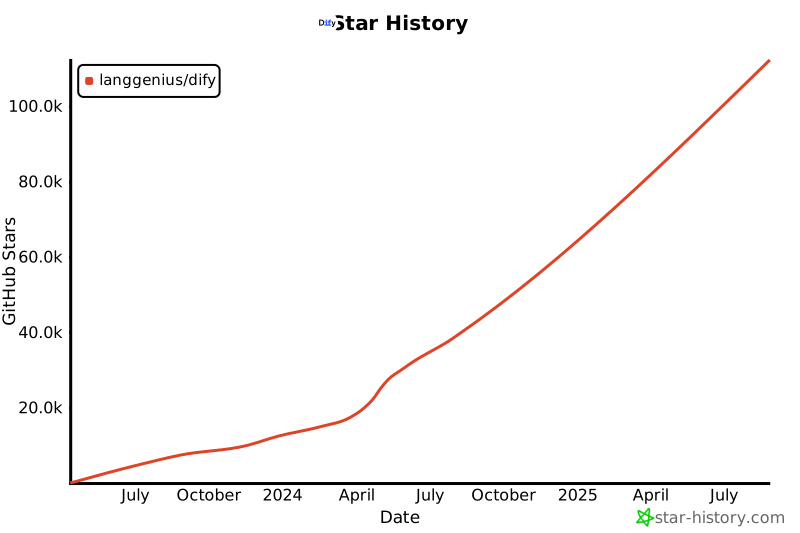](https://star-history.com/#langgenius/dify&Date)
## Security disclosure
To protect your privacy, please avoid posting security issues on GitHub. Instead, send your questions to security@dify.ai and we will provide you with a more detailed answer.
To protect your privacy, please avoid posting security issues on GitHub. Instead, report issues to security@dify.ai, and our team will respond with detailed answer.
## License
This repository is available under the [Dify Open Source License](LICENSE), which is essentially Apache 2.0 with a few additional restrictions.
This repository is licensed under the [Dify Open Source License](LICENSE), based on Apache 2.0 with additional conditions.
<a href="./README_VI.md"><img alt="README Tiếng Việt" src="https://img.shields.io/badge/Ti%E1%BA%BFng%20Vi%E1%BB%87t-d9d9d9"></a>
</p>
<div style="text-align: right;">
مشروع Dify هو منصة تطوير تطبيقات الذكاء الصناعي مفتوحة المصدر. تجمع واجهته البديهية بين سير العمل الذكي بالذكاء الاصطناعي وخط أنابيب RAG وقدرات الوكيل وإدارة النماذج وميزات الملاحظة وأكثر من ذلك، مما يتيح لك الانتقال بسرعة من المرحلة التجريبية إلى الإنتاج. إليك قائمة بالميزات الأساسية:
</br> </br>
**1. سير العمل**: قم ببناء واختبار سير عمل الذكاء الاصطناعي القوي على قماش بصري، مستفيدًا من جميع الميزات التالية وأكثر.
**2. الدعم الشامل للنماذج**: تكامل سلس مع مئات من LLMs الخاصة / مفتوحة المصدر من عشرات من موفري التحليل والحلول المستضافة ذاتيًا، مما يغطي GPT و Mistral و Llama3 وأي نماذج متوافقة مع واجهة OpenAI API. يمكن العثور على قائمة كاملة بمزودي النموذج المدعومين [هنا](https://docs.dify.ai/getting-started/readme/model-providers).
**3. بيئة التطوير للأوامر**: واجهة بيئة التطوير المبتكرة لصياغة الأمر ومقارنة أداء النموذج، وإضافة ميزات إضافية مثل تحويل النص إلى كلام إلى تطبيق قائم على الدردشة.
**4. خط أنابيب RAG**: قدرات RAG الواسعة التي تغطي كل شيء من استيعاب الوثائق إلى الاسترجاع، مع الدعم الفوري لاستخراج النص من ملفات PDF و PPT وتنسيقات الوثائق الشائعة الأخرى.
**5. قدرات الوكيل**: يمكنك تعريف الوكلاء بناءً على أمر وظيفة LLM أو ReAct، وإضافة أدوات مدمجة أو مخصصة للوكيل. توفر Dify أكثر من 50 أداة مدمجة لوكلاء الذكاء الاصطناعي، مثل البحث في Google و DALL·E وStable Diffusion و WolframAlpha.
**6. الـ LLMOps**: راقب وتحلل سجلات التطبيق والأداء على مر الزمن. يمكنك تحسين الأوامر والبيانات والنماذج باستمرار استنادًا إلى البيانات الإنتاجية والتعليقات.
**7.الواجهة الخلفية (Backend) كخدمة**: تأتي جميع عروض Dify مع APIs مطابقة، حتى يمكنك دمج Dify بسهولة في منطق أعمالك الخاص.
## مقارنة الميزات
<table style="width: 100%;">
<tr>
<th align="center">الميزة</th>
<th align="center">Dify.AI</th>
<th align="center">LangChain</th>
<th align="center">Flowise</th>
<th align="center">OpenAI Assistants API</th>
</tr>
<tr>
<td align="center">نهج البرمجة</td>
<td align="center">موجّه لـ تطبيق + واجهة برمجة تطبيق (API)</td>
<td align="center">برمجة Python</td>
<td align="center">موجه لتطبيق</td>
<td align="center">واجهة برمجة تطبيق (API)</td>
</tr>
<tr>
<td align="center">LLMs المدعومة</td>
<td align="center">تنوع غني</td>
<td align="center">تنوع غني</td>
<td align="center">تنوع غني</td>
<td align="center">فقط OpenAI</td>
</tr>
<tr>
<td align="center">محرك RAG</td>
<td align="center">✅</td>
<td align="center">✅</td>
<td align="center">✅</td>
<td align="center">✅</td>
</tr>
<tr>
<td align="center">الوكيل</td>
<td align="center">✅</td>
<td align="center">✅</td>
<td align="center">❌</td>
<td align="center">✅</td>
</tr>
<tr>
<td align="center">سير العمل</td>
<td align="center">✅</td>
<td align="center">❌</td>
<td align="center">✅</td>
<td align="center">❌</td>
</tr>
<tr>
<td align="center">الملاحظة</td>
<td align="center">✅</td>
<td align="center">✅</td>
<td align="center">❌</td>
<td align="center">❌</td>
</tr>
<tr>
<td align="center">ميزات الشركات (SSO / مراقبة الوصول)</td>
<td align="center">✅</td>
<td align="center">❌</td>
<td align="center">❌</td>
<td align="center">❌</td>
</tr>
<tr>
<td align="center">نشر محلي</td>
<td align="center">✅</td>
<td align="center">✅</td>
<td align="center">✅</td>
<td align="center">❌</td>
</tr>
</table>
## استخدام Dify
- **سحابة </br>**
نحن نستضيف [خدمة Dify Cloud](https://dify.ai) لأي شخص لتجربتها بدون أي إعدادات. توفر كل قدرات النسخة التي تمت استضافتها ذاتيًا، وتتضمن 200 أمر GPT-4 مجانًا في خطة الصندوق الرملي.
- **استضافة ذاتية لنسخة المجتمع Dify</br>**
ابدأ سريعًا في تشغيل Dify في بيئتك باستخدام [دليل البدء السريع](#البدء السريع).
استخدم [توثيقنا](https://docs.dify.ai) للمزيد من المراجع والتعليمات الأعمق.
- **مشروع Dify للشركات / المؤسسات</br>**
نحن نوفر ميزات إضافية مركزة على الشركات. [جدول اجتماع معنا](https://cal.com/guchenhe/30min) أو [أرسل لنا بريدًا إلكترونيًا](mailto:business@dify.ai?subject=[GitHub]Business%20License%20Inquiry) لمناقشة احتياجات الشركات. </br>
> بالنسبة للشركات الناشئة والشركات الصغيرة التي تستخدم خدمات AWS، تحقق من [Dify Premium على AWS Marketplace](https://aws.amazon.com/marketplace/pp/prodview-t22mebxzwjhu6) ونشرها في شبكتك الخاصة على AWS VPC بنقرة واحدة. إنها عرض AMI بأسعار معقولة مع خيار إنشاء تطبيقات بشعار وعلامة تجارية مخصصة.
## البقاء قدمًا
قم بإضافة نجمة إلى Dify على GitHub وتلق تنبيهًا فوريًا بالإصدارات الجديدة.
> قبل تثبيت Dify، تأكد من أن جهازك يلبي الحد الأدنى من متطلبات النظام التالية:
>
>- معالج >= 2 نواة
>- ذاكرة وصول عشوائي (RAM) >= 4 جيجابايت
</br>
أسهل طريقة لبدء تشغيل خادم Dify هي تشغيل ملف [docker-compose.yml](docker/docker-compose.yaml) الخاص بنا. قبل تشغيل أمر التثبيت، تأكد من تثبيت [Docker](https://docs.docker.com/get-docker/) و [Docker Compose](https://docs.docker.com/compose/install/) على جهازك:
```bash
cd docker
cp .env.example .env
docker compose up -d
```
بعد التشغيل، يمكنك الوصول إلى لوحة تحكم Dify في متصفحك على [http://localhost/install](http://localhost/install) وبدء عملية التهيئة.
> إذا كنت ترغب في المساهمة في Dify أو القيام بتطوير إضافي، فانظر إلى [دليلنا للنشر من الشفرة (code) المصدرية](https://docs.dify.ai/getting-started/install-self-hosted/local-source-code)
## الخطوات التالية
إذا كنت بحاجة إلى تخصيص الإعدادات، فيرجى الرجوع إلى التعليقات في ملف [.env.example](docker/.env.example) وتحديث القيم المقابلة في ملف `.env`. بالإضافة إلى ذلك، قد تحتاج إلى إجراء تعديلات على ملف `docker-compose.yaml` نفسه، مثل تغيير إصدارات الصور أو تعيينات المنافذ أو نقاط تحميل وحدات التخزين، بناءً على بيئة النشر ومتطلباتك الخاصة. بعد إجراء أي تغييرات، يرجى إعادة تشغيل `docker-compose up -d`. يمكنك العثور على قائمة كاملة بمتغيرات البيئة المتاحة [هنا](https://docs.dify.ai/getting-started/install-self-hosted/environments).
يوجد مجتمع خاص بـ [Helm Charts](https://helm.sh/) وملفات YAML التي تسمح بتنفيذ Dify على Kubernetes للنظام من الإيجابيات العلوية.
- [رسم بياني Helm من قبل @LeoQuote](https://github.com/douban/charts/tree/master/charts/dify)
- [رسم بياني Helm من قبل @BorisPolonsky](https://github.com/BorisPolonsky/dify-helm)
- [ملف YAML من قبل @Winson-030](https://github.com/Winson-030/dify-kubernetes)
#### استخدام Terraform للتوزيع
انشر Dify إلى منصة السحابة بنقرة واحدة باستخدام [terraform](https://www.terraform.io/)
##### Azure Global
- [Azure Terraform بواسطة @nikawang](https://github.com/nikawang/dify-azure-terraform)
##### Google Cloud
- [Google Cloud Terraform بواسطة @sotazum](https://github.com/DeNA/dify-google-cloud-terraform)
#### استخدام AWS CDK للنشر
انشر Dify على AWS باستخدام [CDK](https://aws.amazon.com/cdk/)
##### AWS
- [AWS CDK بواسطة @KevinZhao](https://github.com/aws-samples/solution-for-deploying-dify-on-aws)
## المساهمة
لأولئك الذين يرغبون في المساهمة، انظر إلى [دليل المساهمة](https://github.com/langgenius/dify/blob/main/CONTRIBUTING.md) لدينا.
في الوقت نفسه، يرجى النظر في دعم Dify عن طريق مشاركته على وسائل التواصل الاجتماعي وفي الفعاليات والمؤتمرات.
> نحن نبحث عن مساهمين لمساعدة في ترجمة Dify إلى لغات أخرى غير اللغة الصينية المندرين أو الإنجليزية. إذا كنت مهتمًا بالمساعدة، يرجى الاطلاع على [README للترجمة](https://github.com/langgenius/dify/blob/main/web/i18n/README.md) لمزيد من المعلومات، واترك لنا تعليقًا في قناة `global-users` على [خادم المجتمع على Discord](https://discord.gg/8Tpq4AcN9c).
* [المشكلات على GitHub](https://github.com/langgenius/dify/issues). الأفضل لـ: الأخطاء التي تواجهها في استخدام Dify.AI، واقتراحات الميزات. انظر [دليل المساهمة](https://github.com/langgenius/dify/blob/main/CONTRIBUTING.md).
* [Discord](https://discord.gg/FngNHpbcY7). الأفضل لـ: مشاركة تطبيقاتك والترفيه مع المجتمع.
* [تويتر](https://twitter.com/dify_ai). الأفضل لـ: مشاركة تطبيقاتك والترفيه مع المجتمع.
## تاريخ النجمة
[](https://star-history.com/#langgenius/dify&Date)
## الكشف عن الأمان
لحماية خصوصيتك، يرجى تجنب نشر مشكلات الأمان على GitHub. بدلاً من ذلك، أرسل أسئلتك إلى security@dify.ai وسنقدم لك إجابة أكثر تفصيلاً.
## الرخصة
هذا المستودع متاح تحت [رخصة البرنامج الحر Dify](LICENSE)، والتي تعتبر بشكل أساسي Apache 2.0 مع بعض القيود الإضافية.
## الكشف عن الأمان
لحماية خصوصيتك، يرجى تجنب نشر مشكلات الأمان على GitHub. بدلاً من ذلك، أرسل أسئلتك إلى security@dify.ai وسنقدم لك إجابة أكثر تفصيلاً.
## الرخصة
هذا المستودع متاح تحت [رخصة البرنامج الحر Dify](LICENSE)، والتي تعتبر بشكل أساسي Apache 2.0 مع بعض القيود الإضافية.
<img alt="Actividad de Commits el último mes" src="https://img.shields.io/github/commit-activity/m/langgenius/dify?labelColor=%20%2332b583&color=%20%2312b76a"></a>
Dify es una plataforma de desarrollo de aplicaciones de LLM de código abierto. Su interfaz intuitiva combina flujo de trabajo de IA, pipeline RAG, capacidades de agente, gestión de modelos, características de observabilidad y más, lo que le permite pasar rápidamente de un prototipo a producción. Aquí hay una lista de las características principales:
</br> </br>
**1. Flujo de trabajo**:
Construye y prueba potentes flujos de trabajo de IA en un lienzo visual, aprovechando todas las siguientes características y más.
Integración perfecta con cientos de LLMs propietarios / de código abierto de docenas de proveedores de inferencia y soluciones auto-alojadas, que cubren GPT, Mistral, Llama3 y cualquier modelo compatible con la API de OpenAI. Se puede encontrar una lista completa de proveedores de modelos admitidos [aquí](https://docs.dify.ai/getting-started/readme/model-providers).
Interfaz intuitiva para crear prompts, comparar el rendimiento del modelo y agregar características adicionales como texto a voz a una aplicación basada en chat.
**4. Pipeline RAG**:
Amplias capacidades de RAG que cubren todo, desde la ingestión de documentos hasta la recuperación, con soporte listo para usar para la extracción de texto de PDF, PPT y otros formatos de documento comunes.
**5. Capacidades de agente**:
Puedes definir agent
es basados en LLM Function Calling o ReAct, y agregar herramientas preconstruidas o personalizadas para el agente. Dify proporciona más de 50 herramientas integradas para agentes de IA, como Búsqueda de Google, DALL·E, Difusión Estable y WolframAlpha.
**6. LLMOps**:
Supervisa y analiza registros de aplicaciones y rendimiento a lo largo del tiempo. Podrías mejorar continuamente prompts, conjuntos de datos y modelos basados en datos de producción y anotaciones.
**7. Backend como servicio**:
Todas las ofertas de Dify vienen con APIs correspondientes, por lo que podrías integrar Dify sin esfuerzo en tu propia lógica empresarial.
## Comparación de características
<table style="width: 100%;">
<tr>
<th align="center">Característica</th>
<th align="center">Dify.AI</th>
<th align="center">LangChain</th>
<th align="center">Flowise</th>
<th align="center">API de Asistentes de OpenAI</th>
</tr>
<tr>
<td align="center">Enfoque de programación</td>
<td align="center">API + orientado a la aplicación</td>
<td align="center">Código Python</td>
<td align="center">Orientado a la aplicación</td>
<td align="center">Orientado a la API</td>
</tr>
<tr>
<td align="center">LLMs admitidos</td>
<td align="center">Gran variedad</td>
<td align="center">Gran variedad</td>
<td align="center">Gran variedad</td>
<td align="center">Solo OpenAI</td>
</tr>
<tr>
<td align="center">Motor RAG</td>
<td align="center">✅</td>
<td align="center">✅</td>
<td align="center">✅</td>
<td align="center">✅</td>
</tr>
<tr>
<td align="center">Agente</td>
<td align="center">✅</td>
<td align="center">✅</td>
<td align="center">❌</td>
<td align="center">✅</td>
</tr>
<tr>
<td align="center">Flujo de trabajo</td>
<td align="center">✅</td>
<td align="center">❌</td>
<td align="center">✅</td>
<td align="center">❌</td>
</tr>
<tr>
<td align="center">Observabilidad</td>
<td align="center">✅</td>
<td align="center">✅</td>
<td align="center">❌</td>
<td align="center">❌</td>
</tr>
<tr>
<td align="center">Característica empresarial (SSO/Control de acceso)</td>
<td align="center">✅</td>
<td align="center">❌</td>
<td align="center">❌</td>
<td align="center">❌</td>
</tr>
<tr>
<td align="center">Implementación local</td>
<td align="center">✅</td>
<td align="center">✅</td>
<td align="center">✅</td>
<td align="center">❌</td>
</tr>
</table>
## Usando Dify
- **Nube </br>**
Hospedamos un servicio [Dify Cloud](https://dify.ai) para que cualquiera lo pruebe sin configuración. Proporciona todas las capacidades de la versión autoimplementada e incluye 200 llamadas gratuitas a GPT-4 en el plan sandbox.
- **Auto-alojamiento de Dify Community Edition</br>**
Pon rápidamente Dify en funcionamiento en tu entorno con esta [guía de inicio rápido](#quick-start).
Usa nuestra [documentación](https://docs.dify.ai) para más referencias e instrucciones más detalladas.
- **Dify para Empresas / Organizaciones</br>**
Proporcionamos características adicionales centradas en la empresa. [Envíanos un correo electrónico](mailto:business@dify.ai?subject=[GitHub]Business%20License%20Inquiry) para discutir las necesidades empresariales. </br>
> Para startups y pequeñas empresas que utilizan AWS, echa un vistazo a [Dify Premium en AWS Marketplace](https://aws.amazon.com/marketplace/pp/prodview-t22mebxzwjhu6) e impleméntalo en tu propio VPC de AWS con un clic. Es una AMI asequible que ofrece la opción de crear aplicaciones con logotipo y marca personalizados.
## Manteniéndote al tanto
Dale estrella a Dify en GitHub y serás notificado instantáneamente de las nuevas versiones.
> Antes de instalar Dify, asegúrate de que tu máquina cumpla con los siguientes requisitos mínimos del sistema:
>
>- CPU >= 2 núcleos
>- RAM >= 4GB
</br>
La forma más fácil de iniciar el servidor de Dify es ejecutar nuestro archivo [docker-compose.yml](docker/docker-compose.yaml). Antes de ejecutar el comando de instalación, asegúrate de que [Docker](https://docs.docker.com/get-docker/) y [Docker Compose](https://docs.docker.com/compose/install/) estén instalados en tu máquina:
```bash
cd docker
cp .env.example .env
docker compose up -d
```
Después de ejecutarlo, puedes acceder al panel de control de Dify en tu navegador en [http://localhost/install](http://localhost/install) y comenzar el proceso de inicialización.
> Si deseas contribuir a Dify o realizar desarrollo adicional, consulta nuestra [guía para implementar desde el código fuente](https://docs.dify.ai/getting-started/install-self-hosted/local-source-code)
## Próximos pasos
Si necesita personalizar la configuración, consulte los comentarios en nuestro archivo [.env.example](docker/.env.example) y actualice los valores correspondientes en su archivo `.env`. Además, es posible que deba realizar ajustes en el propio archivo `docker-compose.yaml`, como cambiar las versiones de las imágenes, las asignaciones de puertos o los montajes de volúmenes, según su entorno de implementación y requisitos específicos. Después de realizar cualquier cambio, vuelva a ejecutar `docker-compose up -d`. Puede encontrar la lista completa de variables de entorno disponibles [aquí](https://docs.dify.ai/getting-started/install-self-hosted/environments).
. Después de realizar los cambios, ejecuta `docker-compose up -d` nuevamente. Puedes ver la lista completa de variables de entorno [aquí](https://docs.dify.ai/getting-started/install-self-hosted/environments).
Si desea configurar una configuración de alta disponibilidad, la comunidad proporciona [Gráficos Helm](https://helm.sh/) y archivos YAML, a través de los cuales puede desplegar Dify en Kubernetes.
- [Gráfico Helm por @LeoQuote](https://github.com/douban/charts/tree/master/charts/dify)
- [Gráfico Helm por @BorisPolonsky](https://github.com/BorisPolonsky/dify-helm)
- [Ficheros YAML por @Winson-030](https://github.com/Winson-030/dify-kubernetes)
#### Uso de Terraform para el despliegue
Despliega Dify en una plataforma en la nube con un solo clic utilizando [terraform](https://www.terraform.io/)
##### Azure Global
- [Azure Terraform por @nikawang](https://github.com/nikawang/dify-azure-terraform)
##### Google Cloud
- [Google Cloud Terraform por @sotazum](https://github.com/DeNA/dify-google-cloud-terraform)
#### Usando AWS CDK para el Despliegue
Despliegue Dify en AWS usando [CDK](https://aws.amazon.com/cdk/)
##### AWS
- [AWS CDK por @KevinZhao](https://github.com/aws-samples/solution-for-deploying-dify-on-aws)
## Contribuir
Para aquellos que deseen contribuir con código, consulten nuestra [Guía de contribución](https://github.com/langgenius/dify/blob/main/CONTRIBUTING.md).
Al mismo tiempo, considera apoyar a Dify compartiéndolo en redes sociales y en eventos y conferencias.
> Estamos buscando colaboradores para ayudar con la traducción de Dify a idiomas que no sean el mandarín o el inglés. Si estás interesado en ayudar, consulta el [README de i18n](https://github.com/langgenius/dify/blob/main/web/i18n/README.md) para obtener más información y déjanos un comentario en el canal `global-users` de nuestro [Servidor de Comunidad en Discord](https://discord.gg/8Tpq4AcN9c).
* [Discusión en GitHub](https://github.com/langgenius/dify/discussions). Lo mejor para: compartir comentarios y hacer preguntas.
* [Reporte de problemas en GitHub](https://github.com/langgenius/dify/issues). Lo mejor para: errores que encuentres usando Dify.AI y propuestas de características. Consulta nuestra [Guía de contribución](https://github.com/langgenius/dify/blob/main/CONTRIBUTING.md).
* [Discord](https://discord.gg/FngNHpbcY7). Lo mejor para: compartir tus aplicaciones y pasar el rato con la comunidad.
* [X(Twitter)](https://twitter.com/dify_ai). Lo mejor para: compartir tus aplicaciones y pasar el rato con la comunidad.
## Historial de Estrellas
[](https://star-history.com/#langgenius/dify&Date)
## Divulgación de Seguridad
Para proteger tu privacidad, evita publicar problemas de seguridad en GitHub. En su lugar, envía tus preguntas a security@dify.ai y te proporcionaremos una respuesta más detallada.
## Licencia
Este repositorio está disponible bajo la [Licencia de Código Abierto de Dify](LICENSE), que es esencialmente Apache 2.0 con algunas restricciones adicionales.
## Divulgación de Seguridad
Para proteger tu privacidad, evita publicar problemas de seguridad en GitHub. En su lugar, envía tus preguntas a security@dify.ai y te proporcionaremos una respuesta más detallada.
## Licencia
Este repositorio está disponible bajo la [Licencia de Código Abierto de Dify](LICENSE), que es esencialmente Apache 2.0 con algunas restricciones adicionales.
<img alt="Commits le mois dernier" src="https://img.shields.io/github/commit-activity/m/langgenius/dify?labelColor=%20%2332b583&color=%20%2312b76a"></a>
Dify est une plateforme de développement d'applications LLM open source. Son interface intuitive combine un flux de travail d'IA, un pipeline RAG, des capacités d'agent, une gestion de modèles, des fonctionnalités d'observabilité, et plus encore, vous permettant de passer rapidement du prototype à la production. Voici une liste des fonctionnalités principales:
</br> </br>
**1. Flux de travail**:
Construisez et testez des flux de travail d'IA puissants sur un canevas visuel, en utilisant toutes les fonctionnalités suivantes et plus encore.
Intégration transparente avec des centaines de LLM propriétaires / open source provenant de dizaines de fournisseurs d'inférence et de solutions auto-hébergées, couvrant GPT, Mistral, Llama3, et tous les modèles compatibles avec l'API OpenAI. Une liste complète des fournisseurs de modèles pris en charge se trouve [ici](https://docs.dify.ai/getting-started/readme/model-providers).
Interface intuitive pour créer des prompts, comparer les performances des modèles et ajouter des fonctionnalités supplémentaires telles que la synthèse vocale à une application basée sur des chats.
**4. Pipeline RAG**:
Des capacités RAG étendues qui couvrent tout, de l'ingestion de documents à la récupération, avec un support prêt à l'emploi pour l'extraction de texte à partir de PDF, PPT et autres formats de document courants.
**5. Capac
ités d'agent**:
Vous pouvez définir des agents basés sur l'appel de fonction LLM ou ReAct, et ajouter des outils pré-construits ou personnalisés pour l'agent. Dify fournit plus de 50 outils intégrés pour les agents d'IA, tels que la recherche Google, DALL·E, Stable Diffusion et WolframAlpha.
**6. LLMOps**:
Surveillez et analysez les journaux d'application et les performances au fil du temps. Vous pouvez continuellement améliorer les prompts, les ensembles de données et les modèles en fonction des données de production et des annotations.
**7. Backend-as-a-Service**:
Toutes les offres de Dify sont accompagnées d'API correspondantes, vous permettant d'intégrer facilement Dify dans votre propre logique métier.
Nous hébergeons un service [Dify Cloud](https://dify.ai) pour que tout le monde puisse l'essayer sans aucune configuration. Il fournit toutes les capacités de la version auto-hébergée et comprend 200 appels GPT-4 gratuits dans le plan bac à sable.
- **Auto-hébergement Dify Community Edition</br>**
Lancez rapidement Dify dans votre environnement avec ce [guide de démarrage](#quick-start).
Utilisez notre [documentation](https://docs.dify.ai) pour plus de références et des instructions plus détaillées.
- **Dify pour les entreprises / organisations</br>**
Nous proposons des fonctionnalités supplémentaires adaptées aux entreprises. [Envoyez-nous un e-mail](mailto:business@dify.ai?subject=[GitHub]Business%20License%20Inquiry) pour discuter des besoins de l'entreprise. </br>
> Pour les startups et les petites entreprises utilisant AWS, consultez [Dify Premium sur AWS Marketplace](https://aws.amazon.com/marketplace/pp/prodview-t22mebxzwjhu6) et déployez-le dans votre propre VPC AWS en un clic. C'est une offre AMI abordable avec la possibilité de créer des applications avec un logo et une marque personnalisés.
## Rester en avance
Mettez une étoile à Dify sur GitHub et soyez instantanément informé des nouvelles versions.
> Avant d'installer Dify, assurez-vous que votre machine répond aux exigences système minimales suivantes:
>
>- CPU >= 2 cœurs
>- RAM >= 4 Go
</br>
La manière la plus simple de démarrer le serveur Dify est d'exécuter notre fichier [docker-compose.yml](docker/docker-compose.yaml). Avant d'exécuter la commande d'installation, assurez-vous que [Docker](https://docs.docker.com/get-docker/) et [Docker Compose](https://docs.docker.com/compose/install/) sont installés sur votre machine:
```bash
cd docker
cp .env.example .env
docker compose up -d
```
Après l'exécution, vous pouvez accéder au tableau de bord Dify dans votre navigateur à [http://localhost/install](http://localhost/install) et commencer le processus d'initialisation.
> Si vous souhaitez contribuer à Dify ou effectuer un développement supplémentaire, consultez notre [guide de déploiement à partir du code source](https://docs.dify.ai/getting-started/install-self-hosted/local-source-code)
## Prochaines étapes
Si vous devez personnaliser la configuration, veuillez vous référer aux commentaires dans notre fichier [.env.example](docker/.env.example) et mettre à jour les valeurs correspondantes dans votre fichier `.env`. De plus, vous devrez peut-être apporter des modifications au fichier `docker-compose.yaml` lui-même, comme changer les versions d'image, les mappages de ports ou les montages de volumes, en fonction de votre environnement de déploiement et de vos exigences spécifiques. Après avoir effectué des modifications, veuillez réexécuter `docker-compose up -d`. Vous pouvez trouver la liste complète des variables d'environnement disponibles [ici](https://docs.dify.ai/getting-started/install-self-hosted/environments).
Si vous souhaitez configurer une configuration haute disponibilité, la communauté fournit des [Helm Charts](https://helm.sh/) et des fichiers YAML, à travers lesquels vous pouvez déployer Dify sur Kubernetes.
- [Helm Chart par @LeoQuote](https://github.com/douban/charts/tree/master/charts/dify)
- [Helm Chart par @BorisPolonsky](https://github.com/BorisPolonsky/dify-helm)
- [Fichier YAML par @Winson-030](https://github.com/Winson-030/dify-kubernetes)
#### Utilisation de Terraform pour le déploiement
Déployez Dify sur une plateforme cloud en un clic en utilisant [terraform](https://www.terraform.io/)
##### Azure Global
- [Azure Terraform par @nikawang](https://github.com/nikawang/dify-azure-terraform)
##### Google Cloud
- [Google Cloud Terraform par @sotazum](https://github.com/DeNA/dify-google-cloud-terraform)
#### Utilisation d'AWS CDK pour le déploiement
Déployez Dify sur AWS en utilisant [CDK](https://aws.amazon.com/cdk/)
##### AWS
- [AWS CDK par @KevinZhao](https://github.com/aws-samples/solution-for-deploying-dify-on-aws)
## Contribuer
Pour ceux qui souhaitent contribuer du code, consultez notre [Guide de contribution](https://github.com/langgenius/dify/blob/main/CONTRIBUTING.md).
Dans le même temps, veuillez envisager de soutenir Dify en le partageant sur les réseaux sociaux et lors d'événements et de conférences.
> Nous recherchons des contributeurs pour aider à traduire Dify dans des langues autres que le mandarin ou l'anglais. Si vous êtes intéressé à aider, veuillez consulter le [README i18n](https://github.com/langgenius/dify/blob/main/web/i18n/README.md) pour plus d'informations, et laissez-nous un commentaire dans le canal `global-users` de notre [Serveur communautaire Discord](https://discord.gg/8Tpq4AcN9c).
* [Discussion GitHub](https://github.com/langgenius/dify/discussions). Meilleur pour: partager des commentaires et poser des questions.
* [Problèmes GitHub](https://github.com/langgenius/dify/issues). Meilleur pour: les bogues que vous rencontrez en utilisant Dify.AI et les propositions de fonctionnalités. Consultez notre [Guide de contribution](https://github.com/langgenius/dify/blob/main/CONTRIBUTING.md).
* [Discord](https://discord.gg/FngNHpbcY7). Meilleur pour: partager vos applications et passer du temps avec la communauté.
* [X(Twitter)](https://twitter.com/dify_ai). Meilleur pour: partager vos applications et passer du temps avec la communauté.
## Historique des étoiles
[](https://star-history.com/#langgenius/dify&Date)
## Divulgation de sécurité
Pour protéger votre vie privée, veuillez éviter de publier des problèmes de sécurité sur GitHub. Au lieu de cela, envoyez vos questions à security@dify.ai et nous vous fournirons une réponse plus détaillée.
## Licence
Ce référentiel est disponible sous la [Licence open source Dify](LICENSE), qui est essentiellement l'Apache 2.0 avec quelques restrictions supplémentaires.
## Divulgation de sécurité
Pour protéger votre vie privée, veuillez éviter de publier des problèmes de sécurité sur GitHub. Au lieu de cela, envoyez vos questions à security@dify.ai et nous vous fournirons une réponse plus détaillée.
## Licence
Ce référentiel est disponible sous la [Licence open source Dify](LICENSE), qui est essentiellement l'Apache 2.0 avec quelques restrictions supplémentaires.
LLM Function CallingやReActに基づくエージェントの定義が可能で、AIエージェント用のプリビルトまたはカスタムツールを追加できます。Difyには、Google検索、DALL·E、Stable Diffusion、WolframAlphaなどのAIエージェント用の50以上の組み込みツールが提供します。
Dify is an open-source LLM app development platform. Its intuitive interface combines AI workflow, RAG pipeline, agent capabilities, model management, observability features and more, letting you quickly go from prototype to production. Here's a list of the core features:
</br> </br>
**1. Workflow**:
Build and test powerful AI workflows on a visual canvas, leveraging all the following features and beyond.
Seamless integration with hundreds of proprietary / open-source LLMs from dozens of inference providers and self-hosted solutions, covering GPT, Mistral, Llama3, and any OpenAI API-compatible models. A full list of supported model providers can be found [here](https://docs.dify.ai/getting-started/readme/model-providers).
Intuitive interface for crafting prompts, comparing model performance, and adding additional features such as text-to-speech to a chat-based app.
**4. RAG Pipeline**:
Extensive RAG capabilities that cover everything from document ingestion to retrieval, with out-of-box support for text extraction from PDFs, PPTs, and other common document formats.
**5. Agent capabilities**:
You can define agents based on LLM Function Calling or ReAct, and add pre-built or custom tools for the agent. Dify provides 50+ built-in tools for AI agents, such as Google Search, DALL·E, Stable Diffusion and WolframAlpha.
**6. LLMOps**:
Monitor and analyze application logs and performance over time. You could continuously improve prompts, datasets, and models based on production data and annotations.
**7. Backend-as-a-Service**:
All of Dify's offerings come with corresponding APIs, so you could effortlessly integrate Dify into your own business logic.
We host a [Dify Cloud](https://dify.ai) service for anyone to try with zero setup. It provides all the capabilities of the self-deployed version, and includes 200 free GPT-4 calls in the sandbox plan.
- **Self-hosting Dify Community Edition</br>**
Quickly get Dify running in your environment with this [starter guide](#quick-start).
Use our [documentation](https://docs.dify.ai) for further references and more in-depth instructions.
- **Dify for Enterprise / Organizations</br>**
We provide additional enterprise-centric features. [Send us an email](mailto:business@dify.ai?subject=[GitHub]Business%20License%20Inquiry) to discuss enterprise needs. </br>
> For startups and small businesses using AWS, check out [Dify Premium on AWS Marketplace](https://aws.amazon.com/marketplace/pp/prodview-t22mebxzwjhu6) and deploy it to your own AWS VPC with one-click. It's an affordable AMI offering with the option to create apps with custom logo and branding.
## Staying ahead
Star Dify on GitHub and be instantly notified of new releases.
> Before installing Dify, make sure your machine meets the following minimum system requirements:
>
>- CPU >= 2 Core
>- RAM >= 4GB
</br>
The easiest way to start the Dify server is to run our [docker-compose.yml](docker/docker-compose.yaml) file. Before running the installation command, make sure that [Docker](https://docs.docker.com/get-docker/) and [Docker Compose](https://docs.docker.com/compose/install/) are installed on your machine:
```bash
cd docker
cp .env.example .env
docker compose up -d
```
After running, you can access the Dify dashboard in your browser at [http://localhost/install](http://localhost/install) and start the initialization process.
> If you'd like to contribute to Dify or do additional development, refer to our [guide to deploying from source code](https://docs.dify.ai/getting-started/install-self-hosted/local-source-code)
## Next steps
If you need to customize the configuration, please refer to the comments in our [.env.example](docker/.env.example) file and update the corresponding values in your `.env` file. Additionally, you might need to make adjustments to the `docker-compose.yaml` file itself, such as changing image versions, port mappings, or volume mounts, based on your specific deployment environment and requirements. After making any changes, please re-run `docker-compose up -d`. You can find the full list of available environment variables [here](https://docs.dify.ai/getting-started/install-self-hosted/environments).
If you'd like to configure a highly-available setup, there are community-contributed [Helm Charts](https://helm.sh/) and YAML files which allow Dify to be deployed on Kubernetes.
- [Helm Chart by @LeoQuote](https://github.com/douban/charts/tree/master/charts/dify)
- [Helm Chart by @BorisPolonsky](https://github.com/BorisPolonsky/dify-helm)
- [YAML file by @Winson-030](https://github.com/Winson-030/dify-kubernetes)
For those who'd like to contribute code, see our [Contribution Guide](https://github.com/langgenius/dify/blob/main/CONTRIBUTING.md).
At the same time, please consider supporting Dify by sharing it on social media and at events and conferences.
> We are looking for contributors to help with translating Dify to languages other than Mandarin or English. If you are interested in helping, please see the [i18n README](https://github.com/langgenius/dify/blob/main/web/i18n/README.md) for more information, and leave us a comment in the `global-users` channel of our [Discord Community Server](https://discord.gg/8Tpq4AcN9c).
). Best for: sharing feedback and asking questions.
* [GitHub Issues](https://github.com/langgenius/dify/issues). Best for: bugs you encounter using Dify.AI, and feature proposals. See our [Contribution Guide](https://github.com/langgenius/dify/blob/main/CONTRIBUTING.md).
* [Discord](https://discord.gg/FngNHpbcY7). Best for: sharing your applications and hanging out with the community.
* [X(Twitter)](https://twitter.com/dify_ai). Best for: sharing your applications and hanging out with the community.
## Star History
[](https://star-history.com/#langgenius/dify&Date)
## Security Disclosure
To protect your privacy, please avoid posting security issues on GitHub. Instead, send your questions to security@dify.ai and we will provide you with a more detailed answer.
## License
This repository is available under the [Dify Open Source License](LICENSE), which is essentially Apache 2.0 with a few additional restrictions.
<a href="./README_VI.md"><img alt="README Tiếng Việt" src="https://img.shields.io/badge/Ti%E1%BA%BFng%20Vi%E1%BB%87t-d9d9d9"></a>
</p>
Dify는 오픈 소스 LLM 앱 개발 플랫폼입니다. 직관적인 인터페이스를 통해 AI 워크플로우, RAG 파이프라인, 에이전트 기능, 모델 관리, 관찰 기능 등을 결합하여 프로토타입에서 프로덕션까지 빠르게 전환할 수 있습니다. 주요 기능 목록은 다음과 같습니다:</br> </br>
**1. 워크플로우**:
다음 기능들을 비롯한 다양한 기능을 활용하여 시각적 캔버스에서 강력한 AI 워크플로우를 구축하고 테스트하세요.
수십 개의 추론 제공업체와 자체 호스팅 솔루션에서 제공하는 수백 개의 독점 및 오픈 소스 LLM과 원활하게 통합되며, GPT, Mistral, Llama3 및 모든 OpenAI API 호환 모델을 포함합니다. 지원되는 모델 제공업체의 전체 목록은 [여기](https://docs.dify.ai/getting-started/readme/model-providers)에서 확인할 수 있습니다.
프롬프트를 작성하고, 모델 성능을 비교하며, 텍스트-음성 변환과 같은 추가 기능을 채팅 기반 앱에 추가할 수 있는 직관적인 인터페이스를 제공합니다.
**4. RAG 파이프라인**:
문서 수집부터 검색까지 모든 것을 다루며, PDF, PPT 및 기타 일반적인 문서 형식에서 텍스트 추출을 위한 기본 지원이 포함되어 있는 광범위한 RAG 기능을 제공합니다.
**5. 에이전트 기능**:
LLM 함수 호출 또는 ReAct를 기반으로 에이전트를 정의하고 에이전트에 대해 사전 구축된 도구나 사용자 정의 도구를 추가할 수 있습니다. Dify는 Google Search, DALL·E, Stable Diffusion, WolframAlpha 등 AI 에이전트를 위한 50개 이상의 내장 도구를 제공합니다.
**6. LLMOps**:
시간 경과에 따른 애플리케이션 로그와 성능을 모니터링하고 분석합니다. 생산 데이터와 주석을 기반으로 프롬프트, 데이터세트, 모델을 지속적으로 개선할 수 있습니다.
**7. Backend-as-a-Service**:
Dify의 모든 제품에는 해당 API가 함께 제공되므로 Dify를 자신의 비즈니스 로직에 쉽게 통합할 수 있습니다.
## 기능 비교
<table style="width: 100%;">
<tr>
<th align="center">기능</th>
<th align="center">Dify.AI</th>
<th align="center">LangChain</th>
<th align="center">Flowise</th>
<th align="center">OpenAI Assistants API</th>
</tr>
<tr>
<td align="center">프로그래밍 접근 방식</td>
<td align="center">API + 앱 중심</td>
<td align="center">Python 코드</td>
<td align="center">앱 중심</td>
<td align="center">API 중심</td>
</tr>
<tr>
<td align="center">지원되는 LLMs</td>
<td align="center">다양한 종류</td>
<td align="center">다양한 종류</td>
<td align="center">다양한 종류</td>
<td align="center">OpenAI 전용</td>
</tr>
<tr>
<td align="center">RAG 엔진</td>
<td align="center">✅</td>
<td align="center">✅</td>
<td align="center">✅</td>
<td align="center">✅</td>
</tr>
<tr>
<td align="center">에이전트</td>
<td align="center">✅</td>
<td align="center">✅</td>
<td align="center">❌</td>
<td align="center">✅</td>
</tr>
<tr>
<td align="center">워크플로우</td>
<td align="center">✅</td>
<td align="center">❌</td>
<td align="center">✅</td>
<td align="center">❌</td>
</tr>
<tr>
<td align="center">가시성</td>
<td align="center">✅</td>
<td align="center">✅</td>
<td align="center">❌</td>
<td align="center">❌</td>
</tr>
<tr>
<td align="center">기업용 기능 (SSO/접근 제어)</td>
<td align="center">✅</td>
<td align="center">❌</td>
<td align="center">❌</td>
<td align="center">❌</td>
</tr>
<tr>
<td align="center">로컬 배포</td>
<td align="center">✅</td>
<td align="center">✅</td>
<td align="center">✅</td>
<td align="center">❌</td>
</tr>
</table>
## Dify 사용하기
- **클라우드 </br>**
우리는 누구나 설정이 필요 없이 사용해 볼 수 있도록 [Dify 클라우드](https://dify.ai) 서비스를 호스팅합니다. 이는 자체 배포 버전의 모든 기능을 제공하며, 샌드박스 플랜에서 무료로 200회의 GPT-4 호출을 포함합니다.
- **셀프-호스팅 Dify 커뮤니티 에디션</br>**
환경에서 Dify를 빠르게 실행하려면 이 [스타터 가이드를](#quick-start) 참조하세요.
추가 참조 및 더 심층적인 지침은 [문서](https://docs.dify.ai)를 사용하세요.
- **기업 / 조직을 위한 Dify</br>**
우리는 추가적인 기업 중심 기능을 제공합니다. 잡거나 [이메일 보내기](mailto:business@dify.ai?subject=[GitHub]Business%20License%20Inquiry)를 통해 기업 요구 사항을 논의하십시오. </br>
> AWS를 사용하는 스타트업 및 중소기업의 경우 [AWS Marketplace에서 Dify Premium](https://aws.amazon.com/marketplace/pp/prodview-t22mebxzwjhu6)을 확인하고 한 번의 클릭으로 자체 AWS VPC에 배포하십시오. 맞춤형 로고와 브랜딩이 포함된 앱을 생성할 수 있는 옵션이 포함된 저렴한 AMI 제품입니다.
>Dify를 설치하기 전에 컴퓨터가 다음과 같은 최소 시스템 요구 사항을 충족하는지 확인하세요 :
>- CPU >= 2 Core
>- RAM >= 4GB
</br>
Dify 서버를 시작하는 가장 쉬운 방법은 [docker-compose.yml](docker/docker-compose.yaml) 파일을 실행하는 것입니다. 설치 명령을 실행하기 전에 [Docker](https://docs.docker.com/get-docker/) 및 [Docker Compose](https://docs.docker.com/compose/install/)가 머신에 설치되어 있는지 확인하세요.
```bash
cd docker
cp .env.example .env
docker compose up -d
```
실행 후 브라우저의 [http://localhost/install](http://localhost/install) 에서 Dify 대시보드에 액세스하고 초기화 프로세스를 시작할 수 있습니다.
> Dify에 기여하거나 추가 개발을 하고 싶다면 소스 코드에서 [배포에 대한 가이드](https://docs.dify.ai/getting-started/install-self-hosted/local-source-code)를 참조하세요.
## 다음 단계
구성을 사용자 정의해야 하는 경우 [.env.example](docker/.env.example) 파일의 주석을 참조하고 `.env` 파일에서 해당 값을 업데이트하십시오. 또한 특정 배포 환경 및 요구 사항에 따라 `docker-compose.yaml` 파일 자체를 조정해야 할 수도 있습니다. 예를 들어 이미지 버전, 포트 매핑 또는 볼륨 마운트를 변경합니다. 변경 한 후 `docker-compose up -d`를 다시 실행하십시오. 사용 가능한 환경 변수의 전체 목록은 [여기](https://docs.dify.ai/getting-started/install-self-hosted/environments)에서 찾을 수 있습니다.
Dify를 Kubernetes에 배포하고 프리미엄 스케일링 설정을 구성했다는 커뮤니티가 제공하는 [Helm Charts](https://helm.sh/)와 YAML 파일이 존재합니다.
- [Helm Chart by @LeoQuote](https://github.com/douban/charts/tree/master/charts/dify)
- [Helm Chart by @BorisPolonsky](https://github.com/BorisPolonsky/dify-helm)
- [YAML file by @Winson-030](https://github.com/Winson-030/dify-kubernetes)
#### Terraform을 사용한 배포
[terraform](https://www.terraform.io/)을 사용하여 단 한 번의 클릭으로 Dify를 클라우드 플랫폼에 배포하십시오
코드에 기여하고 싶은 분들은 [기여 가이드](https://github.com/langgenius/dify/blob/main/CONTRIBUTING.md)를 참조하세요.
동시에 Dify를 소셜 미디어와 행사 및 컨퍼런스에 공유하여 지원하는 것을 고려해 주시기 바랍니다.
> 우리는 Dify를 중국어나 영어 이외의 언어로 번역하는 데 도움을 줄 수 있는 기여자를 찾고 있습니다. 도움을 주고 싶으시다면 [i18n README](https://github.com/langgenius/dify/blob/main/web/i18n/README.md)에서 더 많은 정보를 확인하시고 [Discord 커뮤니티 서버](https://discord.gg/8Tpq4AcN9c)의 `global-users` 채널에 댓글을 남겨주세요.
* [Github 토론](https://github.com/langgenius/dify/discussions). 피드백 공유 및 질문하기에 적합합니다.
* [GitHub 이슈](https://github.com/langgenius/dify/issues). Dify.AI 사용 중 발견한 버그와 기능 제안에 적합합니다. [기여 가이드](https://github.com/langgenius/dify/blob/main/CONTRIBUTING.md)를 참조하세요.
* [디스코드](https://discord.gg/FngNHpbcY7). 애플리케이션 공유 및 커뮤니티와 소통하기에 적합합니다.
* [트위터](https://twitter.com/dify_ai). 애플리케이션 공유 및 커뮤니티와 소통하기에 적합합니다.
## Star 히스토리
[](https://star-history.com/#langgenius/dify&Date)
## 보안 공개
개인정보 보호를 위해 보안 문제를 GitHub에 게시하지 마십시오. 대신 security@dify.ai로 질문을 보내주시면 더 자세한 답변을 드리겠습니다.
## 라이선스
이 저장소는 기본적으로 몇 가지 추가 제한 사항이 있는 Apache 2.0인 [Dify 오픈 소스 라이선스](LICENSE)에 따라 사용할 수 있습니다.
📌 <a href="https://dify.ai/blog/introducing-dify-workflow-file-upload-a-demo-on-ai-podcast">Introduzindo o Dify Workflow com Upload de Arquivo: Recrie o Podcast Google NotebookLM</a>
<a href="./README_KR.md"><img alt="README em Coreano" src="https://img.shields.io/badge/한국어-d9d9d9"></a>
<a href="./README_AR.md"><img alt="README em Árabe" src="https://img.shields.io/badge/العربية-d9d9d9"></a>
<a href="./README_TR.md"><img alt="README em Turco" src="https://img.shields.io/badge/Türkçe-d9d9d9"></a>
<a href="./README_VI.md"><img alt="README em Vietnamita" src="https://img.shields.io/badge/Ti%E1%BA%BFng%20Vi%E1%BB%87t-d9d9d9"></a>
<a href="./README_PT.md"><img alt="README em Português - BR" src="https://img.shields.io/badge/Portugu%C3%AAs-BR?style=flat&label=BR&color=d9d9d9"></a>
</p>
Dify é uma plataforma de desenvolvimento de aplicativos LLM de código aberto. Sua interface intuitiva combina workflow de IA, pipeline RAG, capacidades de agente, gerenciamento de modelos, recursos de observabilidade e muito mais, permitindo que você vá rapidamente do protótipo à produção. Aqui está uma lista das principais funcionalidades:
</br> </br>
**1. Workflow**:
Construa e teste workflows poderosos de IA em uma interface visual, aproveitando todos os recursos a seguir e muito mais.
Integração perfeita com centenas de LLMs proprietários e de código aberto de diversas provedoras e soluções auto-hospedadas, abrangendo GPT, Mistral, Llama3 e qualquer modelo compatível com a API da OpenAI. A lista completa de provedores suportados pode ser encontrada [aqui](https://docs.dify.ai/getting-started/readme/model-providers).
Interface intuitiva para criação de prompts, comparação de desempenho de modelos e adição de recursos como conversão de texto para fala em um aplicativo baseado em chat.
**4. Pipeline RAG**:
Extensas capacidades de RAG que cobrem desde a ingestão de documentos até a recuperação, com suporte nativo para extração de texto de PDFs, PPTs e outros formatos de documentos comuns.
**5. Capacidades de agente**:
Você pode definir agentes com base em LLM Function Calling ou ReAct e adicionar ferramentas pré-construídas ou personalizadas para o agente. O Dify oferece mais de 50 ferramentas integradas para agentes de IA, como Google Search, DALL·E, Stable Diffusion e WolframAlpha.
**6. LLMOps**:
Monitore e analise os registros e o desempenho do aplicativo ao longo do tempo. É possível melhorar continuamente prompts, conjuntos de dados e modelos com base nos dados de produção e anotações.
**7. Backend como Serviço**:
Todas os recursos do Dify vêm com APIs correspondentes, permitindo que você integre o Dify sem esforço na lógica de negócios da sua empresa.
## Comparação de recursos
<table style="width: 100%;">
<tr>
<th align="center">Recurso</th>
<th align="center">Dify.AI</th>
<th align="center">LangChain</th>
<th align="center">Flowise</th>
<th align="center">OpenAI Assistants API</th>
</tr>
<tr>
<td align="center">Abordagem de Programação</td>
<td align="center">Orientada a API + Aplicativo</td>
<td align="center">Código Python</td>
<td align="center">Orientada a Aplicativo</td>
<td align="center">Orientada a API</td>
</tr>
<tr>
<td align="center">LLMs Suportados</td>
<td align="center">Variedade Rica</td>
<td align="center">Variedade Rica</td>
<td align="center">Variedade Rica</td>
<td align="center">Apenas OpenAI</td>
</tr>
<tr>
<td align="center">RAG Engine</td>
<td align="center">✅</td>
<td align="center">✅</td>
<td align="center">✅</td>
<td align="center">✅</td>
</tr>
<tr>
<td align="center">Agente</td>
<td align="center">✅</td>
<td align="center">✅</td>
<td align="center">❌</td>
<td align="center">✅</td>
</tr>
<tr>
<td align="center">Workflow</td>
<td align="center">✅</td>
<td align="center">❌</td>
<td align="center">✅</td>
<td align="center">❌</td>
</tr>
<tr>
<td align="center">Observabilidade</td>
<td align="center">✅</td>
<td align="center">✅</td>
<td align="center">❌</td>
<td align="center">❌</td>
</tr>
<tr>
<td align="center">Recursos Empresariais (SSO/Controle de Acesso)</td>
<td align="center">✅</td>
<td align="center">❌</td>
<td align="center">❌</td>
<td align="center">❌</td>
</tr>
<tr>
<td align="center">Implantação Local</td>
<td align="center">✅</td>
<td align="center">✅</td>
<td align="center">✅</td>
<td align="center">❌</td>
</tr>
</table>
## Usando o Dify
- **Nuvem </br>**
Oferecemos o serviço [Dify Cloud](https://dify.ai) para qualquer pessoa experimentar sem nenhuma configuração. Ele fornece todas as funcionalidades da versão auto-hospedada, incluindo 200 chamadas GPT-4 gratuitas no plano sandbox.
- **Auto-hospedagem do Dify Community Edition</br>**
Configure rapidamente o Dify no seu ambiente com este [guia inicial](#quick-start).
Use nossa [documentação](https://docs.dify.ai) para referências adicionais e instruções mais detalhadas.
- **Dify para empresas/organizações</br>**
Oferecemos recursos adicionais voltados para empresas. [Envie suas perguntas através deste chatbot](https://udify.app/chat/22L1zSxg6yW1cWQg) ou [envie-nos um e-mail](mailto:business@dify.ai?subject=[GitHub]Business%20License%20Inquiry) para discutir necessidades empresariais. </br>
> Para startups e pequenas empresas que utilizam AWS, confira o [Dify Premium no AWS Marketplace](https://aws.amazon.com/marketplace/pp/prodview-t22mebxzwjhu6) e implemente no seu próprio AWS VPC com um clique. É uma oferta AMI acessível com a opção de criar aplicativos com logotipo e marca personalizados.
## Mantendo-se atualizado
Dê uma estrela no Dify no GitHub e seja notificado imediatamente sobre novos lançamentos.
> Antes de instalar o Dify, certifique-se de que sua máquina atenda aos seguintes requisitos mínimos de sistema:
>
>- CPU >= 2 Núcleos
>- RAM >= 4 GiB
</br>
A maneira mais fácil de iniciar o servidor Dify é executar nosso arquivo [docker-compose.yml](docker/docker-compose.yaml). Antes de rodar o comando de instalação, certifique-se de que o [Docker](https://docs.docker.com/get-docker/) e o [Docker Compose](https://docs.docker.com/compose/install/) estão instalados na sua máquina:
```bash
cd docker
cp .env.example .env
docker compose up -d
```
Após a execução, você pode acessar o painel do Dify no navegador em [http://localhost/install](http://localhost/install) e iniciar o processo de inicialização.
> Se você deseja contribuir com o Dify ou fazer desenvolvimento adicional, consulte nosso [guia para implantar a partir do código fonte](https://docs.dify.ai/getting-started/install-self-hosted/local-source-code).
## Próximos passos
Se precisar personalizar a configuração, consulte os comentários no nosso arquivo [.env.example](docker/.env.example) e atualize os valores correspondentes no seu arquivo `.env`. Além disso, talvez seja necessário fazer ajustes no próprio arquivo `docker-compose.yaml`, como alterar versões de imagem, mapeamentos de portas ou montagens de volumes, com base no seu ambiente de implantação específico e nas suas necessidades. Após fazer quaisquer alterações, execute novamente `docker-compose up -d`. Você pode encontrar a lista completa de variáveis de ambiente disponíveis [aqui](https://docs.dify.ai/getting-started/install-self-hosted/environments).
Se deseja configurar uma instalação de alta disponibilidade, há [Helm Charts](https://helm.sh/) e arquivos YAML contribuídos pela comunidade que permitem a implantação do Dify no Kubernetes.
- [Helm Chart de @LeoQuote](https://github.com/douban/charts/tree/master/charts/dify)
- [Helm Chart de @BorisPolonsky](https://github.com/BorisPolonsky/dify-helm)
- [Arquivo YAML de @Winson-030](https://github.com/Winson-030/dify-kubernetes)
#### Usando o Terraform para Implantação
Implante o Dify na Plataforma Cloud com um único clique usando [terraform](https://www.terraform.io/)
##### Azure Global
- [Azure Terraform por @nikawang](https://github.com/nikawang/dify-azure-terraform)
##### Google Cloud
- [Google Cloud Terraform por @sotazum](https://github.com/DeNA/dify-google-cloud-terraform)
#### Usando AWS CDK para Implantação
Implante o Dify na AWS usando [CDK](https://aws.amazon.com/cdk/)
##### AWS
- [AWS CDK por @KevinZhao](https://github.com/aws-samples/solution-for-deploying-dify-on-aws)
## Contribuindo
Para aqueles que desejam contribuir com código, veja nosso [Guia de Contribuição](https://github.com/langgenius/dify/blob/main/CONTRIBUTING.md).
Ao mesmo tempo, considere apoiar o Dify compartilhando-o nas redes sociais e em eventos e conferências.
> Estamos buscando contribuidores para ajudar na tradução do Dify para idiomas além de Mandarim e Inglês. Se você tiver interesse em ajudar, consulte o [README i18n](https://github.com/langgenius/dify/blob/main/web/i18n/README.md) para mais informações e deixe-nos um comentário no canal `global-users` em nosso [Servidor da Comunidade no Discord](https://discord.gg/8Tpq4AcN9c).
* [Discussões no GitHub](https://github.com/langgenius/dify/discussions). Melhor para: compartilhar feedback e fazer perguntas.
* [Problemas no GitHub](https://github.com/langgenius/dify/issues). Melhor para: relatar bugs encontrados no Dify.AI e propor novos recursos. Veja nosso [Guia de Contribuição](https://github.com/langgenius/dify/blob/main/CONTRIBUTING.md).
* [Discord](https://discord.gg/FngNHpbcY7). Melhor para: compartilhar suas aplicações e interagir com a comunidade.
* [X(Twitter)](https://twitter.com/dify_ai). Melhor para: compartilhar suas aplicações e interagir com a comunidade.
## Histórico de estrelas
[](https://star-history.com/#langgenius/dify&Date)
## Divulgação de segurança
Para proteger sua privacidade, evite postar problemas de segurança no GitHub. Em vez disso, envie suas perguntas para security@dify.ai e forneceremos uma resposta mais detalhada.
## Licença
Este repositório está disponível sob a [Licença de Código Aberto Dify](LICENSE), que é essencialmente Apache 2.0 com algumas restrições adicionais.
Dify je odprtokodna platforma za razvoj aplikacij LLM. Njegov intuitivni vmesnik združuje agentski potek dela z umetno inteligenco, cevovod RAG, zmogljivosti agentov, upravljanje modelov, funkcije opazovanja in več, kar vam omogoča hiter prehod od prototipa do proizvodnje.
## Hitri začetek
> Preden namestite Dify, se prepričajte, da vaša naprava izpolnjuje naslednje minimalne sistemske zahteve:
>
>- CPU >= 2 Core
>- RAM >= 4 GiB
</br>
Najlažji način za zagon strežnika Dify je prek docker compose . Preden zaženete Dify z naslednjimi ukazi, se prepričajte, da sta Docker in Docker Compose nameščena na vašem računalniku:
```bash
cd dify
cd docker
cp .env.example .env
docker compose up -d
```
Po zagonu lahko dostopate do nadzorne plošče Dify v brskalniku na [http://localhost/install](http://localhost/install) in začnete postopek inicializacije.
#### Iskanje pomoči
Prosimo, glejte naša pogosta vprašanja [FAQ](https://docs.dify.ai/getting-started/install-self-hosted/faqs) če naletite na težave pri nastavitvi Dify. Če imate še vedno težave, se obrnite na [skupnost ali nas](#community--contact).
> Če želite prispevati k Difyju ali narediti dodaten razvoj, glejte naš vodnik za [uvajanje iz izvorne kode](https://docs.dify.ai/getting-started/install-self-hosted/local-source-code)
## Ključne značilnosti
**1. Potek dela**:
Zgradite in preizkusite zmogljive poteke dela AI na vizualnem platnu, pri čemer izkoristite vse naslednje funkcije in več.
Brezhibna integracija s stotinami lastniških/odprtokodnih LLM-jev ducatov ponudnikov sklepanja in samostojnih rešitev, ki pokrivajo GPT, Mistral, Llama3 in vse modele, združljive z API-jem OpenAI. Celoten seznam podprtih ponudnikov modelov najdete [tukaj](https://docs.dify.ai/getting-started/readme/model-providers).
intuitivni vmesnik za ustvarjanje pozivov, primerjavo zmogljivosti modela in dodajanje dodatnih funkcij, kot je pretvorba besedila v govor, aplikaciji, ki temelji na klepetu.
**4. RAG Pipeline**:
E Obsežne zmogljivosti RAG, ki pokrivajo vse od vnosa dokumenta do priklica, s podporo za ekstrakcijo besedila iz datotek PDF, PPT in drugih običajnih formatov dokumentov.
**5. Agent capabilities**:
definirate lahko agente, ki temeljijo na klicanju funkcij LLM ali ReAct, in dodate vnaprej izdelana orodja ali orodja po meri za agenta. Dify ponuja več kot 50 vgrajenih orodij za agente AI, kot so Google Search, DALL·E, Stable Diffusion in WolframAlpha.
**6. LLMOps**:
Spremljajte in analizirajte dnevnike aplikacij in učinkovitost skozi čas. Pozive, nabore podatkov in modele lahko nenehno izboljšujete na podlagi proizvodnih podatkov in opomb.
**7. Backend-as-a-Service**:
AVse ponudbe Difyja so opremljene z ustreznimi API-ji, tako da lahko Dify brez težav integrirate v svojo poslovno logiko.
## Uporaba Dify
- **Cloud </br>**
Gostimo storitev Dify Cloud za vsakogar, ki jo lahko preizkusite brez nastavitev. Zagotavlja vse zmožnosti različice za samostojno namestitev in vključuje 200 brezplačnih klicev GPT-4 v načrtu peskovnika.
- **Self-hosting Dify Community Edition</br>**
Hitro zaženite Dify v svojem okolju s tem [začetnim vodnikom](#quick-start) . Za dodatne reference in podrobnejša navodila uporabite našo [dokumentacijo](https://docs.dify.ai) .
- **Dify za podjetja/organizacije</br>**
Ponujamo dodatne funkcije, osredotočene na podjetja. Zabeležite svoja vprašanja prek tega klepetalnega robota ali nam pošljite e-pošto, da se pogovorimo o potrebah podjetja. </br>
> Za novoustanovljena podjetja in mala podjetja, ki uporabljajo AWS, si oglejte Dify Premium na AWS Marketplace in ga z enim klikom uvedite v svoj AWS VPC. To je cenovno ugodna ponudba AMI z možnostjo ustvarjanja aplikacij z logotipom in blagovno znamko po meri.
## Staying ahead
Star Dify on GitHub and be instantly notified of new releases.
Če morate prilagoditi konfiguracijo, si oglejte komentarje v naši datoteki .env.example in posodobite ustrezne vrednosti v svoji .env datoteki. Poleg tega boste morda morali prilagoditi docker-compose.yamlsamo datoteko, na primer spremeniti različice slike, preslikave vrat ali namestitve nosilca, glede na vaše specifično okolje in zahteve za uvajanje. Po kakršnih koli spremembah ponovno zaženite docker-compose up -d. Celoten seznam razpoložljivih spremenljivk okolja najdete tukaj .
Če želite konfigurirati visoko razpoložljivo nastavitev, so na voljo Helm Charts in datoteke YAML, ki jih prispeva skupnost, ki omogočajo uvedbo Difyja v Kubernetes.
- [Helm Chart by @LeoQuote](https://github.com/douban/charts/tree/master/charts/dify)
- [Helm Chart by @BorisPolonsky](https://github.com/BorisPolonsky/dify-helm)
- [YAML file by @Winson-030](https://github.com/Winson-030/dify-kubernetes)
#### Uporaba Terraform za uvajanje
namestite Dify v Cloud Platform z enim klikom z uporabo [terraform](https://www.terraform.io/)
##### Azure Global
- [Azure Terraform by @nikawang](https://github.com/nikawang/dify-azure-terraform)
##### Google Cloud
- [Google Cloud Terraform by @sotazum](https://github.com/DeNA/dify-google-cloud-terraform)
#### Uporaba AWS CDK za uvajanje
Uvedite Dify v AWS z uporabo [CDK](https://aws.amazon.com/cdk/)
##### AWS
- [AWS CDK by @KevinZhao](https://github.com/aws-samples/solution-for-deploying-dify-on-aws)
## Prispevam
Za tiste, ki bi radi prispevali kodo, si oglejte naš vodnik za prispevke . Hkrati vas prosimo, da podprete Dify tako, da ga delite na družbenih medijih ter na dogodkih in konferencah.
> Iščemo sodelavce za pomoč pri prevajanju Difyja v jezike, ki niso mandarinščina ali angleščina. Če želite pomagati, si oglejte i18n README za več informacij in nam pustite komentar v global-userskanalu našega strežnika skupnosti Discord .
* [GitHub Issues](https://github.com/langgenius/dify/issues). Najboljše za: hrošče, na katere naletite pri uporabi Dify.AI, in predloge funkcij. Oglejte si naš [vodnik za prispevke](https://github.com/langgenius/dify/blob/main/CONTRIBUTING.md).
* [Discord](https://discord.gg/FngNHpbcY7). Najboljše za: deljenje vaših aplikacij in druženje s skupnostjo.
* [X(Twitter)](https://twitter.com/dify_ai). Najboljše za: deljenje vaših aplikacij in druženje s skupnostjo.
[](https://star-history.com/#langgenius/dify&Date)
## Varnostno razkritje
Zaradi zaščite vaše zasebnosti se izogibajte objavljanju varnostnih vprašanj na GitHub. Namesto tega pošljite vprašanja na security@dify.ai in zagotovili vam bomo podrobnejši odgovor.
## Licenca
To skladišče je na voljo pod [odprtokodno licenco Dify](LICENSE) , ki je v bistvu Apache 2.0 z nekaj dodatnimi omejitvami.
<img alt="Geçen ay yapılan commitler" src="https://img.shields.io/github/commit-activity/m/langgenius/dify?labelColor=%20%2332b583&color=%20%2312b76a"></a>
<a href="./README_VI.md"><img alt="README Tiếng Việt" src="https://img.shields.io/badge/Ti%E1%BA%BFng%20Vi%E1%BB%87t-d9d9d9"></a>
</p>
Dify, açık kaynaklı bir LLM uygulama geliştirme platformudur. Sezgisel arayüzü, AI iş akışı, RAG pipeline'ı, ajan yetenekleri, model yönetimi, gözlemlenebilirlik özellikleri ve daha fazlasını birleştirerek, prototipten üretime hızlıca geçmenizi sağlar. İşte temel özelliklerin bir listesi:
</br> </br>
**1. Workflow**:
Görsel bir arayüz üzerinde güçlü AI iş akışları oluşturun ve test edin, aşağıdaki tüm özellikleri ve daha fazlasını kullanarak.
Çok sayıda çıkarım sağlayıcısı ve kendi kendine barındırılan çözümlerden yüzlerce özel / açık kaynaklı LLM ile sorunsuz entegrasyon sağlar. GPT, Mistral, Llama3 ve OpenAI API uyumlu tüm modelleri kapsar. Desteklenen model sağlayıcılarının tam listesine [buradan](https://docs.dify.ai/getting-started/readme/model-providers) ulaşabilirsiniz.
Komut istemlerini oluşturmak, model performansını karşılaştırmak ve sohbet tabanlı uygulamalara metin-konuşma gibi ek özellikler eklemek için kullanıcı dostu bir arayüz.
**4. RAG Pipeline**:
Belge alımından bilgi çekmeye kadar geniş kapsamlı RAG yetenekleri. PDF'ler, PPT'ler ve diğer yaygın belge formatlarından metin çıkarma için hazır destek sunar.
**5. Ajan yetenekleri**:
LLM Fonksiyon Çağırma veya ReAct'a dayalı ajanlar tanımlayabilir ve bu ajanlara önceden hazırlanmış veya özel araçlar ekleyebilirsiniz. Dify, AI ajanları için Google Arama, DALL·E, Stable Diffusion ve WolframAlpha gibi 50'den fazla yerleşik araç sağlar.
**6. LLMOps**:
Uygulama loglarını ve performans metriklerini zaman içinde izleme ve analiz etme imkanı. Üretim ortamından elde edilen verilere ve kullanıcı geri bildirimlerine dayanarak, prompt'ları, veri setlerini ve modelleri sürekli olarak optimize edebilirsiniz. Bu sayede, AI uygulamanızın performansını ve doğruluğunu sürekli olarak artırabilirsiniz.
**7. Hizmet Olarak Backend**:
Dify'ın tüm özellikleri ilgili API'lerle birlikte gelir, böylece Dify'ı kendi iş mantığınıza kolayca entegre edebilirsiniz.
## Özellik karşılaştırması
<table style="width: 100%;">
<tr>
<th align="center">Özellik</th>
<th align="center">Dify.AI</th>
<th align="center">LangChain</th>
<th align="center">Flowise</th>
<th align="center">OpenAI Assistants API</th>
</tr>
<tr>
<td align="center">Programlama Yaklaşımı</td>
<td align="center">API + Uygulama odaklı</td>
<td align="center">Python Kodu</td>
<td align="center">Uygulama odaklı</td>
<td align="center">API odaklı</td>
</tr>
<tr>
<td align="center">Desteklenen LLM'ler</td>
<td align="center">Zengin Çeşitlilik</td>
<td align="center">Zengin Çeşitlilik</td>
<td align="center">Zengin Çeşitlilik</td>
<td align="center">Yalnızca OpenAI</td>
</tr>
<tr>
<td align="center">RAG Motoru</td>
<td align="center">✅</td>
<td align="center">✅</td>
<td align="center">✅</td>
<td align="center">✅</td>
</tr>
<tr>
<td align="center">Ajan</td>
<td align="center">✅</td>
<td align="center">✅</td>
<td align="center">❌</td>
<td align="center">✅</td>
</tr>
<tr>
<td align="center">İş Akışı</td>
<td align="center">✅</td>
<td align="center">❌</td>
<td align="center">✅</td>
<td align="center">❌</td>
</tr>
<tr>
<td align="center">Gözlemlenebilirlik</td>
<td align="center">✅</td>
<td align="center">✅</td>
<td align="center">❌</td>
<td align="center">❌</td>
</tr>
<tr>
<td align="center">Kurumsal Özellikler (SSO/Erişim kontrolü)</td>
<td align="center">✅</td>
<td align="center">❌</td>
<td align="center">❌</td>
<td align="center">❌</td>
</tr>
<tr>
<td align="center">Yerel Dağıtım</td>
<td align="center">✅</td>
<td align="center">✅</td>
<td align="center">✅</td>
<td align="center">❌</td>
</tr>
</table>
## Dify'ı Kullanma
- **Cloud </br>**
Herkesin sıfır kurulumla denemesi için bir [Dify Cloud](https://dify.ai) hizmeti sunuyoruz. Bu hizmet, kendi kendine dağıtılan versiyonun tüm yeteneklerini sağlar ve sandbox planında 200 ücretsiz GPT-4 çağrısı içerir.
- **Dify Topluluk Sürümünü Kendi Sunucunuzda Barındırma</br>**
Bu [başlangıç kılavuzu](#quick-start) ile Dify'ı kendi ortamınızda hızlıca çalıştırın.
Daha fazla referans ve detaylı talimatlar için [dokümantasyonumuzu](https://docs.dify.ai) kullanın.
- **Kurumlar / organizasyonlar için Dify</br>**
Ek kurumsal odaklı özellikler sunuyoruz. Kurumsal ihtiyaçları görüşmek için [bize bir e-posta gönderin](mailto:business@dify.ai?subject=[GitHub]Business%20License%20Inquiry). </br>
> AWS kullanan startuplar ve küçük işletmeler için, [AWS Marketplace'deki Dify Premium'a](https://aws.amazon.com/marketplace/pp/prodview-t22mebxzwjhu6) göz atın ve tek tıklamayla kendi AWS VPC'nize dağıtın. Bu, özel logo ve marka ile uygulamalar oluşturma seçeneğine sahip uygun fiyatlı bir AMI teklifdir.
## Güncel Kalma
GitHub'da Dify'a yıldız verin ve yeni sürümlerden anında haberdar olun.
> Dify'ı kurmadan önce, makinenizin aşağıdaki minimum sistem gereksinimlerini karşıladığından emin olun:
>
>- CPU >= 2 Çekirdek
>- RAM >= 4GB
</br>
Dify sunucusunu başlatmanın en kolay yolu, [docker-compose.yml](docker/docker-compose.yaml) dosyamızı çalıştırmaktır. Kurulum komutunu çalıştırmadan önce, makinenizde [Docker](https://docs.docker.com/get-docker/) ve [Docker Compose](https://docs.docker.com/compose/install/)'un kurulu olduğundan emin olun:
```bash
cd docker
cp .env.example .env
docker compose up -d
```
Çalıştırdıktan sonra, tarayıcınızda [http://localhost/install](http://localhost/install) adresinden Dify kontrol paneline erişebilir ve başlangıç ayarları sürecini başlatabilirsiniz.
> Eğer Dify'a katkıda bulunmak veya ek geliştirmeler yapmak isterseniz, [kaynak koddan dağıtım kılavuzumuza](https://docs.dify.ai/getting-started/install-self-hosted/local-source-code) başvurun.
## Sonraki adımlar
Yapılandırmayı özelleştirmeniz gerekiyorsa, lütfen [.env.example](docker/.env.example) dosyamızdaki yorumlara bakın ve `.env` dosyanızdaki ilgili değerleri güncelleyin. Ayrıca, spesifik dağıtım ortamınıza ve gereksinimlerinize bağlı olarak `docker-compose.yaml` dosyasının kendisinde de, imaj sürümlerini, port eşlemelerini veya hacim bağlantılarını değiştirmek gibi ayarlamalar yapmanız gerekebilir. Herhangi bir değişiklik yaptıktan sonra, lütfen `docker-compose up -d` komutunu tekrar çalıştırın. Kullanılabilir tüm ortam değişkenlerinin tam listesini [burada](https://docs.dify.ai/getting-started/install-self-hosted/environments) bulabilirsiniz.
Yüksek kullanılabilirliğe sahip bir kurulum yapılandırmak isterseniz, Dify'ın Kubernetes üzerine dağıtılmasına olanak tanıyan topluluk katkılı [Helm Charts](https://helm.sh/) ve YAML dosyaları mevcuttur.
- [@LeoQuote tarafından Helm Chart](https://github.com/douban/charts/tree/master/charts/dify)
- [@BorisPolonsky tarafından Helm Chart](https://github.com/BorisPolonsky/dify-helm)
- [@Winson-030 tarafından YAML dosyası](https://github.com/Winson-030/dify-kubernetes)
#### Dağıtım için Terraform Kullanımı
Dify'ı bulut platformuna tek tıklamayla dağıtın [terraform](https://www.terraform.io/) kullanarak
##### Azure Global
- [Azure Terraform tarafından @nikawang](https://github.com/nikawang/dify-azure-terraform)
##### Google Cloud
- [Google Cloud Terraform tarafından @sotazum](https://github.com/DeNA/dify-google-cloud-terraform)
#### AWS CDK ile Dağıtım
[CDK](https://aws.amazon.com/cdk/) kullanarak Dify'ı AWS'ye dağıtın
##### AWS
- [AWS CDK tarafından @KevinZhao](https://github.com/aws-samples/solution-for-deploying-dify-on-aws)
## Katkıda Bulunma
Kod katkısında bulunmak isteyenler için [Katkı Kılavuzumuza](https://github.com/langgenius/dify/blob/main/CONTRIBUTING.md) bakabilirsiniz.
Aynı zamanda, lütfen Dify'ı sosyal medyada, etkinliklerde ve konferanslarda paylaşarak desteklemeyi düşünün.
> Dify'ı Mandarin veya İngilizce dışındaki dillere çevirmemize yardımcı olacak katkıda bulunanlara ihtiyacımız var. Yardımcı olmakla ilgileniyorsanız, lütfen daha fazla bilgi için [i18n README](https://github.com/langgenius/dify/blob/main/web/i18n/README.md) dosyasına bakın ve [Discord Topluluk Sunucumuzdaki](https://discord.gg/8Tpq4AcN9c) `global-users` kanalında bize bir yorum bırakın.
* [Github Tartışmaları](https://github.com/langgenius/dify/discussions). En uygun: geri bildirim paylaşmak ve soru sormak için.
* [GitHub Sorunları](https://github.com/langgenius/dify/issues). En uygun: Dify.AI kullanırken karşılaştığınız hatalar ve özellik önerileri için. [Katkı Kılavuzumuza](https://github.com/langgenius/dify/blob/main/CONTRIBUTING.md) bakın.
* [Discord](https://discord.gg/FngNHpbcY7). En uygun: uygulamalarınızı paylaşmak ve toplulukla vakit geçirmek için.
* [X(Twitter)](https://twitter.com/dify_ai). En uygun: uygulamalarınızı paylaşmak ve toplulukla vakit geçirmek için.
## Star history
[](https://star-history.com/#langgenius/dify&Date)
## Güvenlik açıklaması
Gizliliğinizi korumak için, lütfen güvenlik sorunlarını GitHub'da paylaşmaktan kaçının. Bunun yerine, sorularınızı security@dify.ai adresine gönderin ve size daha detaylı bir cevap vereceğiz.
## Lisans
Bu depo, temel olarak Apache 2.0 lisansı ve birkaç ek kısıtlama içeren [Dify Açık Kaynak Lisansı](LICENSE) altında kullanıma sunulmuştur.
<img alt="Vấn đề đã đóng" src="https://img.shields.io/github/issues-search?query=repo%3Alanggenius%2Fdify%20is%3Aclosed&label=issues%20closed&labelColor=%20%237d89b0&color=%20%235d6b98"></a>
<a href="./README_VI.md"><img alt="README Tiếng Việt" src="https://img.shields.io/badge/Ti%E1%BA%BFng%20Vi%E1%BB%87t-d9d9d9"></a>
</p>
Dify là một nền tảng phát triển ứng dụng LLM mã nguồn mở. Giao diện trực quan kết hợp quy trình làm việc AI, mô hình RAG, khả năng tác nhân, quản lý mô hình, tính năng quan sát và hơn thế nữa, cho phép bạn nhanh chóng chuyển từ nguyên mẫu sang sản phẩm. Đây là danh sách các tính năng cốt lõi:
</br> </br>
**1. Quy trình làm việc**:
Xây dựng và kiểm tra các quy trình làm việc AI mạnh mẽ trên một canvas trực quan, tận dụng tất cả các tính năng sau đây và hơn thế nữa.
Tích hợp liền mạch với hàng trăm mô hình LLM độc quyền / mã nguồn mở từ hàng chục nhà cung cấp suy luận và giải pháp tự lưu trữ, bao gồm GPT, Mistral, Llama3, và bất kỳ mô hình tương thích API OpenAI nào. Danh sách đầy đủ các nhà cung cấp mô hình được hỗ trợ có thể được tìm thấy [tại đây](https://docs.dify.ai/getting-started/readme/model-providers).
Giao diện trực quan để tạo prompt, so sánh hiệu suất mô hình và thêm các tính năng bổ sung như chuyển văn bản thành giọng nói cho một ứng dụng dựa trên trò chuyện.
**4. Mô hình RAG**:
Khả năng RAG mở rộng bao gồm mọi thứ từ nhập tài liệu đến truy xuất, với hỗ trợ sẵn có cho việc trích xuất văn bản từ PDF, PPT và các định dạng tài liệu phổ biến khác.
**5. Khả năng tác nhân**:
Bạn có thể định nghĩa các tác nhân dựa trên LLM Function Calling hoặc ReAct, và thêm các công cụ được xây dựng sẵn hoặc tùy chỉnh cho tác nhân. Dify cung cấp hơn 50 công cụ tích hợp sẵn cho các tác nhân AI, như Google Search, DALL·E, Stable Diffusion và WolframAlpha.
**6. LLMOps**:
Giám sát và phân tích nhật ký và hiệu suất ứng dụng theo thời gian. Bạn có thể liên tục cải thiện prompt, bộ dữ liệu và mô hình dựa trên dữ liệu sản xuất và chú thích.
**7. Backend-as-a-Service**:
Tất cả các dịch vụ của Dify đều đi kèm với các API tương ứng, vì vậy bạn có thể dễ dàng tích hợp Dify vào logic kinh doanh của riêng mình.
## So sánh tính năng
<table style="width: 100%;">
<tr>
<th align="center">Tính năng</th>
<th align="center">Dify.AI</th>
<th align="center">LangChain</th>
<th align="center">Flowise</th>
<th align="center">OpenAI Assistants API</th>
</tr>
<tr>
<td align="center">Phương pháp lập trình</td>
<td align="center">Hướng API + Ứng dụng</td>
<td align="center">Mã Python</td>
<td align="center">Hướng ứng dụng</td>
<td align="center">Hướng API</td>
</tr>
<tr>
<td align="center">LLMs được hỗ trợ</td>
<td align="center">Đa dạng phong phú</td>
<td align="center">Đa dạng phong phú</td>
<td align="center">Đa dạng phong phú</td>
<td align="center">Chỉ OpenAI</td>
</tr>
<tr>
<td align="center">RAG Engine</td>
<td align="center">✅</td>
<td align="center">✅</td>
<td align="center">✅</td>
<td align="center">✅</td>
</tr>
<tr>
<td align="center">Agent</td>
<td align="center">✅</td>
<td align="center">✅</td>
<td align="center">❌</td>
<td align="center">✅</td>
</tr>
<tr>
<td align="center">Quy trình làm việc</td>
<td align="center">✅</td>
<td align="center">❌</td>
<td align="center">✅</td>
<td align="center">❌</td>
</tr>
<tr>
<td align="center">Khả năng quan sát</td>
<td align="center">✅</td>
<td align="center">✅</td>
<td align="center">❌</td>
<td align="center">❌</td>
</tr>
<tr>
<td align="center">Tính năng doanh nghiệp (SSO/Kiểm soát truy cập)</td>
<td align="center">✅</td>
<td align="center">❌</td>
<td align="center">❌</td>
<td align="center">❌</td>
</tr>
<tr>
<td align="center">Triển khai cục bộ</td>
<td align="center">✅</td>
<td align="center">✅</td>
<td align="center">✅</td>
<td align="center">❌</td>
</tr>
</table>
## Sử dụng Dify
- **Cloud </br>**
Chúng tôi lưu trữ dịch vụ [Dify Cloud](https://dify.ai) cho bất kỳ ai muốn thử mà không cần cài đặt. Nó cung cấp tất cả các khả năng của phiên bản tự triển khai và bao gồm 200 lượt gọi GPT-4 miễn phí trong gói sandbox.
- **Tự triển khai Dify Community Edition</br>**
Nhanh chóng chạy Dify trong môi trường của bạn với [hướng dẫn bắt đầu](#quick-start) này.
Sử dụng [tài liệu](https://docs.dify.ai) của chúng tôi để tham khảo thêm và nhận hướng dẫn chi tiết hơn.
- **Dify cho doanh nghiệp / tổ chức</br>**
Chúng tôi cung cấp các tính năng bổ sung tập trung vào doanh nghiệp. [Ghi lại câu hỏi của bạn cho chúng tôi thông qua chatbot này](https://udify.app/chat/22L1zSxg6yW1cWQg) hoặc [gửi email cho chúng tôi](mailto:business@dify.ai?subject=[GitHub]Business%20License%20Inquiry) để thảo luận về nhu cầu doanh nghiệp. </br>
> Đối với các công ty khởi nghiệp và doanh nghiệp nhỏ sử dụng AWS, hãy xem [Dify Premium trên AWS Marketplace](https://aws.amazon.com/marketplace/pp/prodview-t22mebxzwjhu6) và triển khai nó vào AWS VPC của riêng bạn chỉ với một cú nhấp chuột. Đây là một AMI giá cả phải chăng với tùy chọn tạo ứng dụng với logo và thương hiệu tùy chỉnh.
## Luôn cập nhật
Yêu thích Dify trên GitHub và được thông báo ngay lập tức về các bản phát hành mới.
> Trước khi cài đặt Dify, hãy đảm bảo máy của bạn đáp ứng các yêu cầu hệ thống tối thiểu sau:
>
>- CPU >= 2 Core
>- RAM >= 4GB
</br>
Cách dễ nhất để khởi động máy chủ Dify là chạy tệp [docker-compose.yml](docker/docker-compose.yaml) của chúng tôi. Trước khi chạy lệnh cài đặt, hãy đảm bảo rằng [Docker](https://docs.docker.com/get-docker/) và [Docker Compose](https://docs.docker.com/compose/install/) đã được cài đặt trên máy của bạn:
```bash
cd docker
cp .env.example .env
docker compose up -d
```
Sau khi chạy, bạn có thể truy cập bảng điều khiển Dify trong trình duyệt của bạn tại [http://localhost/install](http://localhost/install) và bắt đầu quá trình khởi tạo.
> Nếu bạn muốn đóng góp cho Dify hoặc phát triển thêm, hãy tham khảo [hướng dẫn triển khai từ mã nguồn](https://docs.dify.ai/getting-started/install-self-hosted/local-source-code) của chúng tôi
## Các bước tiếp theo
Nếu bạn cần tùy chỉnh cấu hình, vui lòng tham khảo các nhận xét trong tệp [.env.example](docker/.env.example) của chúng tôi và cập nhật các giá trị tương ứng trong tệp `.env` của bạn. Ngoài ra, bạn có thể cần điều chỉnh tệp `docker-compose.yaml`, chẳng hạn như thay đổi phiên bản hình ảnh, ánh xạ cổng hoặc gắn kết khối lượng, dựa trên môi trường triển khai cụ thể và yêu cầu của bạn. Sau khi thực hiện bất kỳ thay đổi nào, vui lòng chạy lại `docker-compose up -d`. Bạn có thể tìm thấy danh sách đầy đủ các biến môi trường có sẵn [tại đây](https://docs.dify.ai/getting-started/install-self-hosted/environments).
Nếu bạn muốn cấu hình một cài đặt có độ sẵn sàng cao, có các [Helm Charts](https://helm.sh/) và tệp YAML do cộng đồng đóng góp cho phép Dify được triển khai trên Kubernetes.
- [Helm Chart bởi @LeoQuote](https://github.com/douban/charts/tree/master/charts/dify)
- [Helm Chart bởi @BorisPolonsky](https://github.com/BorisPolonsky/dify-helm)
- [Tệp YAML bởi @Winson-030](https://github.com/Winson-030/dify-kubernetes)
#### Sử dụng Terraform để Triển khai
Triển khai Dify lên nền tảng đám mây với một cú nhấp chuột bằng cách sử dụng [terraform](https://www.terraform.io/)
##### Azure Global
- [Azure Terraform bởi @nikawang](https://github.com/nikawang/dify-azure-terraform)
##### Google Cloud
- [Google Cloud Terraform bởi @sotazum](https://github.com/DeNA/dify-google-cloud-terraform)
#### Sử dụng AWS CDK để Triển khai
Triển khai Dify trên AWS bằng [CDK](https://aws.amazon.com/cdk/)
##### AWS
- [AWS CDK bởi @KevinZhao](https://github.com/aws-samples/solution-for-deploying-dify-on-aws)
## Đóng góp
Đối với những người muốn đóng góp mã, xem [Hướng dẫn Đóng góp](https://github.com/langgenius/dify/blob/main/CONTRIBUTING.md) của chúng tôi.
Đồng thời, vui lòng xem xét hỗ trợ Dify bằng cách chia sẻ nó trên mạng xã hội và tại các sự kiện và hội nghị.
> Chúng tôi đang tìm kiếm người đóng góp để giúp dịch Dify sang các ngôn ngữ khác ngoài tiếng Trung hoặc tiếng Anh. Nếu bạn quan tâm đến việc giúp đỡ, vui lòng xem [README i18n](https://github.com/langgenius/dify/blob/main/web/i18n/README.md) để biết thêm thông tin và để lại bình luận cho chúng tôi trong kênh `global-users` của [Máy chủ Cộng đồng Discord](https://discord.gg/8Tpq4AcN9c) của chúng tôi.
* [Thảo luận GitHub](https://github.com/langgenius/dify/discussions). Tốt nhất cho: chia sẻ phản hồi và đặt câu hỏi.
* [Vấn đề GitHub](https://github.com/langgenius/dify/issues). Tốt nhất cho: lỗi bạn gặp phải khi sử dụng Dify.AI và đề xuất tính năng. Xem [Hướng dẫn Đóng góp](https://github.com/langgenius/dify/blob/main/CONTRIBUTING.md) của chúng tôi.
* [Discord](https://discord.gg/FngNHpbcY7). Tốt nhất cho: chia sẻ ứng dụng của bạn và giao lưu với cộng đồng.
* [X(Twitter)](https://twitter.com/dify_ai). Tốt nhất cho: chia sẻ ứng dụng của bạn và giao lưu với cộng đồng.
## Lịch sử Yêu thích
[](https://star-history.com/#langgenius/dify&Date)
## Tiết lộ bảo mật
Để bảo vệ quyền riêng tư của bạn, vui lòng tránh đăng các vấn đề bảo mật trên GitHub. Thay vào đó, hãy gửi câu hỏi của bạn đến security@dify.ai và chúng tôi sẽ cung cấp cho bạn câu trả lời chi tiết hơn.
## Giấy phép
Kho lưu trữ này có sẵn theo [Giấy phép Mã nguồn Mở Dify](LICENSE), về cơ bản là Apache 2.0 với một vài hạn chế bổ sung.
# When the frontend and backend run on different subdomains, set COOKIE_DOMAIN to the site’s top-level domain (e.g., `example.com`). Leading dots are optional.
# Maximum number of submitted thread count in a ThreadPool for parallel node execution
MAX_SUBMIT_COUNT=100
# Lockout duration in seconds
LOGIN_LOCKOUT_DURATION=86400
LOGIN_LOCKOUT_DURATION=86400
# Enable OpenTelemetry
ENABLE_OTEL=false
OTLP_TRACE_ENDPOINT=
OTLP_METRIC_ENDPOINT=
OTLP_BASE_ENDPOINT=http://localhost:4318
OTLP_API_KEY=
OTEL_EXPORTER_OTLP_PROTOCOL=
OTEL_EXPORTER_TYPE=otlp
OTEL_SAMPLING_RATE=0.1
OTEL_BATCH_EXPORT_SCHEDULE_DELAY=5000
OTEL_MAX_QUEUE_SIZE=2048
OTEL_MAX_EXPORT_BATCH_SIZE=512
OTEL_METRIC_EXPORT_INTERVAL=60000
OTEL_BATCH_EXPORT_TIMEOUT=10000
OTEL_METRIC_EXPORT_TIMEOUT=30000
# Prevent Clickjacking
ALLOW_EMBED=false
# Dataset queue monitor configuration
QUEUE_MONITOR_THRESHOLD=200
# You can configure multiple ones, separated by commas. eg: test1@dify.ai,test2@dify.ai
QUEUE_MONITOR_ALERT_EMAILS=
# Monitor interval in minutes, default is 30 minutes
QUEUE_MONITOR_INTERVAL=30
# Swagger UI configuration
SWAGGER_UI_ENABLED=true
SWAGGER_UI_PATH=/swagger-ui.html
# Whether to encrypt dataset IDs when exporting DSL files (default: true)
# Set to false to export dataset IDs as plain text for easier cross-environment import
DSL_EXPORT_ENCRYPT_DATASET_ID=true
# Suggested Questions After Answer Configuration
# These environment variables allow customization of the suggested questions feature
#
# Custom prompt for generating suggested questions (optional)
# If not set, uses the default prompt that generates 3 questions under 20 characters each
# Example: "Please help me predict the five most likely technical follow-up questions a developer would ask. Focus on implementation details, best practices, and architecture considerations. Keep each question between 40-60 characters. Output must be JSON array: [\"question1\",\"question2\",\"question3\",\"question4\",\"question5\"]"
# SUGGESTED_QUESTIONS_PROMPT=
# Maximum number of tokens for suggested questions generation (default: 256)
# Adjust this value for longer questions or more questions
# SUGGESTED_QUESTIONS_MAX_TOKENS=256
# Temperature for suggested questions generation (default: 0.0)
# Higher values (0.5-1.0) produce more creative questions, lower values (0.0-0.3) produce more focused questions
# SUGGESTED_QUESTIONS_TEMPERATURE=0
# Tenant isolated task queue configuration
TENANT_ISOLATED_TASK_CONCURRENCY=1
# Maximum number of segments for dataset segments API (0 for unlimited)
DATASET_MAX_SEGMENTS_PER_REQUEST=0
# Multimodal knowledgebase limit
SINGLE_CHUNK_ATTACHMENT_LIMIT=10
ATTACHMENT_IMAGE_FILE_SIZE_LIMIT=2
ATTACHMENT_IMAGE_DOWNLOAD_TIMEOUT=60
IMAGE_FILE_BATCH_LIMIT=10
# Maximum allowed CSV file size for annotation import in megabytes
ANNOTATION_IMPORT_FILE_SIZE_LIMIT=2
#Maximum number of annotation records allowed in a single import
ANNOTATION_IMPORT_MAX_RECORDS=10000
# Minimum number of annotation records required in a single import
ANNOTATION_IMPORT_MIN_RECORDS=1
ANNOTATION_IMPORT_RATE_LIMIT_PER_MINUTE=5
ANNOTATION_IMPORT_RATE_LIMIT_PER_HOUR=20
# Maximum number of concurrent annotation import tasks per tenant
ANNOTATION_IMPORT_MAX_CONCURRENT=5
# Sandbox expired records clean configuration
SANDBOX_EXPIRED_RECORDS_CLEAN_GRACEFUL_PERIOD=21
SANDBOX_EXPIRED_RECORDS_CLEAN_BATCH_SIZE=1000
SANDBOX_EXPIRED_RECORDS_RETENTION_DAYS=30
SANDBOX_EXPIRED_RECORDS_CLEAN_TASK_LOCK_TTL=90000
# Sandbox Dify CLI configuration
# Directory containing dify CLI binaries (dify-cli-<os>-<arch>). Defaults to api/bin when unset.
SANDBOX_DIFY_CLI_ROOT=
# CLI API URL for sandbox (dify-sandbox or e2b) to call back to Dify API.
# This URL must be accessible from the sandbox environment.
# For local development: use http://localhost:5001 or http://127.0.0.1:5001
# For Docker deployment: use http://api:5001 (internal Docker network)
# For external sandbox (e.g., e2b): use a publicly accessible URL
Before changing any backend code under `api/`, you MUST read the surrounding docstrings and comments. These notes contain required context (invariants, edge cases, trade-offs) and are treated as part of the spec.
Look for:
- The module (file) docstring at the top of a source code file
- Docstrings on classes and functions/methods
- Paragraph/block comments for non-obvious logic
### What to write where
- Keep notes scoped: module notes cover module-wide context, class notes cover class-wide context, function/method notes cover behavioural contracts, and paragraph/block comments cover local “why”. Avoid duplicating the same content across scopes unless repetition prevents misuse.
- **Module (file) docstring**: purpose, boundaries, key invariants, and “gotchas” that a new reader must know before editing.
- Include cross-links to the key collaborators (modules/services) when discovery is otherwise hard.
- Document arguments, return shape, side effects (DB writes, external I/O, task dispatch), and raised domain exceptions.
- Add examples only when they prevent misuse.
- **Paragraph/block comments**: explain *why* (trade-offs, historical constraints, surprising edge cases), not what the code already states.
- Keep comments adjacent to the logic they justify; delete or rewrite comments that no longer match reality.
### Rules (must follow)
In this section, “notes” means module/class/function docstrings plus any relevant paragraph/block comments.
- **Before working**
- Read the notes in the area you’ll touch; treat them as part of the spec.
- If a docstring or comment conflicts with the current code, treat the **code as the single source of truth** and update the docstring or comment to match reality.
- If important intent/invariants/edge cases are missing, add them in the closest docstring or comment (module for overall scope, function for behaviour).
- **During working**
- Keep the notes in sync as you discover constraints, make decisions, or change approach.
- If you move/rename responsibilities across modules/classes, update the affected docstrings and comments so readers can still find the “why” and the invariants.
- Record non-obvious edge cases, trade-offs, and the test/verification plan in the nearest docstring or comment that will stay correct.
- Keep the notes **coherent**: integrate new findings into the relevant docstrings and comments; avoid append-only “recent fix” / changelog-style additions.
- **When finishing**
- Update the notes to reflect what changed, why, and any new edge cases/tests.
- Remove or rewrite any comments that could be mistaken as current guidance but no longer apply.
- Keep docstrings and comments concise and accurate; they are meant to prevent repeated rediscovery.
## Coding Style
This is the default standard for backend code in this repo. Follow it for new code and use it as the checklist when reviewing changes.
### Linting & Formatting
- Use Ruff for formatting and linting (follow `.ruff.toml`).
- Keep each line under 120 characters (including spaces).
### Naming Conventions
- Use `snake_case` for variables and functions.
- Use `PascalCase` for classes.
- Use `UPPER_CASE` for constants.
### Typing & Class Layout
- Code should usually include type annotations that match the repo’s current Python version (avoid untyped public APIs and “mystery” values).
- Prefer modern typing forms (e.g. `list[str]`, `dict[str, int]`) and avoid `Any` unless there’s a strong reason.
- For classes, declare member variables at the top of the class body (before `__init__`) so the class shape is obvious at a glance:
- Document non-obvious behaviour with concise docstrings and comments.
### Miscellaneous
- Use `configs.dify_config` for configuration—never read environment variables directly.
- Maintain tenant awareness end-to-end; `tenant_id` must flow through every layer touching shared resources.
- Queue async work through `services/async_workflow_service`; implement tasks under `tasks/` with explicit queue selection.
- Keep experimental scripts under `dev/`; do not ship them in production builds.
Some files were not shown because too many files have changed in this diff
Show More
Reference in New Issue
Block a user
Blocking a user prevents them from interacting with repositories, such as opening or commenting on pull requests or issues. Learn more about blocking a user.